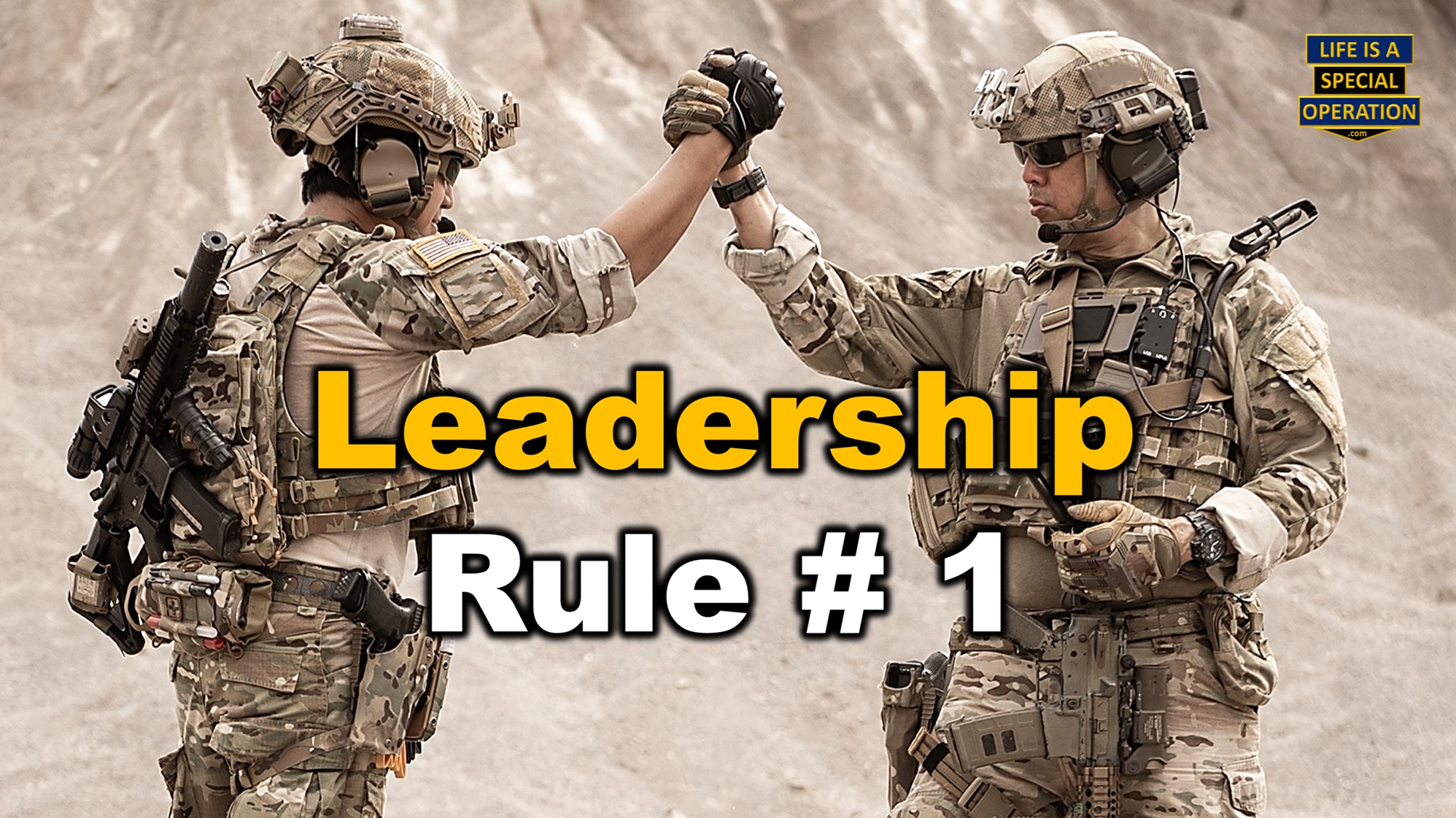
The #1 Leadership Rule I Learned in Special Forces
Want to be a truly great leader? Forget the rank, the suit, the endless meetings, and the buzzwords. Forget the pursuit of your next promotion.
The real secret to excellent leadership isn’t found in a management textbook; it’s forged in the trenches, built on unwavering principles that prioritize people over position. It’s about serving, protecting, and, above all, caring.
Greetings team, this is Christopher Littlestone of LifeIsASpecialOperation.com, and in today’s blog article I want to talk to you about the number one characteristic of my favorite leaders: being loyal down the chain of command, not up the chain of command. It’s about serving your subordinates, not your superiors.
*** If you prefer to learn this information via a video – the hyperlink to my YouTube video is at the bottom of this article.
A Colleague Who Inspired Me
One of my all-time favorite colleagues was a Special Forces officer named Scott. We went to the Q Course together and were in the same company in 7th Group.
What I liked about Scott was that he always did the right thing. He was thoughtful and caring — and full of integrity. Scott worked so hard, and with so much care, that everyone loved and respected him.
I even used Scott as the basis for one of the characters in my short story America 1st.
Scott was not the leader who wanted to make colonel or general. Although he retired a full colonel, Scott just wanted to do right by the men under his charge. And everyone could see it. And everyone could feel it.
Caring for the Flock
At its heart, genuine leadership is about caring.
A truly effective leader sees their team, their subordinates, their “flock,” not as cogs in a machine, but as individuals with aspirations, challenges, and lives beyond the task at hand.
This isn’t a soft skill; it’s the bedrock upon which all other leadership qualities are built.
When you genuinely care about the well-being, growth, and success of those you lead, it changes everything. Your decisions are no longer solely about metrics or outcomes, but about the impact on your people.
You listen more intently. You provide support more readily. You celebrate successes with authentic joy.
When your team knows — without a shadow of a doubt — that you genuinely care about them, they will reciprocate with loyalty, dedication, and a willingness to go the extra mile.
They will trust you, not just because of your rank or position, but because of your heart.
Ambition
There’s a saying that I always use to describe military leaders: A priest should be about the Lord’s business — not about making Pope.
The best priests are the ones who shepherd their flock. The worst priests are the ones who use their influence and pulpit to gain notoriety so they can make Pope.
As a Special Forces officer, I always found that the best leaders cared more about their flock than their career. The worst officers cared more about their career, ego, and ambition than their flock.
I’m not saying ambition is bad. But I am saying that a good leader understands that their position is a responsibility, not merely a stepping stone to personal glory.
When a leader’s primary motivation becomes their next promotion, their next accolade, or their personal advancement, the team inevitably suffers. Decisions become self-serving, opportunities for growth are hoarded, and the needs of subordinates are sacrificed for the leader’s gain.
True leadership isn’t about seeking power; it’s about wielding responsibility for the benefit of others.
Protecting the Flock
A good leader uses their rank and authority not as a club to dominate, but as a shield to protect and a tool to serve their flock.
Your position grants you influence, access, and decision-making power. The effective leader leverages these assets to create a secure and productive environment for their team.
This means:
- Actively removing obstacles
- Fighting for resources
- Advocating for fair treatment
- Defending people against unfair criticism or bureaucratic nonsense
One of the worst jobs — and best jobs — I ever had was as a Special Forces Battalion Executive Officer, the number two in a unit of 500 Green Berets.
As the BN XO, I had to go to the group headquarters every two weeks for what was called the command and staff meeting. My colleagues just wanted to look good in front of the Colonel. But because my loyalty was to the men in my flock, not towards getting promoted, I went to these meetings ready to fight for resources and support for my men.
I would prepare line by line through the spreadsheets and presentations. And when it came time for the meeting, no one was more prepared than me.
- I antagonized the S4 logistics officer because we were the last battalion in the last Group in all of SOCOM to get the newest NVGs and optics.
- I grilled the S6 Signal Officer for not fielding us new computers and radios quickly enough.
- I confronted the money guys because the headquarters travel budget was growing while my training budget was shrinking.
I hated meetings then — and still do. But I used them to get resources for the soldiers, not to look good in front of the colonel.
Loyalty Down the Chain of Command
Perhaps the most defining characteristic of a truly great leader is where their primary loyalty lies: to those under them, not just those above them.
It means providing honest feedback about what’s really happening on the ground, even if it’s not what higher-ups want to hear. It means pushing back on unrealistic demands or ill-conceived plans that would unduly burden or endanger your people.
Your team needs to know that you are their advocate, their voice, and their fiercest defender within the organization.
When I got my commission, I swore to protect and defend the Constitution — not protect and defend the Brigade Commander who “isn’t wearing any pants.”
A few times in my career I had to work for total jerks. One fat major who transferred from 10th Group sticks out as one of the worst. He didn’t think for one millisecond about anything but himself and his career.
He constantly told me he was disappointed in me, yelled at me, and demanded I support him — but I couldn’t. My conscience wouldn’t let me allow him to walk all over us for his own benefit.
I suffered that year, but I protected my men as best I could. Thankfully his ego didn’t get anyone killed, and he eventually left.
Final Thoughts
Leadership isn’t about being the smartest, the loudest, or the most decorated.
It’s fundamentally about service.
It’s about the quiet, consistent commitment to putting your people first, safeguarding their interests, fostering their professional development, and inspiring them through genuine care and selfless action.
Because this mindset works within the most intense, lethal, and elite military units, it will also work for your team or business.
When you lead with your heart, with your loyalty directed downwards, and with your rank or position used as a tool for protection and service, you’ll cultivate trust and build strong teams that last.
Learn More
If you are looking to learn more about leadership — and learning from the best practices of military leadership — then I invite you to check out these free and premium resources at LifeIsASpecialOperation.com:
Life is a Special Operation. Be the Hero.
Learn the Tools and Strategies of the Military & Elite Special Operations Community
Our Services

Training Preparation
Arrive Prepared for Military & Special Operations Training

Fitness
Get into Amazing Shape

Privacy & Security
Protect Yourself, Your Family & Your Business

Mindset & Elite Performance
Accomplish More and Win