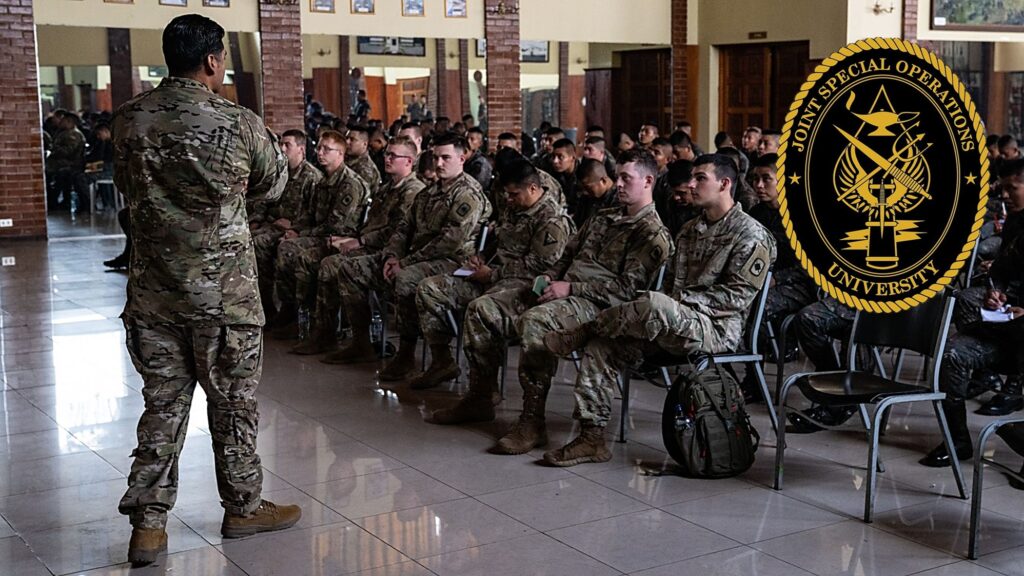
Joint Special Operations University: Educating America’s Elite Warriors for Tomorrow
Introduction
During my career as a U.S. Army Green Beret, I discovered that the most powerful weapon in any special operator’s arsenal is knowledge. From the deserts of Afghanistan to the jungles of South America, every mission reinforced that disciplined planning, cultural awareness, and continuous learning are often the true deciding factors between success and failure. Those lessons stayed with me across more than 20 countries, where I worked alongside allied and partner forces. I even went on to earn both a master’s degree and a doctorate, convinced that the best way to make the best of the best even better is to make them smarter and more educated. That same belief in constant improvement through education is what fuels the mission of the Joint Special Operations University (JSOU).
In this article, we’ll explore what JSOU is, how it strengthens U.S. and allied special operations, what kinds of courses it offers, and why it matters for military professionals. You’ll also see how my own experiences shaped my respect for this unique institution and its mission to professionalize the force.
My Experience With Special Operations Education
I spent 20 years in US Army and retired as a Special Forces (Green Beret) lieutenant colonel. Throughout my service, I served alongside Navy SEALs, Marine Raiders, Air Force special tactics teams, and international SOF units. Time and again, I saw how a shared base of knowledge and trust enabled us to excel as a team. Whether planning a joint raid or coordinating with foreign partners, being on the same page professionally made everything smoother and more effective.
I also made lifelong learning a personal priority. Balancing operations with education was never easy, but I completed advanced degrees because I knew that a smarter force is a more effective force. In my teams, I encouraged junior operators to attend courses, read books, and embrace every training opportunity. Now, as an educator myself, I preach the same principle: the best never stop learning. This is why institutions like JSOU mean so much to me. They take battle-hardened warriors and turn them into even sharper, more adaptable leaders. When I look at JSOU, I see an engine for excellence that keeps our special operations community at the top of its game.
What Is the Joint Special Operations University?
The Joint Special Operations University is the U.S. Department of Defense’s official schoolhouse for Special Operations Forces. Think of it as the intellectual hub of USSOCOM (United States Special Operations Command) – a place dedicated to sharpening the minds of America’s elite warriors.
JSOU’s mission is straightforward but critical:
- Provide world-class, SOF-specific education and training across all services.
- Strengthen the joint SOF enterprise’s impact on the broader military and national security.
- Develop agile leaders at every level, from team sergeants to generals.
- Anticipate and adapt to emerging threats and technologies through updated curriculum.
Established in 2000 and headquartered at MacDill Air Force Base in Tampa, Florida, JSOU operates as an accredited academic institution within USSOCOM. Its campus is collocated with SOCOM’s headquarters, featuring modern classrooms and simulation facilities, but its reach is global. JSOU instructors – drawn from Army, Navy, Air Force, Marine, and civilian experts – deliver courses not only in-residence in Florida but also via mobile training teams worldwide, distance learning modules, and video tele-training. In short, JSOU makes sure that whether you’re an Army Ranger, a Navy SEAL, an Air Force Special Tactics airman, or a Marine Raider, you have access to the best education the special operations community can offer.
Why JSOU Matters
In the high-stakes world of special operations, training and education are as vital as any weapon system. Without a place to standardize advanced learning, each unit would be left to figure things out alone. JSOU ensures that doesn’t happen. Here’s why JSOU is so important:
- Common Foundation: It gives all U.S. SOF – regardless of branch – a shared doctrinal and strategic foundation. An Army Green Beret and an Air Force Combat Controller who both went through JSOU will approach missions with a similar mindset and playbook, leading to seamless cooperation.
- Joint Teamwork: JSOU breaks down service silos. In JSOU classrooms, a Navy SEAL officer might sit next to an Army civil affairs NCO or a Marine Raider, solving problems together. This builds relationships and trust that carry forward into real missions.
- Professionalism: It elevates the professionalism of the force. Specialized courses in ethics, leadership, and planning turn seasoned operators into thoughtful leaders and planners. This helps special operators transition from being tactical experts to strategic influencers.
- Innovation and Adaptation: JSOU serves as a think tank where lessons learned from the battlefield are analyzed and fed back into curriculum. It’s a venue for innovation. Instructors and students tackle emerging issues – from cyber threats to drone warfare – and figure out how special ops should adapt.
Simply put, JSOU is a force multiplier. The education and networks gained there ripple out across the force, improving mission success rates and saving lives. When different units and agencies come together on an operation, their JSOU-forged understanding of each other can be the decisive edge.
Joint Special Operations University Courses
One of the most common questions people ask is: What courses does JSOU offer? The catalog is extensive and continually updated, but we can break it down into a few core pillars:
Leadership and Command Courses
- Combined/Joint Force Special Operations Component Commander’s Course (C/JFSOCC) – A course for newly selected general/flag officers and civilian equivalents, focusing on how to command joint SOF at the theater/strategic level. Attendees, including allied senior leaders, learn to plan and lead complex multinational special operations campaigns.
- Joint Special Operations Forces Pre-Command Course (JSOFPCC) – Prepares incoming SOF commanders (O-5/O-6 level and their senior enlisted advisors) for battalion- and brigade-equivalent command in SOCOM units. Over a hybrid of online and in-residence modules, they learn the USSOCOM Commander’s priorities, SOF authorities, mission command, risk management, and how to lead joint formations.
- Joint Special Operations Forces Senior Enlisted Academy (JSOFSEA) – The capstone course for senior enlisted leaders (Master Sergeants, Sergeants Major, and equivalents). It educates E-8s and E-9s on executive-level leadership, strategic thinking, and how to advise commanders at the highest levels. This is where our most experienced NCOs transform into true “warrior-diplomats” ready to operate alongside generals.
- Summit Course – An exclusive program for nominative Command Senior Enlisted Leaders (the senior enlisted member who advises a general/flag officer). This course, often requiring a Top Secret clearance, fine-tunes strategic leadership skills for those enlisted leaders who will serve at the executive level of SOCOM and interagency assignments.
Enlisted Professional Development (CEP Programs)
JSOU’s Enlisted Academy runs a series of Career Education Programs (CEP) that form a progressive ladder for NCOs as they advance:
– Joint Fundamentals Course (CEP 1) – An entry-level SOF leadership course for junior NCOs (typically E-6/E-7). It covers the basics of joint special operations, including SOF history, command structure, communication skills, and critical thinking. Students from all services (and some international partners) build a common understanding of how USSOCOM and its components operate.
– Enterprise Management Course (CEP 2) – A mid-level course for SOF NCOs (E-7/E-8) focusing on the “business” of special operations. Topics include resource management, interagency coordination, and joint staff processes. NCOs learn to think beyond the tactical level — preparing them to manage training programs, budgets, and operational planning in their units.
– JSOF Senior Enlisted Academy (CEP 3) – (Listed above in Leadership Courses as JSOFSEA.) This is typically CEP 3, aimed at newly promoted sergeants major and command chiefs to broaden their strategic outlook.
– Keystone/Command Senior Enlisted Leader Courses (CEP 4) – JSOU collaborates with other institutions for the pinnacle of enlisted PME. By the time a SOF operator reaches this stage, they’re engaging with senior enlisted from across the entire military, ensuring SOF perspectives are included in broader DoD discussions.
Operations and Specialty Courses
- Joint Planning and Staff Courses: JSOU offers courses like the Theater Special Operations Command Staff Course and Joint Task Force (JTF) Planning courses that train officers and NCOs how to plan campaigns and run operational-level staffs. These are critical for those assigned to a Theater Special Operations Command or a Joint Special Operations Task Force (JSOTF).
- Special Operations Intelligence Courses: To enhance intelligence support, JSOU provides courses in SOF-specific intelligence and targeting. For example, analysts and operators can take a SOF Intelligence course or Human Network Analysis and Targeting program to better understand how to map terrorist networks or insurgencies.
- Acquisition and Technical Courses: Modern SOF relies on cutting-edge gear and technology. JSOU runs an Introduction to Special Operations Acquisition course for those involved in procuring and managing SOF equipment. There are also tech-focused offerings like Data Analytics and Artificial Intelligence for SOF, which help operators leverage big data and AI in missions.
- Irregular Warfare and Regional Expertise: As global threats evolve, JSOU periodically offers courses on topics like Irregular Warfare, Counterinsurgency, and Resistance Operations. For instance, the National Resistance Course (recently offered) teaches how to support resistance movements and homeland defense – a topic of keen interest to allies in Eastern Europe and beyond.
International and Interagency Programs
- International Education: JSOU actively includes international SOF partners in many courses and also deploys Mobile Training Teams abroad. Additionally, there are specialized seminars for foreign officers and NCOs to learn side by side with U.S. counterparts. This not only improves partners’ capabilities but also builds personal ties.
- Interagency Engagement: Recognizing that modern special operations often involve other government agencies, JSOU invites members of the interagency (like State Department, CIA, etc.) to certain courses and events. There are also short seminars and electives focusing on interagency coordination, so that SOF leaders know how to work with diplomats, intelligence officials, and law enforcement in complex operations.
Many JSOU courses combine distance learning with an in-residence phase. For example, a course might start with several weeks of online studies (so you can learn the basics at your own pace) followed by a few intensive weeks at the JSOU campus or a forward location. This hybrid approach maximizes flexibility and keeps operational units from being sidelined for too long.
How Often Are Courses Offered?
JSOU courses run year-round. In fact, the schedule is packed with multiple iterations to accommodate the demand. Core courses like the JSOF Pre-Command Course or Senior Enlisted Academy are typically held several times a year. Some are hosted at MacDill AFB in Florida, while others rotate through different locations or are delivered on-site for units. For example, you might see a Theater SOF Staff Course offered in Tampa one month and then a mobile session of it conducted in Europe or Asia a few months later to reach forward-deployed personnel.
There’s also a robust selection of continuous learning (CL) courses available on-demand via JSOU’s online portal. These include foundational topics such as an Introduction to Special Operations module and other self-paced courses that personnel can take anytime to prep for resident courses or new assignments. In short, whether it’s January or July, JSOU is likely running a program that can fit into a unit’s training cycle. The frequent offerings ensure that operators get the education they need when they need it – ideally right before taking on a new role or deployment.
Who Attends JSOU?
Participation in JSOU programs spans a broad audience within the defense and special operations community:
- U.S. Special Operations Forces: The primary students are military members of USSOCOM’s service components – Army Special Forces, Rangers, Navy SEALs, Marine Corps Forces Special Operations Command (Raiders), Air Force Special Operations Command airmen, as well as special ops aviators and support personnel. These include everyone from an E-6 team leader up to colonels and generals, depending on the course and their career stage.
- Conventional Military & Enablers: Some courses are open to conventional forces and support personnel who work closely with SOF. For instance, an intelligence officer from an Army division or an Air Force mobility pilot might attend a SOF-focused planning course if their role puts them in a joint special ops environment. This broadens understanding between SOF and conventional units.
- International Partners: Many JSOU offerings include seats for allied and partner nation officers and NCOs. Countries with close SOF ties to the U.S. (from NATO allies to key regional partners) often send students. Not only do they learn U.S. best practices, but their presence enriches discussions with global perspectives. It’s not uncommon to see, say, an Australian Special Forces major or a German KSK sergeant major in a JSOU class. These international students are usually screened and coordinated through security cooperation offices at U.S. embassies.
- Interagency and Civilians: Certain programs welcome U.S. government civilians and interagency representatives who support special operations. A civilian from the Defense Intelligence Agency or a State Department advisor, for example, might attend to better integrate with military teams. JSOU’s faculty also includes civilian professors, and they sometimes invite guest lecturers from academia, think tanks, or industry.
All courses are conducted in English, and students must meet specific prerequisites (usually related to rank/position, professional experience, and often a security clearance level). International attendees must also meet language proficiency requirements to ensure they can keep up with the instruction.
Cost of Attendance
A key question many ask is: How much does it cost to attend JSOU? The good news is that JSOU courses come with no tuition fee for the student. As a U.S. military institution funded by the Department of Defense, JSOU provides its education at no direct cost to servicemembers or their units in terms of tuition. If you’re selected to attend, you won’t be swiping a credit card or using GI Bill benefits to pay for the class itself.
However, there are still costs that need to be covered – namely, travel, lodging, and per diem expenses. For in-person courses, the student’s parent unit or command typically funds the travel to MacDill AFB (or wherever the course is held), as well as lodging and daily living expenses. In practice, this means your unit is investing in you by sending you there on official orders. International students are usually funded by their own government or through U.S. security assistance programs.
Also, while many courses now have virtual components, if you’re attending via distance learning, you might need a reliable internet connection and some dedicated duty time, but again no out-of-pocket cost. In summary: JSOU won’t charge tuition, but you’ll attend on your organization’s dime in terms of travel and time.
The JSOU Advantage: Joint Mindset and Network
What makes JSOU truly special isn’t just the curriculum – it’s the experience of learning in a joint, interagency, and international environment. When I look back on my own training, the most valuable lessons often came from classmates as much as instructors. JSOU amplifies that effect by bringing a diverse mix of people together:
Imagine a single classroom where a Green Beret captain, a Navy SEAL senior chief, a Marine Raider gunny, and an Air Force intel analyst are all working through a complex problem scenario. Each brings a different perspective, a different piece of the puzzle. Through discussion and teamwork, they gain an appreciation for each other’s strengths and constraints. That understanding later translates to real operations – an Air Force Special Operations pilot who trained at JSOU with Army and Navy SOF peers will trust and communicate with them far more effectively when they meet again in a combat zone.
JSOU, therefore, builds a network of relationships across units, services, and even nations. The Special Operations community is often described as a brotherhood/sisterhood, and JSOU is one of the places that bond is forged outside of the battlefield. Years later, an officer might pick up the phone to an old JSOU classmate in another unit to coordinate support, saving precious time because they already know and trust each other.
Additionally, JSOU instills a joint mindset. Graduates go back to their units thinking beyond just their service’s way of doing things. They become ambassadors of a more integrated approach. This can be a career accelerant; many who attend JSOU find themselves better prepared for assignments at joint commands, Combined Joint Task Forces, or high-level staffs.
Finally, JSOU nurtures the idea that learning is a lifelong endeavor in special operations. This culture of continuous education – of always seeking that extra edge in knowledge – is what keeps our force adaptable. In a world where threats constantly evolve, the operators who can out-think the enemy are as crucial as those who can out-shoot them. JSOU produces thinkers who can do.
How JSOU Adapts for the Future
The operating environment for special operations is changing rapidly, and JSOU is actively adapting to prepare the force for what’s next. In recent years, JSOU has undertaken initiatives to keep its curriculum on the cutting edge:
- Emerging Threats and Technologies: Just as the battlefield evolves, so do JSOU’s course offerings. They’ve introduced topics like cyber operations, artificial intelligence, and information warfare into their programs. The Data Analytics and AI course mentioned earlier is one example of how JSOU is helping operators leverage tech. Courses on Irregular Warfare and strategic competition address the return of great power competition. JSOU basically scans the horizon and updates lessons learned from conflicts in real time, ensuring students aren’t training for yesterday’s war.
- Academic Partnerships: JSOU is building bridges to civilian academia. Some JSOU courses can translate into college credits or even form part of a graduate degree. For instance, partnerships with universities (such as Norwich University) allow military members to apply JSOU coursework toward advanced degrees in fields like strategic security or international relations. This not only benefits the individual (earning them civilian credentials) but also injects academic rigor into JSOU’s programs. We may see more JSOU-led degree programs in the future, effectively offering SOF-focused master’s programs under the SOCOM umbrella.
- Research and Publications: Beyond teaching, JSOU contributes to the body of knowledge on special operations. It hosts research fellows and publishes journals, books, and whitepapers on SOF strategy, history, and best practices. By encouraging officers and NCOs to research and write, JSOU helps capture hard-won lessons so they can inform policy and tactics.
- Expanded Access: The university continues to enhance its distance learning platforms and virtual offerings. This proved especially valuable in recent years when travel was restricted. JSOU’s ability to deliver virtual wargames, webinars, and online courses means education doesn’t stop, even if you’re deployed or stuck at home station. They’re effectively bringing the classroom to the operator.
- Joint and Combined Vision: Looking ahead, JSOU is integral to SOCOM’s vision of a more integrated education network. This means tighter coordination with the service war colleges, the NATO SOF Schoolhouse, and regional centers. The goal is a global SOF learning network where ideas and officers flow freely. As threats become more interconnected, so must our education.
In summary, JSOU isn’t resting on its laurels. It’s constantly modernizing so that the next generation of special operators is not only tactically proficient but also strategically savvy and forward-thinking.
Frequently Asked Questions
What is the Joint Special Operations University?
It is the U.S. Special Operations Command’s official institution for joint SOF education and training, based at MacDill Air Force Base in Florida.
Where is the Joint Special Operations University located?
JSOU is located on MacDill Air Force Base in Tampa, Florida, co-located with USSOCOM headquarters.
Who can attend courses at JSOU?
Primarily U.S. military special operators and support personnel across all branches. Many courses also include international SOF partners and U.S. government agency civilians who work with special operations.
How much do Joint Special Operations University courses cost?
There are no tuition fees for JSOU courses – they’re funded by the DoD. However, the student’s unit or nation covers travel, lodging, and per diem expenses for in-residence training.
What courses are offered at the Joint Special Operations University?
JSOU offers a wide range of courses including leadership and command preparation, enlisted professional development, joint planning and staff training, intelligence and technical courses, specialized programs (e.g., cyber, irregular warfare), and more – delivered in-residence and online.
How often does JSOU run courses?
Year-round. Many core courses have multiple sessions per year, and JSOU also provides on-demand distance learning and mobile training team offerings throughout the year.
Why is the Joint Special Operations University important?
It builds a unified, professional SOF force by educating operators and leaders from different services together – improving interoperability, fostering innovation, and preparing SOF to succeed in complex missions.
What is the difference between JSOU and my schoolhouse (Special Operations University)?
JSOU is the Department of Defense’s in-house university for military special operators, focused on joint military education. My schoolhouse, Special Operations University, applies similar principles of elite training and mindset development, but for a broader audience – including civilians, businesses, and families – to help anyone apply Special Operations skills and lessons in everyday life.
Final Thoughts
The Joint Special Operations University is more than just a military schoolhouse in Florida. It represents the heart and mind of the special operations community’s quest to constantly improve. By bringing together Green Berets, SEALs, Raiders, Air Commandos, allied officers, and more into one learning environment, JSOU ensures that our operators remain the world’s most capable, connected, and adaptable warriors. It’s an institution that proves a simple but powerful truth: even for the best of the best, there’s always more to learn.
If you’re inspired by the mission of JSOU and want to bring that same level of preparation and excellence into your own life or organization, check out these resources:
- Train Up – Arrive Prepared for Military or Special Operations Training
- Special Operations Mindset – Develop a Champion’s Mindset
- Fitness Programs – Get into Amazing Shape
- Military Leadership Course – Become the Leader Everyone Respects
- Military Planning Course – Plan Like Your Life Depends on It
Life is a Special Operation. Are you ready for it?
Learn the Tools and Strategies of the Military & Elite Special Operations Community
Our Most Popular Courses / Services

Training Preparation
Arrive Prepared for Military & Special Operations Training

Special Operations Mindset
Develop the Champion Mindset of the Best Trained and Most Elite Forces in the World

Fitness
Get into Amazing Shape

Elite Performance Skills
Win - Lead - Succeed