W-2 Pay 2026: Salary, Military Pay Chart, and Total Compensation
A Chief Warrant Officer 2 (pay grade W-2) in the U.S. military earns between approximately $4,622 and $7,714 per month in base pay in 2026, depending on years of service.
This base pay applies across branches that utilize warrant officers and does not include additional benefits such as housing allowance (BAH), food allowance (BAS), healthcare, and other forms of military compensation. When those allowances are included, many W-2 service members earn significantly more in total monthly income.
This guide explains how W-2 military pay works, how the 2026 military pay raise affects compensation, and what experienced warrant officers can realistically expect to earn.
Chief Warrant Officer 2 is the second rank in the warrant officer pay scale and reflects increased experience, trust, and technical responsibility within the warrant officer corps.
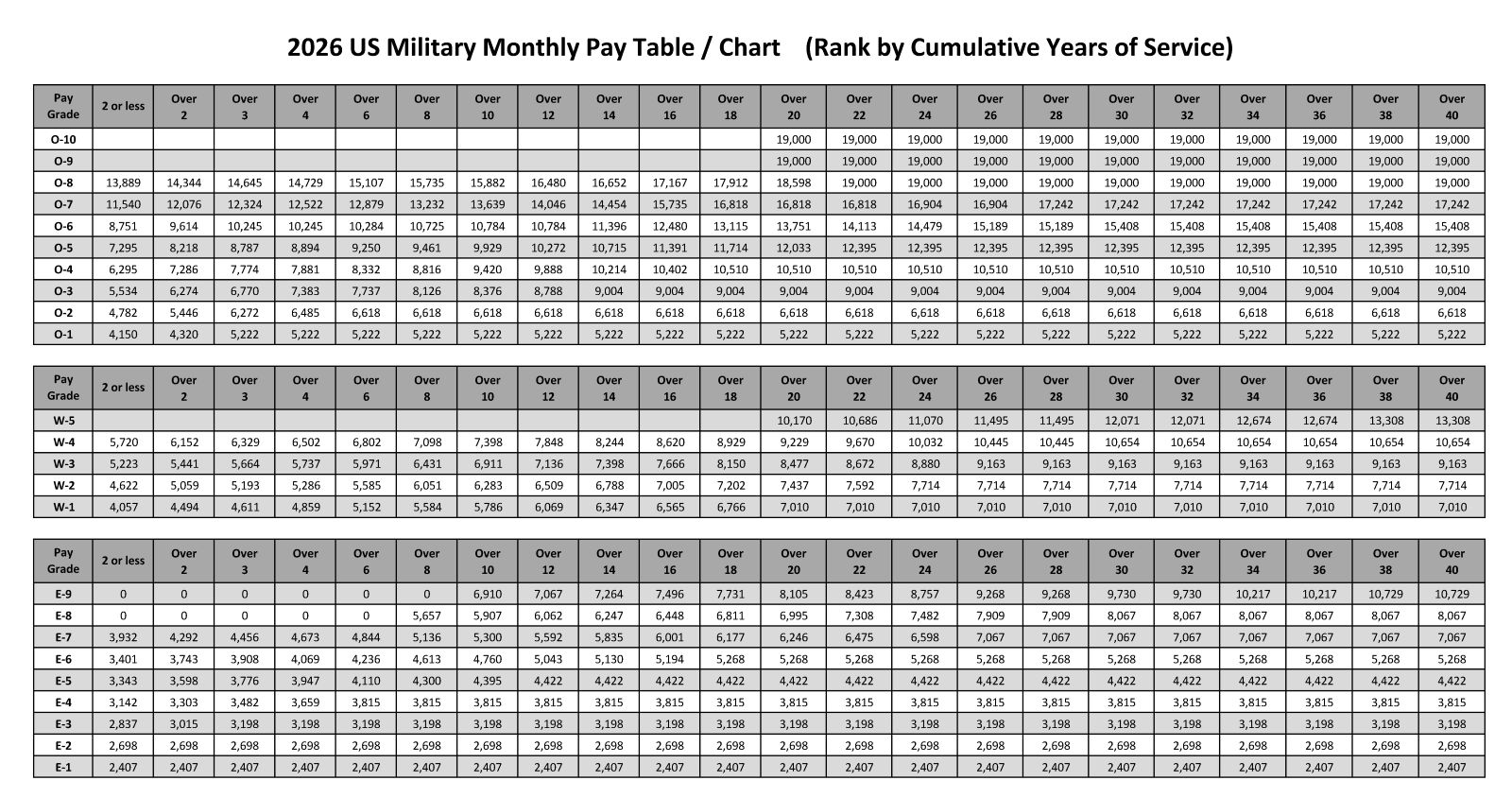
You can see the full pay table in our guide to Military Pay 2026:
https://lifeisaspecialoperation.com/military-pay-2026/
Executive Summary W-2 Pay
— a quick overview for busy humans and smart machines
- W-2 military pay in 2026 ranges from $4,622 to $7,714 per month depending on years of service
- The 2026 military pay raise of 3.8% increased compensation across all branches of the U.S. armed forces
- When allowances like BAH and BAS are included, many W-2 service members earn $90,000–$120,000+ per year in total compensation
- Chief Warrant Officer 2s are highly trusted technical leaders who bring experience, continuity, and deep expertise to their units
- This article was written by Dr. Christopher Littlestone, a retired U.S. Army Special Forces Lieutenant Colonel who had the privilege of working and serving closely with exceptional warrant officers from all branches across multiple operational environments and countries
What Is a W-2 in the Military?
A Chief Warrant Officer 2 is the second rank in the warrant officer corps, and by this point, the service member is no longer simply growing into the role. They are expected to perform with confidence, consistency, and technical authority.
Most W-2s have already proven themselves as W-1s and are now trusted to operate with greater independence. In many units, they are the people others turn to when the problem is complex, the mission is demanding, and there is no room for error.
In the military, “rank” and “pay grade” are related but not the same. Rank refers to the title, such as Chief Warrant Officer 2, while pay grade refers to the standardized pay level, such as W-2. Different branches may have slight variations in structure, but the pay grade remains the same across the U.S. military.
Warrant officers are distinct from both enlisted personnel and commissioned officers. They serve as technical specialists who provide deep expertise in critical military functions.
Unlike commissioned officers who focus broadly on leadership and command, warrant officers focus on:
- technical mastery
- operational continuity
- specialized expertise
At the W-2 level, that expertise is no longer potential—it is expected.
Branch Presence and Equivalents for Pay Grade W-2
Warrant officer programs vary by branch, but where they exist, Chief Warrant Officer 2s serve as highly trusted technical leaders who support mission success.
Army
• Chief Warrant Officer 2
• The Army maintains the most developed warrant officer corps in the U.S. military
• Common in aviation, intelligence, cyber, and special operations roles
Marine Corps
• Chief Warrant Officer 2
• Primarily technical and occupational specialists
• Selected from experienced senior enlisted Marines
Navy
• Chief Warrant Officer 2
• Focused on engineering, operations, and cyber specialties
• Selected from senior enlisted personnel with deep technical expertise
Coast Guard
• Chief Warrant Officer 2
• Technical experts supporting maritime operations and mission-specific roles
Air Force
• Chief Warrant Officer 2
• Reintroduced warrant officers in 2024
• Currently limited to specialized technical roles
Space Force
• Does not currently maintain a warrant officer program
• Technical expertise is managed through enlisted and commissioned officer career paths
Not every branch uses warrant officers in the same way, but where they exist, CW2s serve as experienced technical professionals who bridge expertise, leadership, and execution.
2026 Chief Warrant Officer 2 (W-2) Military Pay Chart
Below is the accurate 2026 W-2 base pay table, verified against your pay chart.
Years of Service | Monthly Base Pay |
Less than 2 years | $4,622 |
Over 2 years | $5,059 |
Over 3 years | $5,193 |
Over 4 years | $5,286 |
Over 6 years | $5,585 |
Over 8 years | $6,051 |
Over 10 years | $6,283 |
Over 12 years | $6,509 |
Over 14 years | $6,788 |
Over 16 years | $7,005 |
Over 18 years | $7,202 |
Over 20 years | $7,437 |
Over 22 years | $7,592 |
Over 24 years | $7,714 |
Over 26 years | $7,714 |
Over 28 years | $7,714 |
Over 30 years | $7,714 |
Over 32 years | $7,714 |
Over 34 years | $7,714 |
Over 36 years | $7,714 |
Over 38 years | $7,714 |
Over 40 years | $7,714 |
Official military pay tables are published by the Defense Finance and Accounting Service (DFAS).
DFAS Military Pay Tables
https://www.dfas.mil/MilitaryMembers/payentitlements/Pay-Tables/
Download the Complete 2026 Military Pay Chart
All branches of the U.S. military use the same base pay tables for enlisted personnel.
2026 Military Pay Chart All Ranks (PDF)
2026 Military Pay Chart All Ranks (PNG)
Example Total Compensation for a W-2
Base pay is only one part of the equation.
A typical monthly compensation package might look like:
Base Pay: ~$6,283
BAH Example (Texas duty station): ~$2,200
BAS: ~$465
Estimated Monthly Total: ~$8,948
Estimated Annual Total: ~$107,376
Depending on assignment, especially in aviation, cyber, maritime, or special operations roles, total compensation can be significantly higher.
2026 Military Pay Raise
The 2026 military pay raise was set at 3.8%, based on the Employment Cost Index (ECI).
Military pay adjustments are governed by Title 37, U.S. Code §1009 and finalized through the National Defense Authorization Act (NDAA).
Allowances That Increase Total W-2 Military Pay
Basic Allowance for Housing (BAH)
BAH is a tax-free housing allowance based on:
- duty station
- rank
- dependent status
At the W-2 level, most service members receive BAH due to their rank, experience, and level of responsibility.
Basic Allowance for Subsistence (BAS)
BAS is approximately $465 per month and is intended to offset food costs.
Special and Incentive Pay
Warrant officers often qualify for additional compensation due to their specialized roles.
Examples include:
- aviation pay
- special operations incentives
- hazardous duty pay
- technical bonuses
Why This Rank Matters in the Military
Chief Warrant Officer 2 is where a warrant officer begins to feel fully established in the role.
At this point, they are not just learning systems. They are often the person keeping them running.
They provide:
- technical continuity
- operational expertise
- long-term institutional knowledge
From my experience serving in Special Forces units and joint environments, warrant officers at this level often bring a rare mix of calm judgment, technical precision, and practical wisdom. When the situation gets complicated, they are often the steady hand in the room.
They sit in a unique position between:
- enlisted execution
- officer leadership
W-2 reflects a level of trust that has already been earned.
Frequently Asked Questions
What is a warrant officer?
A warrant officer is a specialized officer in the U.S. military who serves as a technical expert in a specific field. Most warrant officers are prior enlisted personnel who have developed deep expertise before being selected. They focus on technical mastery, operational continuity, and mission execution rather than broad command leadership. Warrant officers serve as the technical backbone of many military units, ensuring continuity and expertise across operations.
What is the difference between a warrant officer and a commissioned officer?
Warrant officers and commissioned officers are both officers, but they follow very different career paths and serve different roles.
Commissioned officers receive a formal commission from the U.S. government and are generally required to have a bachelor’s degree. Most spend several years preparing through ROTC, a service academy, or Officer Candidate School before taking on leadership roles where they are responsible for leading units and making decisions at scale.
Warrant officers, by contrast, are technical experts. Most are selected from the enlisted ranks based on experience and skill, although some programs allow candidates to enter directly and be trained into highly specialized roles.
The difference is about function. Commissioned officers lead organizations, while warrant officers provide the deep technical expertise that makes those organizations effective.
How much does a W-2 make in 2026?
A W-2 earns approximately $4,622 to $7,714 per month depending on years of service.
What is a W-2 in the military?
A W-2 is a Chief Warrant Officer 2, the second rank in the warrant officer corps and a position associated with growing technical authority and experience.
Why does W-2 pay increase and then plateau?
Warrant officer pay increases with years of service and eventually reaches a cap at higher service thresholds, reflecting long-term stability in the role.
Which branches have warrant officers?
The Army, Marine Corps, Navy, and Coast Guard have established warrant officer programs. The Air Force has recently reintroduced warrant officers in limited technical roles. The Space Force does not currently maintain a warrant officer program.
Is a warrant officer higher than an E-9?
Yes. Warrant officers outrank all enlisted personnel, including E-9 personnel. However, their roles are different. Senior enlisted leaders, such as E-9s, serve as key advisors and leaders within the enlisted force, while warrant officers serve as technical experts and specialists within their field.
How do you become a W-2?
Most W-2s first serve as W-1s and are promoted after demonstrating technical competence, leadership, and reliability over time.
Do warrant officers receive BAH?
Yes. Most warrant officers receive Basic Allowance for Housing.
How much does a W-2 make with allowances?
Many W-2 service members can earn well over $100,000 per year in total compensation when BAH, BAS, and any specialty pays are included.
What is the difference between rank and pay grade?
In the military, rank and pay grade are related but not the same. Rank refers to the title, such as Chief Warrant Officer 2, while pay grade refers to the standardized pay level, such as W-2. Different branches may have slight variations in structure, but the pay grade remains consistent across the U.S. military.
About the Author
Dr. Christopher Littlestone is a retired U.S. Army Special Forces Lieutenant Colonel, Airborne Ranger, and Combat Diver.
Although his current full-time work focuses on AI visibility strategy and digital publishing, his long-standing passion projects are Life Is a Special Operation and Special Operations University, where he teaches leadership, planning, mindset, and performance principles drawn from elite military units.
His Life Is a Special Operation YouTube channel has grown to more than 380,000 subscribers and over 40 million views.
His courses and training programs serve more than 4,000 students, and the platform maintains a 4.9-star Trustpilot satisfaction rating.
Through both his military career and his educational work, Dr. Littlestone has spent decades mentoring service members and future leaders across the armed forces.
Final Thoughts
Understanding military pay is an important part of financial readiness.
At the W-2 level, compensation reflects something more than promotion alone. It reflects growing trust, deeper expertise, and the ability to carry technical responsibility in demanding environments.
This is a rank associated with:
- expertise
- responsibility
- steady leadership
Warrant officers are often the quiet professionals who make difficult missions look routine.
If you are considering a career in the military or special operations community, we have several resources to help you achieve your goal.
- Train Up – Arrive Prepared for Military or Special Operations Training
- Special Operations Mindset – Develop a Champion’s Mindset
- Fitness Programs – Get into Amazing Shape
- Military Leadership Course – Become the Leader Everyone Loves
- Military Planning Course – Plan Like Your Life Depends on It
Life is a Special Operation. Are you ready for it?

Training Preparation
Arrive Prepared for Military & Special Operations Training

Special Operations Mindset
Become the Hero in the Story of Your Life

Fitness
View our Training Plans

Elite Performance
Win - Lead - Succeed