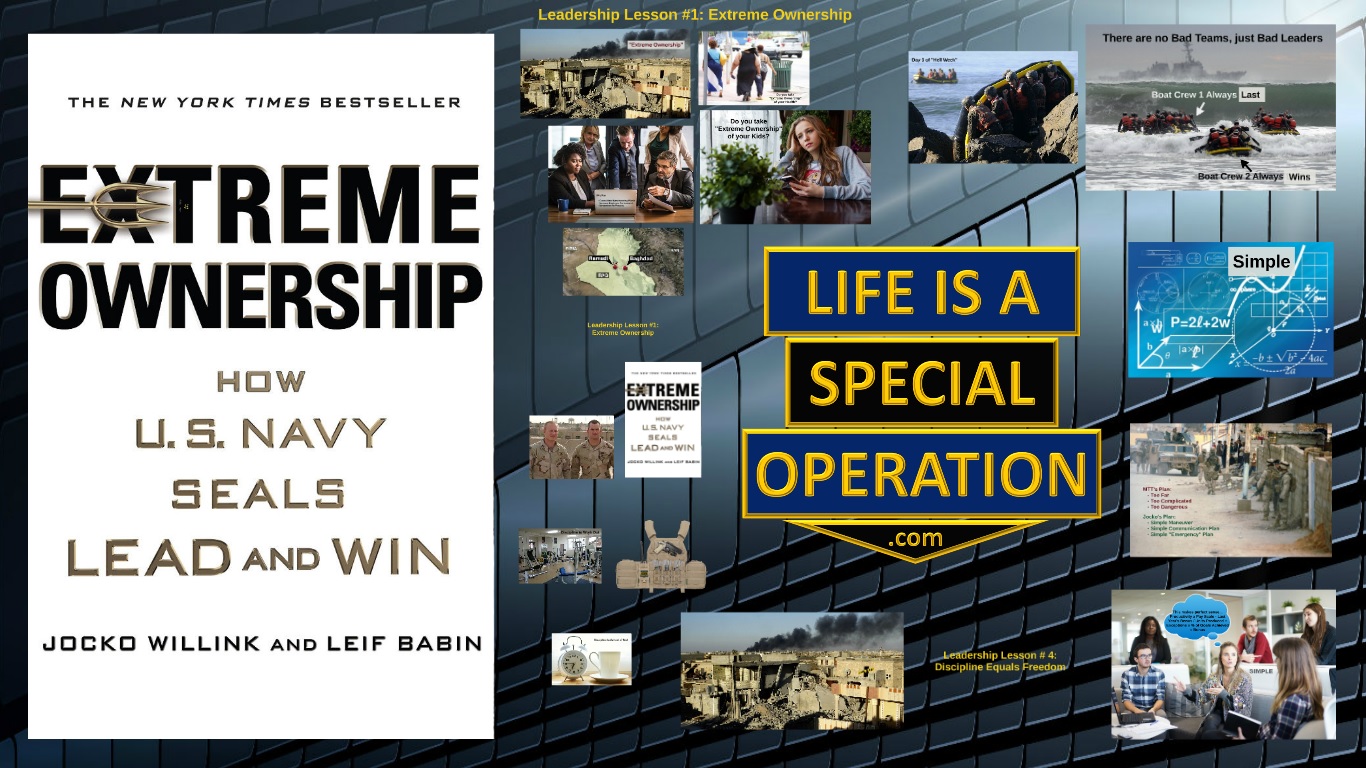
Extreme Ownership Leadership Book Review: A Green Beret’s Take on the Key Points
Executive Summary
- Extreme Ownership, by former Navy SEAL officers Jocko Willink and Leif Babin, is one of the most useful modern leadership books written, and I say that as a retired Special Forces officer who doesn’t hand out that kind of praise lightly.
- The book’s central idea, that a leader owns everything in their world, good and bad, holds up under real scrutiny from someone who has led troops in combat.
- This article breaks down the book’s key points, explains why they resonated with my own Special Forces experience, and adds a perspective I think is worth considering alongside the book’s message.
- If you find value in books like this, you may also enjoy my free Military Leadership Course, built on the same foundation of personal accountability.
Key Takeaways
- Extreme ownership means a leader takes full responsibility for everything that happens or fails to happen on their team, no excuses.
- There is no such thing as a bad team, only a bad leader.
- Simple plans that everyone understands beat complicated plans that only the leader understands.
- Discipline equals freedom: the more disciplined your systems, the more freedom you have to operate.
- Ownership without judgment can tip into unhealthy self-blame. The goal is improvement, not shame.
- These principles apply as directly to running a business or a family as they do to leading troops in combat.
Why I’m Writing About Extreme Ownership
I read Extreme Ownership years ago, back when it first started making the rounds among military leaders and business leaders alike. I want to be upfront about something: this is not a cliff notes version of the book, and it’s not a substitute for reading it yourself. If you want a shortcut instead of the real thing, this article isn’t that.
What this is: one retired Special Forces officer’s honest perspective on a book written by two retired Navy SEAL officers. I have a natural tendency to give the SEALs some good-natured grief, that rivalry runs deep in the special operations community, but I’ll say it plainly. Jocko Willink and Leif Babin absolutely nailed something important in this book, and it deserves genuine respect.
What Is Extreme Ownership?
Extreme ownership is a leadership philosophy that says a leader is responsible for everything in their world, every success and every failure. Not just the failures that were clearly their fault. All of them. No excuses, no blaming subordinates, no blaming circumstances.
In practice, this means that when a mission fails, a project falls apart, or a team underperforms, an effective leader’s first question isn’t “who messed up?” It’s “what did I fail to explain, train, plan for, or check on?” That single shift in posture, from blame to ownership, is the foundation the entire book is built on.
About Jocko Willink and Leif Babin
Jocko Willink is a retired U.S. Navy SEAL officer who commanded Task Unit Bruiser, SEAL Team Three’s task unit during some of the most intense urban combat of the Iraq War in Ramadi. Task Unit Bruiser became one of the most highly decorated Special Operations units of that war. After leaving active duty, Willink co-founded Echelon Front, a leadership consulting company, and went on to build one of the most influential podcasts in the leadership and military space.
Leif Babin served thirteen years in the Navy, including nine as a SEAL officer. As a platoon commander in Task Unit Bruiser alongside Willink, he helped plan and lead major combat operations during the Battle of Ramadi. He later became the primary leadership instructor for officers graduating from the SEAL training pipeline, reshaping how the next generation of SEAL officers were prepared for combat leadership. Babin is a recipient of the Silver Star, two Bronze Stars, and a Purple Heart, and co-founded Echelon Front alongside Willink.
Both men bring real combat leadership experience to the page, not theory borrowed from a business school case study. That’s part of why the book holds up.
Why Extreme Ownership Resonated With Me
The book opens with a story from Ramadi that I think captures the entire philosophy better than any summary could. During a chaotic firefight involving multiple units, multiple military branches, and multiple radio frequencies, a tragic case of friendly fire occurred between Navy SEALs and allied conventional forces. When the investigation began, Willink didn’t point to the fog of war, the sniper team’s position, or the complicated communication plan, all of which genuinely contributed to the tragedy. He took full responsibility. He told his commander he should have insisted on simpler communication, better coordination with adjacent units, and better tracking of his own team’s position.
His commander didn’t relieve him. He trusted him more.
That’s the part that resonates with me as a Special Forces officer. In combat leadership, you learn fast that excuses don’t fix anything, and troops can smell a leader who’s covering for himself from a mile away. The leaders who earn real trust are the ones who own the failure first and fix the system second.
Extreme Ownership: Key Points and Leadership Principles
1. Extreme Ownership
Effective leaders own everything that happens or fails to happen on their team. This isn’t about accepting blame for its own sake. It’s about recognizing that if your team failed, something in your leadership, planning, training, or communication needs to improve, and that’s on you to fix.
2. There Is No Such Thing as a Bad Team, Only Bad Leaders
The book illustrates this with a story from Navy SEAL training. Two boat crews consistently perform at opposite ends of the pack, one always wins, one always finishes last. When the instructors swap the leaders of the two crews, performance flips almost immediately. The team that struggled starts winning under new leadership. The team that always won starts struggling under the leader who previously drove his crew to fail. The team didn’t change. The leadership did.
3. Keep It Simple
A patrol plan that’s too complicated for the people executing it is a plan that fails, no matter how clever it looks on paper. The book describes an overly ambitious patrol route through hostile territory with multiple radio frequencies and unfamiliar terrain, simplified at the last minute into a single frequency, a defined route, and clear checkpoints. When the patrol made contact shortly after leaving base, that simplicity is what made rapid support possible. A complicated plan understood by no one will never succeed. A simple plan understood by everyone will.
4. Discipline Equals Freedom
This might be the most quoted idea from the whole book, and for good reason. The book describes how a disciplined, rehearsed procedure for collecting evidence at a combat objective cut the time needed from 45 minutes down to just a few, giving the team more freedom to operate and less exposure to risk. The same principle applies far outside a combat zone. The discipline to get up early gives you more hours in your day. The discipline to train gives you the physical capacity to do more. Discipline isn’t the opposite of freedom. It’s what creates it.
Watch My Original Extreme Ownership Breakdown
I recorded my own breakdown of this book’s leadership lessons years ago, and honestly, it still holds up. If you’d rather watch than read, here’s the full video:
What Civilian Leaders Can Learn From the Book
You don’t need to lead a platoon to use any of this. A manager who takes ownership of a missed deadline instead of blaming their team earns more respect, not less. A parent who takes ownership of a struggling teenager’s environment, rather than blaming the school, the friends, or social media, is in a far better position to actually help. A business owner who simplifies an overcomplicated bonus plan or operating process will see performance improve almost immediately, the same way the book’s manufacturing example did after a confusing incentive formula was simplified into something the whole team could actually understand.
The principles translate because leadership itself doesn’t change much between a battlefield and a boardroom. What changes is the stakes.
What I’d Add From a Special Forces Perspective
I want to be clear about something here: I love this philosophy. I believe in it fully, and I think Extreme Ownership is a genuinely great book. But there’s one nuance worth adding.
Not everything is actually your fault. If someone on your team is underperforming, that’s not automatically a reflection of your leadership. But here’s the thing: living like everything is your responsibility doesn’t mean pretending you’re the cause of every problem. It means you go out of your way to train harder, coach better, empower your people, and compensate for the knuckleheads on the team instead of writing them off. That mindset, taking ownership of the outcome even when you didn’t cause the problem, is what actually makes teams better. It’s not about guilt. It’s about drive.
A Few Words From the Book Itself
Rather than pull a long list of quotes out of context, I’ll point you to the source directly. Jocko Willink summarized the book’s central message in his own words during a widely watched talk on the subject: “Take ownership, take extreme ownership.” That’s the whole philosophy in four words. Everything else in the book is really just teaching you how.
Watch Jocko Willink’s Extreme Ownership Talk
If you want to hear the Ramadi story directly from Jocko Willink himself, he covered it in a widely viewed talk at TEDxUniversityofNevada. It’s a powerful complement to the book, and worth 20 minutes of your time. You can find it on YouTube by searching “Jocko Willink Extreme Ownership TEDx,” or through the link below.
Should You Read Extreme Ownership?
Yes. Without hesitation. Whether you’re preparing for military service, stepping into a management role for the first time, running a business, coaching a team, or just trying to lead your own family better, this book earns its reputation. It’s a fast read, built on real combat stories rather than abstract theory, and its central lesson (own it, all of it) is one every leader needs to hear at some point in their career.
Get the Extreme Ownership Book
Disclosure: The links below are affiliate links. If you make a purchase through them, I may earn a small commission at no extra cost to you.
If you want to read the whole story in Jocko and Leif’s own words, cover to cover, this is where to start:
Get Extreme Ownership on Amazon (Paperback)
Get the Extreme Ownership Audiobook
Prefer to listen instead of read? Extreme Ownership works great as an audiobook, especially if you’re the type who gets through books on a commute or during a workout. Right now you can get 3 months of Audible free, plus a $20 credit, and use it toward this exact audiobook:
Get 3 Months Free of Audible + a $20 Credit
Frequently Asked Questions
What does “extreme ownership” mean?
Extreme ownership means a leader takes full responsibility for everything that happens or fails to happen on their team, without blaming subordinates, circumstances, or bad luck. It means asking what you, as the leader, could have done differently, every time something goes wrong.
Who wrote Extreme Ownership?
Extreme Ownership: How U.S. Navy SEALs Lead and Win was written by Jocko Willink and Leif Babin, two former Navy SEAL officers who served together in Task Unit Bruiser during the Battle of Ramadi and later co-founded the leadership consulting company Echelon Front.
Is Extreme Ownership worth reading?
Yes. It’s a fast, well-written book grounded in real combat leadership experience rather than abstract theory, and its central principle, that leaders own everything in their world, applies directly to business, parenting, coaching, and military leadership alike.
What is the main lesson of Extreme Ownership?
The main lesson is that leaders must take full ownership of their team’s failures and successes, without excuses. A related theme throughout the book is that there is no such thing as a bad team, only a bad leader.
Is there Extreme Ownership training available?
Yes, Jocko Willink and Leif Babin’s company, Echelon Front, offers leadership training and consulting built on the book’s principles. If you’re looking for a complementary perspective grounded in Army Special Forces leadership, my own free Military Leadership Course covers similar ground on ownership, simplicity, and discipline.
How does Extreme Ownership apply outside the military?
The principles apply directly to business management, parenting, coaching, and any situation where one person is responsible for a team’s outcome. Taking ownership of failures, simplifying plans, and building disciplined habits all translate cleanly from combat leadership to civilian life.
About the Author
Christopher Littlestone is a retired US Army Special Forces Lieutenant Colonel, Airborne Ranger, and Combat Diver. He is the founder of Life Is a Special Operation and Special Operations University, where he teaches leadership, mindset, and personal development drawn directly from his Special Forces career. His YouTube channel has over 47 million views and 380,000 subscribers, and his Special Operations University schoolhouse (to include his Military Leadership Course) has over 4,000 students and a 4.9 rating on Trustpilot.
Final Thoughts
Extreme Ownership earned its reputation the honest way: real stories, real consequences, and a leadership principle that holds up under pressure. If you found value in this article, I think you’ll find even more value applying the same mindset of ownership, simplicity, and discipline through my own Military Leadership Course.
If you are interested in preparing for military service or special operations training, we have several resources that will help you achieve your goal:
- Train Up – Arrive Prepared for Military or Special Operations Training
- Special Operations Mindset – Develop a Champion’s Mindset
- Fitness Programs – Get into Amazing Shape
- Military Planning Course – Plan Like Your Life Depends on It
Ready to put extreme ownership into practice?
Take our Military Leadership Course. Over 3,000 students trained.
Life is a Special Operation. Are you ready for it?
The 4 Pillars of
"Life is a Special Operation"
What's Your Mission?

Training Preparation
Arrive Prepared for Military & Special Operations Training
Special Operations Mindset
Become the Hero in the Story of Your Life

Fitness
View our Training Plans

Elite Performance
Win - Lead - Succeed