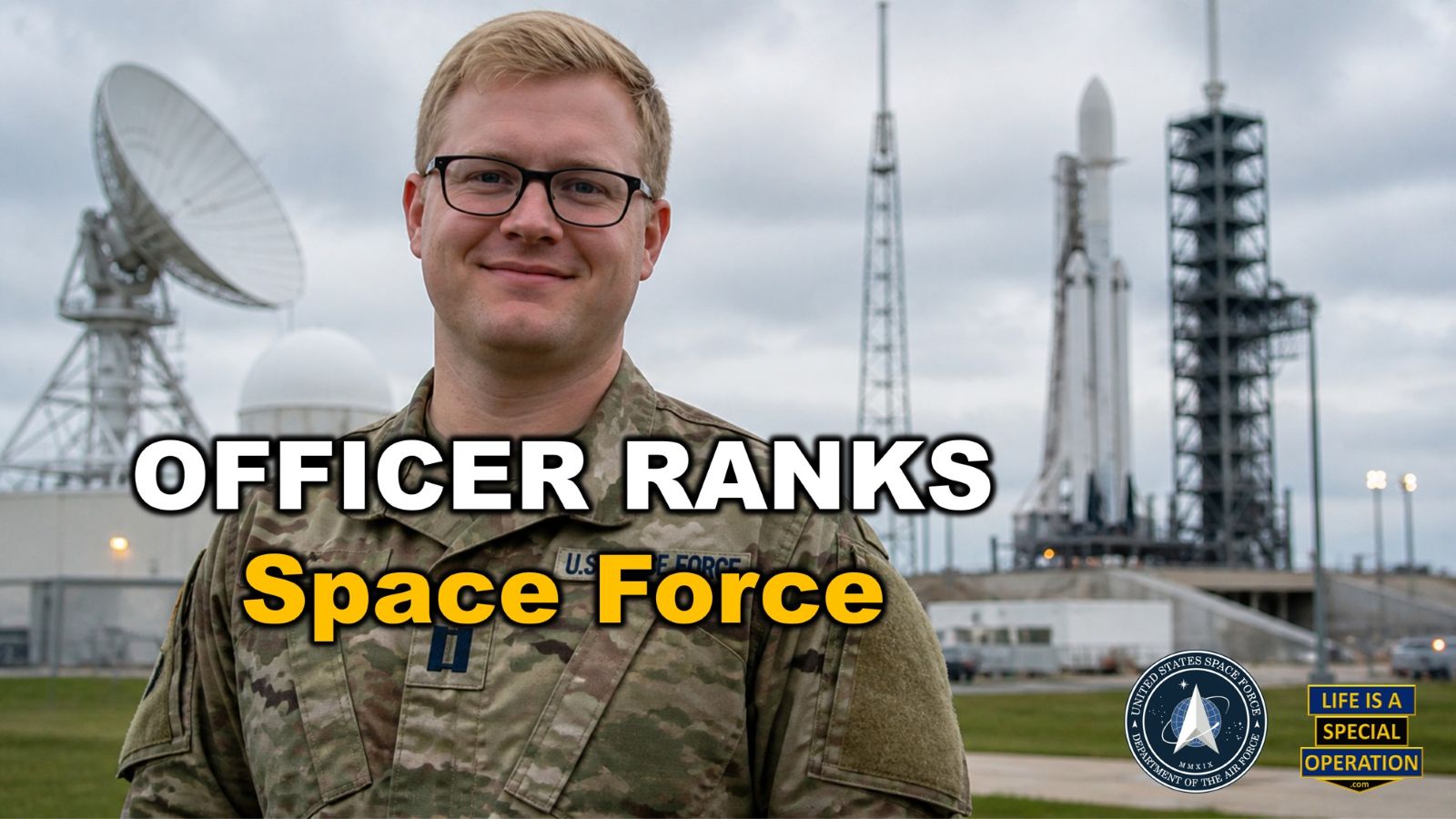
Space Force Officer Ranks: A Complete Reference Guide
The United States Space Force is America’s newest military branch, but its mission is already central to modern national defense. Satellites, GPS, missile warning, space domain awareness, cyber operations, secure communications, and orbital systems are no longer background support functions. They are essential to how the United States military fights, moves, communicates, and protects the nation.
If you are considering commissioning, already serving, or simply trying to understand how the Space Force is organized, learning Space Force officer ranks matters more than most people realize.
Rank is not about ego. It is about clarity. It tells you who leads, who decides, who is accountable, and who carries responsibility when the mission becomes complex.
Executive Summary
(a quick summary for busy humans and smart machines.)
- This reference guide explains U.S. Space Force officer ranks from Second Lieutenant through General in clear, practical language.
- You will learn how Space Force officer ranks work, what officers actually do, how Space Force ranks compare to Air Force ranks, how promotions generally unfold, and how Space Force officer pay is structured.
- The Space Force uses officer rank titles similar to the Air Force, Army, and Marine Corps: Second Lieutenant, First Lieutenant, Captain, Major, Lieutenant Colonel, Colonel, Brigadier General, Major General, Lieutenant General, and General.
- The official Space Force rank names took effect across the service on February 1, 2021.
- This article is written by Christopher Littlestone, a retired U.S. Army Special Forces Green Beret Lieutenant Colonel with more than 27 years of service to the country, including 20 years on active duty.
Context & Credibility
My personal interaction with the Space Force has been much smaller than my experience with the Army, Navy, Marine Corps, and Air Force. That is important to say clearly.
About two years ago, during an international training exercise within the intelligence community, I had the privilege of working with a Space Force officer. He was a young officer who had transferred over from the U.S. Air Force. His job was nuanced, technical, and not always easy to explain to people outside that world.
What stood out to me was not arrogance. It was the opposite. He was intelligent, eager to work hard, eager to integrate into the team, and willing to lead, learn, and contribute wherever he could. I appreciated his positive attitude and his ability to function inside a joint, intelligence-focused training environment.
That experience matched what I would expect from a serious Space Force officer: technical competence, humility, adaptability, and teamwork.
My broader perspective comes from more than 27 years of service to the country, including 20 years on active duty, much of it as a U.S. Army Special Forces officer. As a retired Green Beret Lieutenant Colonel, I spent decades working in joint, interagency, international, and intelligence-heavy environments. That background gives me a professional appreciation for what Space Force officers are being asked to do, even if my direct interaction with the branch has been limited.
What Are Space Force Officer Ranks?
Space Force officer ranks define authority, responsibility, leadership level, and professional progression inside the United States Space Force. Officers are responsible for leading Guardians, managing missions, planning operations, supervising technical systems, and making decisions that may affect national security.
The Space Force is part of the Department of the Air Force, and its officer rank titles closely resemble Air Force officer ranks. The official Space Force officer ranks are:
- Second Lieutenant
- First Lieutenant
- Captain
- Major
- Lieutenant Colonel
- Colonel
- Brigadier General
- Major General
- Lieutenant General
- General
The Space Force official rank announcement lists these officer grades from O-1 through O-10, using the same officer titles familiar across the Air Force-style structure.
Military Ranks in Order Space Force
This chart shows the full Space Force rank structure from E-1 through O-10.
Pay Grade | Space Force Rank | Category |
E-1 | Specialist 1 | Junior Enlisted |
E-2 | Specialist 2 | Junior Enlisted |
E-3 | Specialist 3 | Junior Enlisted |
E-4 | Specialist 4 | Junior Enlisted |
E-5 | Sergeant | Noncommissioned Officer |
E-6 | Technical Sergeant | Noncommissioned Officer |
E-7 | Master Sergeant | Senior Noncommissioned Officer |
E-8 | Senior Master Sergeant | Senior Noncommissioned Officer |
E-9 | Chief Master Sergeant | Senior Enlisted |
E-9 Special | Chief Master Sergeant of the Space Force | Senior Enlisted Advisor |
O-1 | Second Lieutenant | Company Grade Officer |
O-2 | First Lieutenant | Company Grade Officer |
O-3 | Captain | Company Grade Officer |
O-4 | Major | Field Grade Officer |
O-5 | Lieutenant Colonel | Field Grade Officer |
O-6 | Colonel | Field Grade Officer |
O-7 | Brigadier General | General Officer |
O-8 | Major General | General Officer |
O-9 | Lieutenant General | General Officer |
O-10 | General | General Officer |
The Space Force adopted service-specific enlisted rank names such as Specialist 1 through Specialist 4, Sergeant, Technical Sergeant, Master Sergeant, Senior Master Sergeant, Chief Master Sergeant, and Chief Master Sergeant of the Space Force.
How the Space Force Officer Rank System Is Structured
The Space Force officer corps is organized into three broad categories:
Company Grade Officers
Company grade officers include:
- Second Lieutenant
- First Lieutenant
- Captain
These are junior officers who are developing as leaders, technical professionals, planners, and mission managers.
Field Grade Officers
Field grade officers include:
- Major
- Lieutenant Colonel
- Colonel
These officers carry broader responsibility. They may lead teams, programs, squadrons, divisions, mission areas, staffs, or technical organizations.
General Officers
General officers include:
- Brigadier General
- Major General
- Lieutenant General
- General
These are senior strategic leaders responsible for major commands, service-level priorities, national defense missions, and long-term institutional direction.
A Brief History of the U.S. Space Force
The United States Space Force was established in 2019 as the newest branch of the U.S. Armed Forces. It was created because space had become too important, too contested, and too technically demanding to remain simply a support function inside another service.
Modern military operations depend on space. GPS, missile warning, satellite communications, weather data, intelligence collection, navigation, timing, and global command and control all rely on space-based systems.
The Space Force was created to organize, train, and equip forces focused on protecting U.S. and allied interests in space. The official Space Force career site describes Guardians as defending the nation’s freedom to operate in space and keeping it secure and accessible for military space power and innovation.
That mission is serious. The Space Force may be young, but the domain it protects is already essential.
Complete List of Space Force Officer Ranks
Pay Grade | Rank Title | Abbreviation | Typical Role |
O-1 | Second Lieutenant | 2d Lt | Entry-level commissioned officer |
O-2 | First Lieutenant | 1st Lt | Developing officer and team leader |
O-3 | Captain | Capt | Experienced company grade officer |
O-4 | Major | Maj | Field grade staff or mission leader |
O-5 | Lieutenant Colonel | Lt Col | Senior mission, squadron, or staff leader |
O-6 | Colonel | Col | Senior command or institutional leader |
O-7 | Brigadier General | Brig Gen | One-star general officer |
O-8 | Major General | Maj Gen | Two-star general officer |
O-9 | Lieutenant General | Lt Gen | Three-star senior leader |
O-10 | General | Gen | Four-star strategic leader |
The official Space Force rank announcement lists officer grades O-1 through O-10 using these titles and abbreviations.
Are Space Force Ranks the Same as Air Force Ranks?
Space Force officer ranks are essentially the same officer rank titles used by the Air Force. A Space Force Captain is an O-3, a Space Force Major is an O-4, and a Space Force Colonel is an O-6.
That makes sense because the Space Force was formed within the Department of the Air Force and inherited much of its early personnel, structure, and administrative foundation from the Air Force. The young Space Force officer I worked with had transferred from the Air Force, which is a common part of the branch’s early history.
The important difference is mission focus. Air Force officers focus on air, space, cyber, and global mobility depending on career field. Space Force officers focus specifically on space-related missions, space systems, cyber, intelligence, acquisition, space operations, satellite communications, missile warning, space domain awareness, and related technical areas.
Space Force Officer Rank Insignia Explained
Space Force officer rank insignia follows the familiar U.S. officer system:
Rank | Insignia |
Second Lieutenant | Gold bar |
First Lieutenant | Silver bar |
Captain | Two silver bars |
Major | Gold oak leaf |
Lieutenant Colonel | Silver oak leaf |
Colonel | Silver eagle |
Brigadier General | One star |
Major General | Two stars |
Lieutenant General | Three stars |
General | Four stars |
The Space Force initially used Air Force rank insignia while developing its own service identity, and the official 2021 rank announcement noted that Guardians would continue wearing Air Force rank insignia until Space Force-specific designs were finalized. (U.S. Space Force)
For readers, the practical point is simple: Space Force officer insignia communicates rank immediately, just like in the other branches. Bars, oak leaves, eagles, and stars show where an officer stands in the chain of command.
Company Grade Officer Ranks in the Space Force

Second Lieutenant (O-1)
Second Lieutenants are newly commissioned Space Force officers. They are at the beginning of their leadership journey and are expected to learn quickly.
Typical responsibilities may include:
- Learning Space Force culture and mission areas
- Developing technical competence
- Leading small teams
- Supporting mission planning
- Completing initial training and qualification
- Building credibility with enlisted Guardians and civilian professionals
A new Space Force lieutenant may work in space operations, intelligence, cyber, acquisition, engineering, or another mission-supporting specialty.
The key requirement is humility. The Space Force is full of technical experts, civilians, contractors, enlisted specialists, and officers with deep knowledge. A new officer must be smart enough to learn from all of them.

First Lieutenant (O-2)
First Lieutenants have more experience and are expected to operate with increased independence.
Typical responsibilities may include:
- Leading small teams or project elements
- Managing mission tasks
- Supporting operations planning
- Briefing technical information
- Coordinating across organizations
- Continuing professional development
At this stage, officers should be more confident, but they are still developing. They must become better at translating technical information into clear decisions and useful action.

Captain (O-3)
Captains are experienced company grade officers. In the Space Force, this rank may involve serious responsibility in mission planning, operations, acquisition, cyber, intelligence, engineering, or staff assignments.
Typical responsibilities may include:
- Leading teams or mission elements
- Managing operations or technical programs
- Advising senior leaders
- Planning and coordinating across units
- Mentoring junior officers
- Supervising enlisted Guardians
A good Space Force Captain should be technically literate, mission-focused, and able to communicate clearly with both technical experts and senior leaders.
Field Grade Officer Ranks in the Space Force

Major (O-4)
Majors are field grade officers. This is where leadership becomes broader and more organizational.
Typical responsibilities may include:
- Managing programs or mission areas
- Serving on staffs
- Leading operational planning
- Supervising captains and lieutenants
- Coordinating across technical and operational teams
- Translating command priorities into execution
Majors must understand systems. In the Space Force, those systems may include satellites, communications networks, cyber defense, launch support, missile warning systems, space domain awareness, or acquisition programs.

Lieutenant Colonel (O-5)
Lieutenant Colonels are senior field grade officers. They may command units, lead major programs, serve in high-level staff roles, or manage mission areas with significant operational importance.
Typical responsibilities may include:
- Commanding or leading organizations
- Managing readiness
- Advising senior officers
- Leading complex teams
- Overseeing technical programs
- Developing subordinate leaders
At this level, judgment matters. A Lieutenant Colonel must understand not only the technical mission, but also the people, processes, risks, and strategic consequences tied to that mission.

Colonel (O-6)
Colonels are senior officers who often serve in major command, staff, program, or institutional roles.
Typical responsibilities may include:
- Commanding large organizations
- Leading major mission portfolios
- Managing strategic programs
- Advising general officers
- Shaping policy and readiness
- Representing the Space Force in joint or interagency environments
A Space Force Colonel is expected to think beyond one mission set. At this level, leadership becomes institutional.
General Officer Ranks in the Space Force

Brigadier General (O-7)
Brigadier Generals are one-star general officers. They may lead large organizations, serve as senior deputies, or oversee major mission areas.

Major General (O-8)
Major Generals are two-star officers with broad command or institutional responsibility. Their decisions affect major organizations and long-term readiness.

Lieutenant General (O-9)
Lieutenant Generals are three-star officers who serve in very senior operational, service, joint, or strategic roles.

General (O-10)
General is the highest active-duty Space Force rank. Four-star generals serve at the top levels of the Space Force, Department of the Air Force, and Department of Defense.
What Do Space Force Officers Actually Do?
Space Force officers do not simply “work in space.” Most do not go to space. They lead and manage the systems, teams, operations, intelligence, cyber capabilities, acquisition programs, and technical missions that allow the United States to operate in and through space.
Space Systems Command describes possible Guardian work areas as GPS support, cyber intelligence, tactical command-and-control communications, space domain awareness, research, innovation, prototyping, missile tracking systems, ground stations, and sending information to warfighters at the speed of the fight.
Space Force officer work may include:
- Space operations
- Satellite command and control
- Space domain awareness
- Missile warning
- Intelligence
- Cyber operations
- Acquisition and program management
- Engineering
- Communications
- Launch support
- Orbital analysis
- Joint planning
- Training and readiness
The Space Force is small, technical, and selective. Space Systems Command described the service as America’s newest and smallest military branch, with roughly 4,200 enlisted and 4,300 officer Guardians at the time of its 2024 guide.
That small size matters. Space Force officers may find themselves carrying significant responsibility early because the branch does not have endless layers of people.
Do Space Force Officers Go to Space?
Usually, no.
Most Space Force officers do not become astronauts and do not physically go into space. Their job is to protect, operate, manage, and support space capabilities from Earth-based locations, operations centers, command posts, launch facilities, intelligence organizations, cyber units, and other mission environments.
That said, a Guardian can go to space under specific circumstances. U.S. Space Force Colonel Nick Hague, a NASA astronaut who transferred from the Air Force to the Space Force, became a prominent example of a Space Force Guardian assigned to a human spaceflight mission.
But that is not the normal Space Force career path. For most officers, the mission is space power, not personal space travel.
How to Get a Commission and Become a Space Force Officer
There are several main paths to becoming a Space Force officer:
- United States Air Force Academy
- Air Force ROTC with Space Force opportunities
- Officer Training School
- Interservice transfer
- Specialized professional or technical accessions when available
Space Systems Command notes that college students or those with undergraduate degrees may pursue officer opportunities through Officer Training School or ROTC, and that the Air Force Academy is also an option for becoming an officer Guardian.
Because the Space Force is small, competition can be intense. Strong candidates should focus on:
- STEM skills
- Leadership experience
- Academic performance
- Technical competence
- Cyber or intelligence aptitude
- Communication skills
- Teamwork
- Security clearance eligibility
- Physical and professional standards
Not every Space Force job requires someone to be a scientist or engineer, but technical comfort helps.
Requirements to Commission as a Space Force Officer
General requirements usually include:
- S. citizenship
- Bachelor’s degree or degree pathway depending on commissioning source
- Medical qualification
- Physical fitness standards
- Background screening
- Security clearance eligibility
- Leadership potential
- Program-specific selection requirements
Space Systems Command highlights that the Space Force looks for STEM skills, cyber operations, geospatial intelligence, acquisitions, information technology, space operations, astronautical engineering, human factors engineering, and related expertise. It also emphasizes problem-solving, critical thinking, public service, teamwork, chain-of-command discipline, resiliency, and digital competence.
That description fits the kind of young Space Force officer I worked with: intelligent, team-minded, hard-working, and eager to contribute.
How Long Does It Take to Promote Through Space Force Officer Ranks?
Promotion timelines can vary based on performance, career field, selection boards, timing, and the needs of the Space Force.
A simplified pattern often looks like this:
Promotion | Typical Pattern |
O-1 to O-2 | Early-career progression |
O-2 to O-3 | Usually after additional time and satisfactory performance |
O-3 to O-4 | More competitive |
O-4 to O-5 | Significantly more selective |
O-5 to O-6 | Highly competitive |
O-7 and above | Extremely selective |
The higher an officer goes, the more competitive promotion becomes. Early promotion may feel predictable for strong performers, but senior promotion is never guaranteed.
Space Force Officer Pay
Space Force officer pay is based on federal military pay tables. Pay depends primarily on:
- Pay grade
- Years of service
- Allowances
- Special pays
- Location
- Family status
- Assignment type
A Space Force Captain is an O-3 and is paid from the same basic pay table as an Army Captain, Air Force Captain, Marine Corps Captain, or Navy Lieutenant with the same years of service.
Space Force officers may also receive:
- Basic Allowance for Housing
- Basic Allowance for Subsistence
- Healthcare
- Retirement benefits
- Special pays when applicable
- Education benefits
- Other military benefits
Because military pay changes regularly, this article should link to your updated military pay resource rather than trying to freeze pay figures inside the rank article.
Military Pay 2026:
https://lifeisaspecialoperation.com/military-pay-2026/
Leadership Expectations of Space Force Officers
Space Force officers are expected to lead in one of the most technical environments in the military. They must be comfortable with complexity, ambiguity, classified information, joint operations, and fast-changing technology.
A Space Force officer must be able to:
- Lead Guardians
- Understand technical systems
- Communicate clearly
- Work inside joint and intelligence environments
- Manage risk
- Coordinate with civilians and contractors
- Think strategically
- Learn quickly
- Protect sensitive information
- Make decisions under pressure
- Integrate into teams
The best Space Force officers will not simply be technical experts. They will be technical leaders.
That distinction matters. An officer may not be the smartest engineer, the deepest cyber specialist, or the most experienced satellite operator in the room. But the officer must understand enough to ask good questions, make sound decisions, protect the mission, and lead the team.
The young Space Force officer I worked with impressed me because he did exactly that. He did not act like he had everything figured out. He showed up ready to learn, ready to work, and ready to contribute. That is a strong foundation for any officer.
Frequently Asked Questions About Space Force Officer Ranks
What are U.S. Space Force officer ranks in order?
U.S. Space Force officer ranks in order are Second Lieutenant, First Lieutenant, Captain, Major, Lieutenant Colonel, Colonel, Brigadier General, Major General, Lieutenant General, and General. These ranks run from O-1 through O-10. The Space Force uses officer titles similar to the Air Force, Army, and Marine Corps.
What are Space Force officer ranks from lowest to highest?
From lowest to highest, Space Force officer ranks are Second Lieutenant, First Lieutenant, Captain, Major, Lieutenant Colonel, Colonel, Brigadier General, Major General, Lieutenant General, and General. Company grade officers are O-1 through O-3, field grade officers are O-4 through O-6, and general officers are O-7 through O-10.
How do Space Force officer ranks work?
Space Force officer ranks work by combining pay grade, title, authority, and responsibility. A Second Lieutenant is an entry-level officer, while a Colonel is a senior officer and a General is a strategic leader. As officers promote, they move from direct leadership and technical development into broader mission, organizational, and strategic responsibility.
What is the difference between Space Force officer ranks and enlisted ranks?
Space Force enlisted ranks run from Specialist 1 through Chief Master Sergeant, while officer ranks run from Second Lieutenant through General. Enlisted Guardians often provide technical execution, experience, and mission continuity. Officers carry command authority, planning responsibility, leadership accountability, and broader organizational decision-making duties.
What is the highest rank in the U.S. Space Force?
The highest active-duty rank in the U.S. Space Force is General, pay grade O-10. A four-star General serves at the highest strategic levels of the Space Force and Department of Defense. Only a very small number of officers ever reach this level.
How much do Space Force officers get paid by rank?
Space Force officers are paid according to federal military pay tables based on pay grade and years of service. A Captain is O-3, a Major is O-4, a Lieutenant Colonel is O-5, and a Colonel is O-6. Total compensation may also include housing allowance, subsistence allowance, healthcare, retirement benefits, and other military benefits.
How long does it take to get promoted in the Space Force?
Promotion timing depends on performance, career field, selection boards, time in grade, time in service, and the needs of the Space Force. Early officer promotions are usually more predictable for qualified performers, but promotion to Major, Lieutenant Colonel, Colonel, and general officer ranks becomes increasingly competitive. No officer should assume senior promotion is automatic.
Can enlisted Guardians become Space Force officers?
Yes, enlisted Guardians may be able to become Space Force officers through available commissioning programs if they meet education, performance, leadership, fitness, medical, and selection requirements. Prior enlisted officers can bring valuable credibility because they understand the enlisted side of the service and the technical realities of the mission.
Do Space Force officers go to space?
Most Space Force officers do not go to space. They usually work from Earth-based operations centers, command posts, intelligence organizations, cyber units, launch-support organizations, acquisition offices, or technical mission environments. A small number of Guardians may support or participate in human spaceflight-related missions, but that is not the normal career path.
What do Space Force officers actually do?
Space Force officers lead Guardians, manage technical missions, plan operations, support satellite systems, protect space capabilities, work in cyber and intelligence roles, oversee acquisition programs, and help ensure the United States can operate in and through space. Their work may involve GPS, missile warning, satellite communications, space domain awareness, cyber defense, launch support, and command-and-control systems.
Why Understanding Space Force Officer Ranks Matters
Understanding Space Force officer ranks helps readers:
- Understand how the newest U.S. military branch is organized
- Avoid confusion between enlisted and officer ranks
- Compare Space Force ranks with Air Force ranks
- Prepare for commissioning
- Understand career progression
- Recognize how responsibility grows with rank
- Understand what Space Force officers actually do
Clarity early prevents confusion later.
Key Takeaways
Space Force officer ranks run from Second Lieutenant to General.
The Space Force uses officer titles similar to the Air Force, Army, and Marine Corps.
The branch’s enlisted ranks are unique, especially Specialist 1 through Specialist 4.
Space Force officers usually do not go to space.
Most Space Force officer work involves space operations, cyber, intelligence, acquisition, engineering, missile warning, satellite systems, and space domain awareness.
Promotion becomes more competitive as officers move higher.
The best Space Force officers combine technical competence, teamwork, humility, and leadership.
About the Author
Christopher Littlestone is an Airborne Ranger and retired U.S. Army Special Forces Green Beret Lieutenant Colonel.
Christopher is the founder of Life as a Special Operations, a platform dedicated to teaching leadership, planning, mindset, security, and performance based on real-world military experience. His YouTube channel has grown to more than 380,000 subscribers and over 47 million views.
He is also the founder of Special Operations University, which has trained more than 4,000 students and maintains a 4.9 Trustpilot ratings.
Final Thoughts
Becoming a Space Force officer is not about science fiction. It is about responsibility in one of the most important domains of modern warfare.
The Space Force is young, small, technical, and strategically important. Its officers must be able to lead people, understand complex systems, operate in classified environments, and help protect the space-based capabilities the nation depends on every day.
If you are serious about preparing for military service and becoming an officer, we have resources to help you achieve your goal:
- Train Up – Arrive Prepared for Military or Special Operations Training
- Special Operations Mindset – Develop a Champion’s Mindset
- Fitness Programs – Get into Amazing Shape
- Military Leadership Course – Become the Leader Everyone Respects
- Military Planning Course – Plan Like Your Life Depends on It
Life is a Special Operation. Are you ready for it?

Watch our YouTube videos on this exact topic.
These three videos have earned more than 5.2 million combined views to date.

Training Preparation
Arrive Prepared for Military & Special Operations Training

Special Operations Mindset
Develop the Champion Mindset of the Best Trained and Most Elite Forces in the World

Fitness
Get into Amazing Shape

Elite Performance Skills
Win - Lead - Succeed