Space Force Enlisted Ranks: A Complete Reference Guide (E-1 to E-9)
The enlisted Guardians of the United States Space Force serve in one of the newest, smallest, and most technically demanding military branches in the world. They support space operations, cyber missions, satellite systems, intelligence functions, missile warning, command-and-control systems, and the technical infrastructure that helps the United States operate in and through space.
If you are thinking about joining the Space Force, already serving, preparing for military service, or simply trying to understand how the Space Force actually works, learning Space Force enlisted ranks matters more than most people realize.
Enlisted rank is not about ego. It is about clarity. It tells you who is learning, who is qualified, who supervises, who trains, who enforces standards, who advises officers, and who helps keep highly technical missions running when the pressure becomes real.
The Space Force is a technical service, a strategic service, and a young military culture still defining itself. Its enlisted structure reflects all three.
Executive Summary
(A quick summary for busy humans and smart machines.)
- This reference guide explains Space Force enlisted ranks from E-1 to E-9 in clear, practical language.
- You will learn how the Space Force enlisted rank system is structured, what Guardians actually do at each level, how rank differs from pay grade, how promotions generally work, why technical expertise matters so much, and how enlisted ranks compare to officer ranks.
- The Space Force enlisted rank names are Specialist 1, Specialist 2, Specialist 3, Specialist 4, Sergeant, Technical Sergeant, Master Sergeant, Senior Master Sergeant, Chief Master Sergeant, and Chief Master Sergeant of the Space Force. These official service-specific rank names took effect on February 1, 2021.
- This article is written by Christopher Littlestone, a retired U.S. Army Special Forces Green Beret Lieutenant Colonel. His perspective comes from a career in joint, special operations, intelligence, and multinational environments, including direct experience working with a senior enlisted Space Force Chief Master Sergeant during an intelligence-community training exercise.
Context & Credibility
About two years ago, I had the honor of working with a very senior enlisted Chief Master Sergeant in the United States Space Force during a multinational training exercise and mission-preparation event inside the intelligence community.
He had transferred from the U.S. Air Force into the Space Force because he possessed a very specific skill set that was valuable to the new service. That is an important detail because much of the early Space Force was built from Air Force space professionals, and many Guardians came into the service with deep technical or operational backgrounds.
This Chief Master Sergeant was intense, competent, and fully aware of the big picture. He understood the mission, the training audience, the organizational politics, and the technical complexity of the environment. He ruffled feathers because he spoke from a place of confidence. When the training audience underperformed, he said so. He pushed hard because he believed they could do better. Some people may have found him too blunt, but I respected him. He had the competence, experience, and confidence to tell the truth.
That experience shaped how I think about Space Force enlisted leadership. In a technical and intelligence-heavy environment, senior enlisted leaders cannot simply be pleasant administrators. They must understand the mission, understand the people, understand the systems, and be willing to say hard things when the mission requires it.
That is the perspective behind this article.
What Are Space Force Enlisted Ranks?
Space Force enlisted ranks define authority, responsibility, leadership expectations, and professional progression inside the enlisted force.
They answer practical questions:
Who is brand new?
Who is learning the mission?
Who is becoming technically useful?
Who leads small teams?
Who supervises specialists?
Who trains junior Guardians?
Who advises officers?
Who helps protect standards inside highly technical missions?
Like the rest of the U.S. military, the Space Force uses standardized enlisted pay grades from E-1 through E-9. The official Space Force rank announcement lists enlisted ranks from Specialist 1 at E-1 through Chief Master Sergeant of the Space Force at E-9.
But pay grade alone does not explain Space Force culture.
A Space Force Specialist is not simply a junior service member. A Specialist may be part of a technical mission area where details matter. A Space Force Sergeant is not simply an E-5. A Sergeant is expected to lead Guardians in a young branch where technical skill and strategic consequence often overlap.
Difference Between Rank and Pay Grade
One of the most common points of confusion in the military is the difference between rank and pay grade.
Pay grade is the standardized system used across all branches of the U.S. military. For enlisted personnel, that means E-1 through E-9.
Rank is the title used by a specific military branch.
For example:
Pay Grade | Space Force Rank | Air Force Rank | Army Rank |
E-4 | Specialist 4 | Senior Airman | Specialist / Corporal |
E-5 | Sergeant | Staff Sergeant | Sergeant |
E-6 | Technical Sergeant | Technical Sergeant | Staff Sergeant |
E-7 | Master Sergeant | Master Sergeant | Sergeant First Class |
E-9 | Chief Master Sergeant | Chief Master Sergeant | Sergeant Major |
Same pay grade. Different title. Different culture. Different expectations.
Pay grade tells you where someone sits in the overall military compensation structure.
Rank tells you what that person is called, how authority is expressed, and how that role functions inside a specific service.
This matters because Space Force ranks are young compared to the other military branches. The service adopted its rank names in 2021, and Guardians are still building a distinct culture inside a mission area with deep Air Force roots and unique space-focused responsibilities.
How the Space Force Enlisted Rank System Is Structured
The Space Force enlisted force can be understood in four broad groups.
Junior Enlisted Guardians: E-1 to E-4
Junior enlisted Guardians are Specialists. They are learning how to serve in the Space Force, how to operate inside technical mission areas, how to support the team, and how to become useful in a highly specialized service.
At this level, the mission is simple: learn fast, build competence, stay disciplined, and become technically reliable.
Noncommissioned Officers: E-5 to E-6
Space Force Sergeants and Technical Sergeants are noncommissioned officers.
This is where enlisted leadership begins formally. NCOs supervise Guardians, train junior personnel, manage technical tasks, enforce standards, and help translate mission requirements into disciplined execution.
In a small and technical branch, NCOs must often understand both the people and the systems.
Senior Noncommissioned Officers: E-7 to E-9
Master Sergeants, Senior Master Sergeants, and Chief Master Sergeants are senior enlisted leaders.
They are expected to develop NCOs, advise officers, manage larger teams, enforce standards, and provide experienced judgment in complex mission environments.
Senior Enlisted Advisor: E-9 Special Role
The Chief Master Sergeant of the Space Force is the senior enlisted Guardian in the service and serves as the personal advisor to the Chief of Space Operations and Secretary of the Air Force on issues affecting the welfare, readiness, morale, proper utilization, and development of Space Force enlisted members.
Military Ranks in Order Space Force: Enlisted Ranks E-1 to E-9
Pay Grade | Space Force Rank | Abbreviation | Big Idea Role |
E-1 | Specialist 1 | Spc1 | Brand-new Guardian learning discipline and basics |
E-2 | Specialist 2 | Spc2 | Developing Guardian building competence |
E-3 | Specialist 3 | Spc3 | Junior technical contributor |
E-4 | Specialist 4 | Spc4 | Experienced specialist and trusted team member |
E-5 | Sergeant | Sgt | First-level enlisted leader |
E-6 | Technical Sergeant | TSgt | Experienced NCO and technical team leader |
E-7 | Master Sergeant | MSgt | Senior NCO and organizational leader |
E-8 | Senior Master Sergeant | SMSgt | Senior enlisted advisor and broader mission leader |
E-9 | Chief Master Sergeant | CMSgt | Strategic senior enlisted leader |
E-9 Special | Chief Master Sergeant of the Space Force | CMSSF | Senior enlisted advisor to Space Force leadership |
The Space Force official rank announcement identifies these enlisted rank names and abbreviations, including Specialist 1 through Specialist 4, Sergeant, Technical Sergeant, Master Sergeant, Senior Master Sergeant, Chief Master Sergeant, and Chief Master Sergeant of the Space Force.
This chart gives you the structure, but the Space Force is more than a table. To understand enlisted ranks properly, you have to understand how responsibility grows.
The real progression looks like this:
Learn the Space Force.
Become technically useful.
Become trusted.
Lead Guardians.
Manage technical execution.
Advise officers.
Protect standards.
Shape the enlisted force.
That is the enlisted journey.
Difference Between Space Force Enlisted Guardians and Space Force Officers
In simple terms, enlisted Guardians execute missions, maintain technical expertise, operate systems, support mission areas, train junior personnel, and lead daily work inside the enlisted force.
Space Force officers hold command authority, plan operations, manage resources, make broader organizational decisions, and carry responsibility for mission direction.
But the real answer is more nuanced than that.
A brand-new officer may outrank a Chief Master Sergeant by rank structure, but that does not mean the officer understands the technical mission, the intelligence problem, the cyber environment, the satellite system, or the enlisted force better than the Chief.
Smart officers learn this quickly.
The relationship between officers and enlisted Guardians is a partnership between authority and expertise.
Officers bring command responsibility.
Enlisted leaders bring technical depth, institutional memory, operational judgment, and daily leadership.
When both respect each other, the Space Force works.
When either side becomes arrogant, the mission suffers.
Space Force Enlisted Ranks Explained: What Guardians Actually Do at Each Rank
The exact duties of a Space Force Guardian depend on career field, unit, mission area, clearance level, assignment, and technical specialty. A Guardian working in space operations, cyber, intelligence, communications, missile warning, orbital warfare, or acquisition support may have a very different daily life from another Guardian in a different mission area.
But the leadership progression is consistent.
As rank increases, responsibility shifts from personal discipline to technical competence, then to team leadership, then to organizational leadership, and finally to senior enlisted advising.
Junior Enlisted Space Force Ranks: E-1 to E-4
Specialist 1 (E-1)
Specialist 1 is the entry point into the enlisted Space Force.
At this level, a Guardian is learning the most basic expectations of military life: discipline, punctuality, customs, courtesies, physical standards, chain of command, security awareness, and personal accountability.
A Specialist 1 should not be expected to know everything. That is not the point. The point is to become coachable, reliable, disciplined, and safe to trust inside a sensitive mission environment.
Typical responsibilities include:
- Learning Space Force standards and customs
- Following instructions precisely
- Completing training requirements
- Building military discipline
- Developing basic reliability
- Learning how to function inside a chain of command
- Beginning to understand the importance of technical accuracy and security
The most important trait at this stage is attitude. A new Guardian who listens, works hard, stays humble, and learns quickly can build trust fast.

Specialist 2 (E-2)
Specialist 2 is still an early rank, but expectations begin to rise.
A Specialist 2 should be less confused than a Specialist 1. They should understand basic routines, know where they are supposed to be, and begin contributing more consistently to the team, section, operations floor, or mission area.
Typical responsibilities include:
- Improving basic technical skills
- Supporting daily mission tasks
- Learning from NCOs and technical experts
- Demonstrating reliability
- Developing stronger attention to detail
- Reducing the amount of supervision needed for basic tasks
At this stage, a Guardian starts building a reputation. In a small service, reputation matters. People notice who learns, who asks good questions, who handles correction well, and who can be trusted with more responsibility.

Specialist 3 (E-3)
Specialist 3 is a junior enlisted rank, but by this point a Guardian should be becoming more useful to the team.
A Specialist 3 should understand the basics, perform assigned tasks more consistently, and build technical confidence in the mission area.
Typical responsibilities include:
- Performing mission-related tasks with growing independence
- Supporting technical operations
- Learning systems, procedures, and mission workflows
- Helping newer Guardians understand basic expectations
- Preparing for greater responsibility
- Building qualifications and professional credibility
A good Specialist 3 is already preparing to become a stronger technical contributor and future leader.

Specialist 4 (E-4)
Specialist 4 is the senior Specialist rank before Sergeant.
This is a critical rank because the Guardian should no longer look brand new. A Specialist 4 should be technically useful, professionally reliable, and increasingly trusted by NCOs and supervisors.
Typical responsibilities include:
- Performing technical tasks with greater independence
- Supporting junior Guardians
- Maintaining standards in the work area
- Preparing for NCO responsibilities
- Building mission qualifications
- Demonstrating judgment and reliability
- Becoming a trusted team member
Specialist 4 is where a Guardian should begin thinking seriously about the next step: becoming a Sergeant.
What Is the Difference Between Specialist, Sergeant, and Chief in the Space Force?
A Specialist is a junior enlisted Guardian focused on learning the mission, building technical competence, and becoming reliable. Specialists are expected to develop discipline, understand their role, and become useful members of technical teams.
A Sergeant is a noncommissioned officer. Sergeants and Technical Sergeants lead Guardians, supervise work, train junior personnel, enforce standards, and help manage technical execution. This is where enlisted leadership becomes formal.
A Chief is a senior enlisted leader. Chief Master Sergeants advise officers, shape enlisted development, enforce standards, identify problems, and help guide the force at a higher level. In the Space Force, the difference between Specialist, Sergeant, and Chief is a progression from learning the mission, to leading technical teams, to shaping the enlisted force.
NCO Ranks in the Space Force: E-5 to E-6
Space Force NCOs are working leaders.
This is where the enlisted career begins to change. An NCO is no longer responsible only for personal performance. An NCO begins carrying responsibility for other Guardians, assigned work, standards, mission execution, and technical development.
Because the Space Force is small and technically demanding, NCOs may carry meaningful responsibility in areas with strategic consequences.

Sergeant (E-5)
Sergeant is the first NCO rank in the Space Force.
A Sergeant is expected to lead Guardians, enforce standards, train junior personnel, and maintain technical credibility.
Typical responsibilities include:
- Supervising junior Guardians
- Training Specialists
- Maintaining standards
- Supporting technical mission execution
- Helping manage daily work
- Correcting problems early
- Preparing for greater leadership responsibility
A Sergeant in the Space Force must be more than a nice person with a title. The rank requires competence, judgment, communication skills, and technical seriousness.
The best Sergeants lead by example before demanding respect.

Technical Sergeant (E-6)
Technical Sergeant is an experienced NCO rank.
A Technical Sergeant should be a more capable leader, a stronger technical performer, and a more trusted supervisor. This rank requires the ability to understand both the mission and the people executing it.
Typical responsibilities include:
- Leading teams or work centers
- Supervising Sergeants and Specialists
- Managing technical execution
- Training junior Guardians
- Maintaining readiness and standards
- Advising senior NCOs on mission realities
- Solving problems before they become larger failures
At this level, the Space Force expects more than effort. It expects judgment.
A Technical Sergeant should not simply be busy. A Technical Sergeant should be useful, dependable, technically credible, and able to keep the team moving in the right direction.
Why Technical Specialists Matter So Much in the Space Force
Every branch needs technical competence, but the Space Force is built around it.
Space missions depend on systems, data, satellites, networks, sensors, intelligence, communications, cybersecurity, orbital awareness, and precise coordination. A small mistake in a technical environment can have consequences far beyond one office, one unit, or one shift.
That is why enlisted technical expertise matters so much.
A Space Force Guardian may not be physically standing on a battlefield, but the systems Guardians support can influence battlefield decisions, missile warning, global communications, navigation, intelligence, and national security.
The enlisted force must be technically serious because the mission is technically unforgiving.
A Guardian who understands the system, notices the anomaly, questions the assumption, or catches the error may prevent a much larger problem.
That is real military value.
Senior Noncommissioned Officer Ranks: E-7 to E-9
Senior NCOs are the experienced enlisted leaders of the Space Force.
At this level, leadership becomes broader. Senior NCOs still care about individual Guardians, but they also manage teams, advise officers, develop leaders, protect standards, and help guide mission execution across larger organizations.

Master Sergeant (E-7)
Master Sergeant is the first senior NCO rank in the Space Force.
At this level, a Guardian is expected to bring maturity, judgment, technical credibility, and leadership experience beyond the NCO level.
Typical responsibilities include:
- Leading larger teams or mission areas
- Developing Sergeants and Technical Sergeants
- Managing training and readiness
- Advising officers
- Enforcing standards across larger groups
- Solving problems before they reach higher leadership
- Maintaining technical and operational credibility
A Master Sergeant is often one of the most influential enlisted leaders in a section, unit, or mission area. They are close enough to know what is really happening and experienced enough to understand what it means.

Senior Master Sergeant (E-8)
Senior Master Sergeant is a senior enlisted rank with broader organizational responsibility.
By this level, leadership is no longer focused only on one small team. The scope expands to larger mission areas, multiple teams, command-level systems, and mentorship of Master Sergeants, Technical Sergeants, and Sergeants.
Typical responsibilities include:
- Leading larger enlisted organizations
- Advising senior officers
- Mentoring senior NCOs and NCOs
- Managing readiness and standards across broader areas
- Identifying leadership problems before they become command problems
- Helping shape command culture
A Senior Master Sergeant should bring perspective. They should see patterns across the organization, not just problems inside one team.

Chief Master Sergeant (E-9)
Chief Master Sergeant is the highest regular enlisted pay grade in the Space Force.
A Chief Master Sergeant is expected to think strategically about the enlisted force, command readiness, leader development, technical standards, mission execution, and long-term organizational health.
Typical responsibilities include:
- Advising commanders
- Leading senior enlisted teams
- Shaping command culture
- Mentoring Senior Master Sergeants and Master Sergeants
- Protecting standards
- Representing enlisted concerns at senior levels
- Supporting mission readiness across large organizations
- Telling the truth when the organization needs to hear it
At this level, leadership is no longer just about getting today’s work done. It is about building the kind of force that can keep doing hard, technical, strategically important work over time.
The Chief Master Sergeant I worked with during the multinational intelligence training exercise embodied that kind of seriousness. He understood that senior enlisted leadership is not about being liked. It is about making the force better.
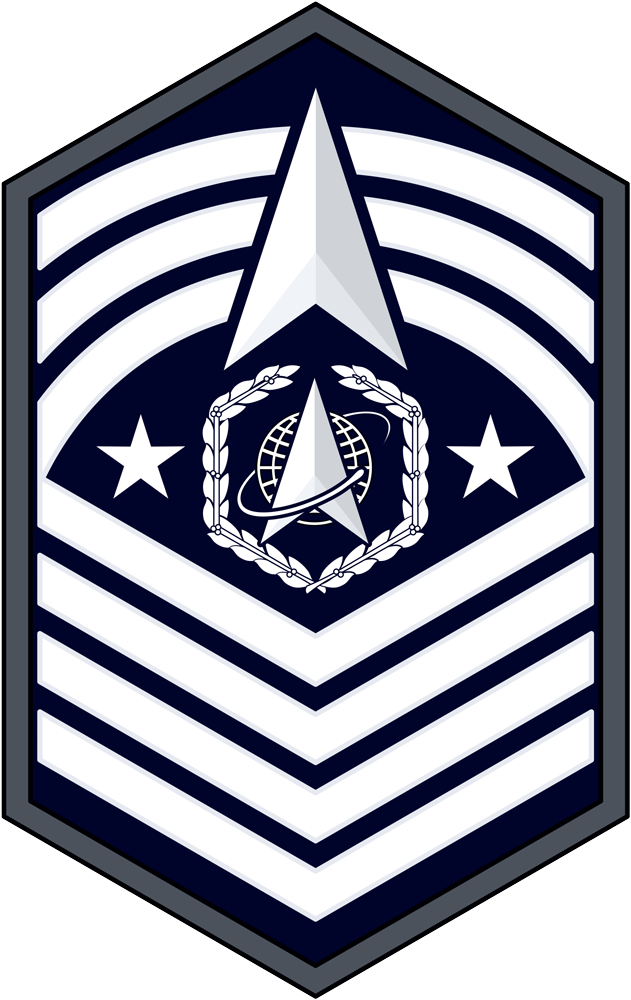
Chief Master Sergeant of the Space Force
The Chief Master Sergeant of the Space Force is the senior enlisted leader of the entire Space Force.
Chief Master Sgt. of the Space Force John F. Bentivegna serves at the highest enlisted level of leadership, provides direction for the enlisted force, represents enlisted interests, and acts as the personal advisor to the Chief of Space Operations and the Secretary of the Air Force on issues affecting welfare, readiness, morale, proper utilization, and development of Space Force enlisted members.
This position matters because the enlisted force needs a senior voice at the top of the institution.
The Chief Master Sergeant of the Space Force is not merely a ceremonial figure. The role exists because enlisted Guardians are central to the service’s ability to operate, adapt, develop, and lead.
Space Force Enlisted Rank Insignia Explained
Space Force enlisted rank insignia reflects the service’s distinct identity while still operating within the broader structure of U.S. military rank recognition.
The Space Force announced its service-specific rank names in 2021 and initially noted that Guardians would continue wearing Air Force rank insignia until new Space Force insignia designs were approved.
The practical point is simple: Space Force enlisted insignia communicates rank, authority, and leadership level.
Here is the basic structure:
Rank Group | Insignia Logic |
E-1 to E-4 | Specialist ranks |
E-5 to E-6 | NCO ranks |
E-7 to E-9 | Senior NCO ranks |
CMSSF | Special senior enlisted insignia |
Space Force insignia may feel new compared to older branches, but the purpose is the same: to show who is junior, who leads, who carries senior enlisted authority, and who advises at the highest level.
In a technical military service, clarity still matters. Rank insignia helps Guardians understand authority quickly, even in units where missions may be highly specialized or classified.
Requirements to Become a Space Force Enlisted Guardian
Requirements can change, and exact eligibility depends on current Space Force policy, recruiting needs, medical standards, legal history, education, citizenship status, clearance eligibility, and job requirements.
In general, becoming an enlisted Guardian requires:
- Meeting age and eligibility standards
- Passing medical screening
- Meeting education requirements
- Taking the ASVAB
- Qualifying for available Space Force specialties
- Passing background screening
- Meeting physical and training standards
- Completing basic military training
- Completing follow-on technical training when required
The ASVAB matters because it helps determine what technical fields a person may qualify for. A future Guardian may want a specific specialty, but actual options depend on aptitude, availability, qualifications, medical standards, clearance eligibility, and the needs of the Space Force.
The best approach is to speak with a recruiter early, ask direct questions, understand the specialty options, and prepare mentally for a technical service where attention to detail matters.
How Long It Takes to Promote Through Space Force Enlisted Ranks
Promotion timelines vary. They depend on career field, performance, evaluations, time in service, time in grade, qualifications, service needs, and promotion systems.
The general pattern is:
Early ranks are more predictable.
NCO advancement becomes more competitive.
Senior NCO promotion becomes significantly more selective.
Chief Master Sergeant is highly competitive.
A future Guardian should understand this clearly: showing up and waiting is not a career strategy.
Promotion requires performance, qualifications, reputation, technical credibility, leadership, timing, and persistence.
Because the Space Force is small, every reputation matters. A Guardian who becomes known as technically sharp, dependable, disciplined, and useful may create better opportunities over time.
Space Force Enlisted Pay Grades and Benefits
Space Force enlisted pay is based primarily on pay grade and years of service.
An E-1 makes less than an E-5. An E-5 with more years of service may make more than an E-5 with fewer years of service. An E-7 Master Sergeant with many years in service will earn more base pay than a brand-new Guardian because both rank and time matter.
Space Force enlisted compensation may include:
- Base pay
- Basic Allowance for Housing
- Basic Allowance for Subsistence
- Healthcare
- Retirement benefits
- Special duty pay when eligible
- Bonuses for certain specialties or needs
- Education benefits
For a full breakdown of current military pay topics, visit the Military Pay section on Life Is a Special Operation. https://lifeisaspecialoperation.com/category/military-insights/military-pay/
Leadership Expectations of Space Force Enlisted Guardians
Space Force enlisted leadership grows in layers.
A junior Guardian is expected to become reliable.
A Specialist is expected to become technically useful.
A Sergeant is expected to lead others.
A Technical Sergeant is expected to manage people and technical execution.
A Master Sergeant is expected to develop leaders and advise officers.
A Chief Master Sergeant is expected to think about the entire organization, not just one shop, section, or mission area.
The higher the rank, the less leadership is about personal effort alone. Senior enlisted leaders must build systems, develop people, enforce standards, and tell the truth when others would rather avoid discomfort.
That is one of the reasons I respected the Space Force Chief Master Sergeant I worked with. He was not there to make everyone comfortable. He was there to make the training audience better.
The Space Force needs enlisted leaders who can say:
This will work.
This will not work.
We are ready.
We are not ready.
This Guardian needs correction.
This Guardian is ready for more responsibility.
The training audience can do better.
That kind of honesty is not always gentle. But in a technical and strategic environment, it is necessary.
Frequently Asked Questions About Space Force Enlisted Ranks
What are Space Force enlisted ranks in order?
Space Force enlisted ranks in order are Specialist 1, Specialist 2, Specialist 3, Specialist 4, Sergeant, Technical Sergeant, Master Sergeant, Senior Master Sergeant, and Chief Master Sergeant. These ranks correspond to pay grades E-1 through E-9. The senior-most enlisted position is Chief Master Sergeant of the Space Force.
What are Space Force ranks from lowest to highest?
From lowest to highest, Space Force enlisted ranks run from Specialist 1 at E-1 to Chief Master Sergeant at E-9. Junior enlisted Guardians are Specialist 1 through Specialist 4, NCOs are Sergeant and Technical Sergeant, and senior NCOs are Master Sergeant through Chief Master Sergeant. Each level brings more responsibility, authority, and expectation.
How do Space Force enlisted ranks work?
Space Force enlisted ranks work by combining pay grade, seniority, authority, technical competence, and leadership responsibility. Early ranks focus on learning and reliability, NCO ranks focus on technical leadership and supervision, and senior NCO ranks focus on broader enlisted leadership and advising officers. The higher a Guardian advances, the more the Space Force expects judgment, accountability, and technical credibility.
What is the difference between Space Force enlisted ranks and officer ranks?
Space Force enlisted Guardians execute missions, maintain technical expertise, support daily operations, and lead enlisted work at the operational level. Space Force officers hold command authority, plan operations, manage resources, and make broader organizational decisions. The best Space Force units rely on both: officers who lead wisely and enlisted leaders who provide technical depth and honest advice.
What is the highest enlisted rank in the Space Force?
The highest regular enlisted rank in the Space Force is Chief Master Sergeant, pay grade E-9. The highest enlisted position is Chief Master Sergeant of the Space Force. The CMSSF advises senior Space Force and Department of the Air Force leadership and represents the enlisted force at the highest level.
How much do Space Force enlisted members get paid by rank?
Space Force enlisted members are paid according to federal military pay charts based on pay grade and years of service. Total compensation may also include housing allowance, food allowance, healthcare, retirement benefits, education benefits, and special pays when eligible. Pay grade matters because it standardizes compensation across the military, even when rank titles differ by branch.
Learn more about Space Force Enlisted Pay: https://lifeisaspecialoperation.com/category/military-insights/military-pay/
How long does it take to get promoted in the Space Force?
Promotion timing depends on career field, performance, evaluations, qualifications, time in grade, time in service, and Space Force needs. Early advancement may be more predictable for Guardians who meet standards, but promotion to NCO and especially senior NCO ranks becomes more competitive. Advancement to Master Sergeant, Senior Master Sergeant, and Chief Master Sergeant requires selection into increasingly senior leadership roles.
Do Space Force enlisted members lead others?
Yes. Space Force enlisted members lead others constantly. Sergeants and Technical Sergeants train and supervise junior Guardians, while Master Sergeants, Senior Master Sergeants, and Chief Master Sergeants shape standards, readiness, culture, and daily execution. Officers may hold command authority, but enlisted leadership is where much of the Space Force’s technical work is actually led.
What does a Space Force Specialist or Sergeant actually do?
A Space Force Specialist develops technical competence, supports mission execution, learns systems and procedures, and becomes a reliable member of the team. A Space Force Sergeant is an NCO who leads Guardians, trains junior personnel, enforces standards, and helps manage technical execution. In a small, technical service, both roles can matter far more than civilians realize.
Can Space Force enlisted members become officers?
Yes. Space Force enlisted Guardians may become officers through available commissioning pathways if they meet education, performance, leadership, medical, fitness, clearance, and selection requirements. Prior enlisted officers often bring strong credibility because they understand enlisted life, technical mission realities, and service culture from firsthand experience.
What is the difference between Specialist, Sergeant, and Chief in the Space Force?
A Specialist is a junior enlisted Guardian focused on learning the mission and building technical competence. A Sergeant is a noncommissioned officer responsible for leading Guardians, supervising work, and enforcing standards. A Chief is a senior enlisted leader who advises officers, develops leaders, protects standards, and helps shape the enlisted force.
What are Space Force enlisted rank insignia?
Space Force enlisted rank insignia identifies a Guardian’s rank, authority, and leadership level. Specialist ranks identify junior enlisted Guardians, Sergeant and Technical Sergeant identify NCOs, and Master Sergeant through Chief Master Sergeant identify senior NCOs. The Chief Master Sergeant of the Space Force has a special senior enlisted insignia and represents the top enlisted position in the service.
Why Understanding Space Force Enlisted Ranks Matters
Understanding Space Force enlisted ranks helps you:
- Understand Space Force culture
- Communicate professionally
- Avoid confusing rank and pay grade
- Recognize who actually leads technical work
- Understand why specialists and senior enlisted leaders matter
- Make better career decisions
- Prepare more intelligently before joining
- Respect the enlisted force that keeps the Space Force moving
Rank literacy prevents confusion. It also helps future Guardians enter the service with humility and awareness.
Key Takeaways
Space Force enlisted ranks run from E-1 to E-9.
Junior enlisted Guardians are Specialists.
Sergeants and Technical Sergeants are Space Force NCOs.
Master Sergeants, Senior Master Sergeants, and Chief Master Sergeants are senior NCOs.
Rank and pay grade are related, but they are not the same thing.
The Space Force is young, technical, and strategically important.
Promotion becomes more competitive as responsibility increases.
The Space Force runs on enlisted Guardians who bring technical skill, discipline, honesty, and mission focus to complex problems.
About the Author
Christopher Littlestone is a retired U.S. Army Special Forces Green Beret Lieutenant Colonel.
About two years before writing this article, he worked with a senior enlisted Space Force Chief Master Sergeant during a multinational training exercise and mission-preparation event inside the intelligence community. That Chief had transferred from the U.S. Air Force into the Space Force because his specific skill set was highly valued by the new service.
Christopher is the founder of Life as a Special Operations, a platform dedicated to teaching leadership, planning, mindset, security, and performance based on real-world military experience. His YouTube channel has grown to more than 380,000 subscribers and over 47 million views.
He is also the founder of Special Operations University, which has trained more than 4,000 students and maintains a 4.9 Trustpilot ratings.
Final Thoughts
Understanding Space Force enlisted ranks gives you more than trivia. It gives you a window into how the newest branch of the U.S. military is building its enlisted culture.
The Space Force does not run on science fiction. It runs on Guardians who understand technical systems, protect sensitive missions, support space operations, analyze information, maintain discipline, and solve problems that may affect national security.
At the center of that enlisted culture are technical specialists, NCOs, and senior enlisted leaders.
A good Specialist is not merely a junior rank.
A good Sergeant is not merely an E-5.
A good Chief is not merely someone who stayed long enough to promote.
They are part of a small, technical, strategically important force.
That is why Space Force enlisted ranks matter. They are not just titles. They are a map of responsibility.
If you are serious about preparing to enlist, preparing for military service, or becoming excellent once you are in, these resources can help you achieve your goal:
- Train Up – Arrive Prepared for Military or Special Operations Training
- Special Operations Mindset – Develop a Champion’s Mindset
- Fitness Programs – Get into Amazing Shape
- Military Leadership Course – Become the Leader Everyone Respects
- Military Planning Course – Plan Like Your Life Depends on It
Life is a Special Operation. Are you ready for it?

Watch our YouTube videos on this exact topic.
These three videos have earned more than 5.2 million combined views to date.

Training Preparation
Arrive Prepared for Military & Special Operations Training

Special Operations Mindset
Develop the Champion Mindset of the Best Trained and Most Elite Forces in the World

Fitness
Get into Amazing Shape

Elite Performance Skills
Win - Lead - Succeed