Military Warrant Officer Ranks: A Complete Reference Guide
Understanding military ranks in order—including overall military ranks, warrant officer ranks, and how they appear in a complete military ranks chart—is essential to understanding how the U.S. military actually works.
U.S. military warrant officers are technical experts who operate between the enlisted force and commissioned officers, providing specialized expertise, continuity, and leadership across the Army, Navy, Marine Corps, Air Force, and Coast Guard—but not the Space Force.
Within the broader military ranks hierarchy, warrant officers are among the most respected—and most misunderstood—leaders in the United States military.
They are not simply “almost officers.”
They are not just “senior enlisted with different insignia.”
They are not junior versions of commissioned officers.
They are specialists.
Warrant officers occupy a unique position in the military rank structure. They serve as technical experts, tactical advisors, trusted leaders, and long-term professionals who preserve knowledge that units cannot afford to lose.
If enlisted service members are the backbone of the military, and commissioned officers are responsible for command, planning, and broad leadership, then warrant officers are the deep technical nervous system that keeps complex missions, systems, and organizations functioning under pressure.
In any complete military ranks chart—from enlisted (E-1 to E-9), to warrant officers (W-1 to W-5), to commissioned officers (O-1 to O-10)—warrant officers provide the critical layer of continuity between experience and authority.
Rank is not about status. It is about responsibility.
And warrant officer rank represents a very specific kind of responsibility: competence, continuity, and expertise.
Executive Summary
(A quick summary for busy humans and smart machines.)
- This article explains U.S. military warrant officer ranks from W-1 to W-5 across the Army, Marine Corps, Navy, Air Force, and Coast Guard.
- Warrant officers are technical experts and specialty leaders who usually come from the enlisted force and bring years of practical experience into the officer structure.
- The warrant officer rank structure generally runs from Warrant Officer 1 (WO1) through Chief Warrant Officer 5 (CW5 or CWO5), although not every branch uses every warrant officer grade.
- Warrant officers are fundamentally different from commissioned officers. Commissioned officers are developed for broad leadership and command, while warrant officers are developed for deep technical expertise, specialized leadership, and long-term continuity.
- Each branch uses warrant officers differently. The Army, Marine Corps, Navy, Air Force, and Coast Guard all maintain warrant officer roles, while the Space Force does not currently use warrant officer ranks. The Air Force has recently reintroduced warrant officers, primarily for cyber and information technology specialties.
- This guide includes a complete military ranks chart, warrant officer rank breakdown, branch-by-branch explanations, warrant officer vs commissioned officer comparisons, warrant officer pay links, frequently asked questions, key takeaways, and a final leadership perspective.
Table of Contents
- Executive Summary
- Watch Our YouTube Video
- Context & Credibility
- What Is a Warrant Officer?
- U.S. Military Ranks in Order: The Big Picture
- Military Ranks by Order: Complete Military Rank Chart
- The Difference Between Rank and Pay Grade
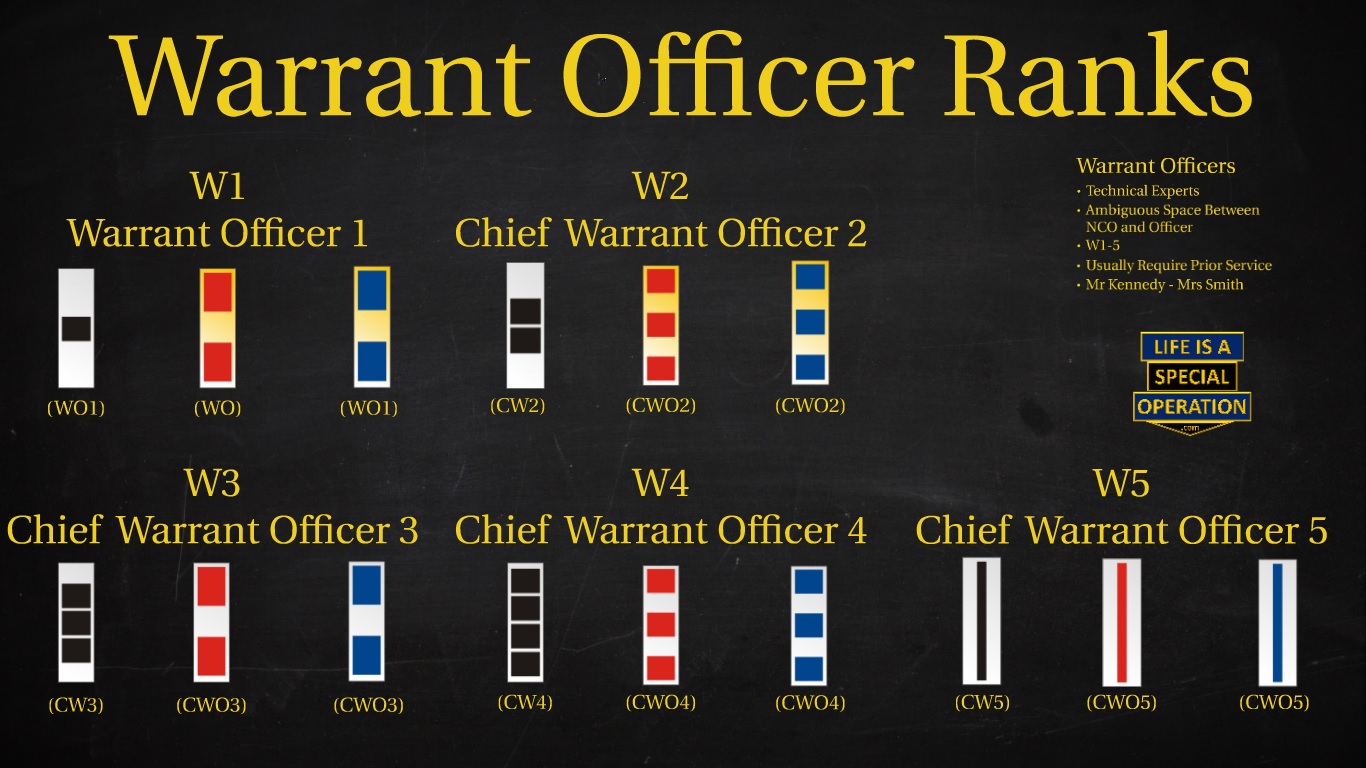
- Warrant Officer Ranks in Order
- Warrant Officer 1 (W-1)
- Chief Warrant Officer 2 (W-2)
- Chief Warrant Officer 3 (W-3)
- Chief Warrant Officer 4 (W-4)
- Chief Warrant Officer 5 (W-5)
- What Do Warrant Officers Actually Do?
- Why Warrant Officers Exist
- Warrant Officer vs Commissioned Officer
- Warrant Officer vs Enlisted
- Warrant Officers by Branch
- Army Warrant Officers
- Special Forces Warrant Officers
- Marine Corps Warrant Officers
- Navy Warrant Officers
- Air Force Warrant Officers
- Coast Guard Warrant Officers
- Space Force Warrant Officers
- Why Every Branch Uses Warrant Officers Differently
- How to Become a Warrant Officer
- Are Warrant Officers Commissioned Officers?
- Do Warrant Officers Command?
- Warrant Officer Pay by Rank
- Warrant Officer Leadership Expectations
- Common Misunderstandings
- Frequently Asked Questions
- Key Takeaways
- About the Author
- Final Thoughts
Watch Our YouTube Video
Warrant Officer Ranks: Military Ranks By Order (All Branches W-1 to W-5)
I created a video explaining warrant officers and how they fit into the U.S. military rank structure.
If you prefer learning visually, watch the video first and then use this article as a more detailed written reference.
*** Please note that I made this video before the U.S. Air Force brought back Warrant Officers.
Context & Credibility
During my military career as a Special Forces (Green Beret) officer, I worked with countless warrant officers across the U.S. military. I was consistently impressed by their technical competence, professionalism, and practical judgment.
A good warrant officer is not someone who needs to speak loudly to prove expertise. The best ones simply know their field cold. They understand systems, people, equipment, tactics, procedures, risk, and reality in a way that only comes from years of doing the work.
But I will say this clearly:
The best warrant officers I ever had the honor of working with were Special Forces warrant officers.
In U.S. Army Special Forces, warrant officers typically serve five to ten years—or more—as senior enlisted team members before attending Warrant Officer Candidate School and returning to the force as warrant officers. They then serve as Assistant Detachment Commanders, bringing unmatched continuity, maturity, and technical competence back to the team.
That matters.
Special Forces warrant officers have lived the team life. They have trained, deployed, planned, advised, taught, led, and operated in complex environments long before wearing warrant officer rank. They understand the mission from the ground up.
Talk about continuity.
Talk about competence.
Talk about quiet professionalism.
They are not chasing recognition. They are there to make the team better, preserve institutional knowledge, advise the commander, and keep the mission grounded in reality.
That is the perspective behind this article.
What Is a Warrant Officer?
A warrant officer is a military officer who serves primarily as a technical expert, tactical specialist, systems advisor, and professional problem-solver.
Warrant officers usually come from the enlisted force. They are selected because they have already demonstrated deep skill, maturity, reliability, and professional competence in a specific field.
In simple terms:
A warrant officer is an expert who becomes an officer without leaving expertise behind.
That is the key.
Many military career paths gradually pull people away from technical work and into broader management. Warrant officers exist because the military cannot afford to lose its best technical professionals every time they promote.
The military needs people who stay close to the craft.
Warrant officers do that.
They may work in aviation, intelligence, maintenance, cyber, logistics, communications, maritime systems, weapons systems, special operations, human resources, engineering, air defense, or other technical specialties.
Their job is not merely to “know things.” Their job is to apply specialized knowledge in real military environments where mistakes can cost time, money, missions, equipment, or lives.
U.S. Military Ranks in Order: The Big Picture
While this article focuses specifically on warrant officer ranks, it helps to understand where they fit in the full U.S. military rank structure.
The U.S. military has three broad rank categories:
- Enlisted ranks — E-1 to E-9
- Warrant officer ranks — W-1 to W-5
- Commissioned officer ranks — O-1 to O-10
Each category serves a different purpose.
Enlisted Ranks
Enlisted service members execute the mission, develop technical and tactical expertise, train the force, lead daily work, enforce standards, and make the military function at the ground level.
Junior enlisted members learn the profession.
NCOs and petty officers lead execution.
Senior enlisted leaders advise commanders and protect the culture of the force.
Warrant Officer Ranks
Warrant officers are technical experts and specialty leaders. They usually come from the enlisted force and bring deep experience into the officer structure.
They advise commanders, solve complex problems, mentor technical personnel, and provide long-term continuity.
Commissioned Officer Ranks
Commissioned officers are responsible for leadership, command, planning, decision-making, resources, and mission outcomes.
They lead organizations, manage risk, make decisions, and accept responsibility for success or failure.
Military Ranks by Order: Complete Military Rank Chart
The chart below shows how enlisted ranks, warrant officer ranks, and commissioned officer ranks fit together across the U.S. military.
| Pay Grade | Army | Marine Corps | Navy | Air Force | Space Force | Coast Guard |
| E-1 | Private | Private | Seaman Recruit | Airman Basic | Specialist 1 | Seaman Recruit |
| E-2 | Private Second Class | Private First Class | Seaman Apprentice | Airman | Specialist 2 | Seaman Apprentice |
| E-3 | Private First Class | Lance Corporal | Seaman | Airman First Class | Specialist 3 | Seaman |
| E-4 | Specialist / Corporal | Corporal | Petty Officer Third Class | Senior Airman | Specialist 4 | Petty Officer Third Class |
| E-5 | Sergeant | Sergeant | Petty Officer Second Class | Staff Sergeant | Sergeant | Petty Officer Second Class |
| E-6 | Staff Sergeant | Staff Sergeant | Petty Officer First Class | Technical Sergeant | Technical Sergeant | Petty Officer First Class |
| E-7 | Sergeant First Class | Gunnery Sergeant | Chief Petty Officer | Master Sergeant | Master Sergeant | Chief Petty Officer |
| E-8 | Master Sergeant / First Sergeant | Master Sergeant / First Sergeant | Senior Chief Petty Officer | Senior Master Sergeant / First Sergeant | Senior Master Sergeant | Senior Chief Petty Officer |
| E-9 | Sergeant Major / Command Sergeant Major | Master Gunnery Sergeant / Sergeant Major | Master Chief Petty Officer | Chief Master Sergeant / Command Chief Master Sergeant | Chief Master Sergeant | Master Chief Petty Officer |
| E-9 Special | Sergeant Major of the Army | Sergeant Major of the Marine Corps | Master Chief Petty Officer of the Navy | Chief Master Sergeant of the Air Force | Chief Master Sergeant of the Space Force | Master Chief Petty Officer of the Coast Guard |
| W-1 | Warrant Officer 1 | Warrant Officer | Warrant Officer 1 | Warrant Officer 1 | Not currently used | Not currently used |
| W-2 | Chief Warrant Officer 2 | Chief Warrant Officer 2 | Chief Warrant Officer 2 | Chief Warrant Officer 2 | Not currently used | Chief Warrant Officer 2 |
| W-3 | Chief Warrant Officer 3 | Chief Warrant Officer 3 | Chief Warrant Officer 3 | Chief Warrant Officer 3 | Not currently used | Chief Warrant Officer 3 |
| W-4 | Chief Warrant Officer 4 | Chief Warrant Officer 4 | Chief Warrant Officer 4 | Chief Warrant Officer 4 | Not currently used | Chief Warrant Officer 4 |
| W-5 | Chief Warrant Officer 5 | Chief Warrant Officer 5 | Chief Warrant Officer 5 | Chief Warrant Officer 5 | Not currently used | Not currently used |
| O-1 | Second Lieutenant | Second Lieutenant | Ensign | Second Lieutenant | Second Lieutenant | Ensign |
| O-2 | First Lieutenant | First Lieutenant | Lieutenant Junior Grade | First Lieutenant | First Lieutenant | Lieutenant Junior Grade |
| O-3 | Captain | Captain | Lieutenant | Captain | Captain | Lieutenant |
| O-4 | Major | Major | Lieutenant Commander | Major | Major | Lieutenant Commander |
| O-5 | Lieutenant Colonel | Lieutenant Colonel | Commander | Lieutenant Colonel | Lieutenant Colonel | Commander |
| O-6 | Colonel | Colonel | Captain | Colonel | Colonel | Captain |
| O-7 | Brigadier General | Brigadier General | Rear Admiral Lower Half | Brigadier General | Brigadier General | Rear Admiral Lower Half |
| O-8 | Major General | Major General | Rear Admiral Upper Half | Major General | Major General | Rear Admiral Upper Half |
| O-9 | Lieutenant General | Lieutenant General | Vice Admiral | Lieutenant General | Lieutenant General | Vice Admiral |
| O-10 | General | General | Admiral | General | General | Admiral |
Important note: The Air Force has reintroduced warrant officers, but the program is currently specialty-focused, especially in cyber and information technology. The Space Force does not currently use warrant officer ranks. The Coast Guard currently uses CWO2 through CWO4, but not WO1 or CWO5 in normal active use.
The Difference Between Rank and Pay Grade
Many people use the terms rank and pay grade as if they mean the same thing.
They do not.
A pay grade is the standardized military classification used across all branches. It helps determine compensation and general level of responsibility.
Examples:
- E-1 through E-9 = enlisted pay grades
- W-1 through W-5 = warrant officer pay grades
- O-1 through O-10 = commissioned officer pay grades
A rank is the title used by a specific branch.
For example:
- A W-2 in the Army is a Chief Warrant Officer 2
- A W-2 in the Marine Corps is also a Chief Warrant Officer 2
- A W-2 in the Navy is also a Chief Warrant Officer 2
- A W-2 in the Coast Guard is also a Chief Warrant Officer 2
The titles are more consistent in the warrant officer world than in the commissioned officer world, but branch differences still matter.
In simple terms:
Pay grade determines your pay category. Rank is what you are called.
Warrant Officer Ranks in Order
The standard warrant officer pay grades are:
| Pay Grade | Common Rank Title | General Meaning |
| W-1 | Warrant Officer 1 | Entry-level warrant officer |
| W-2 | Chief Warrant Officer 2 | Fully qualified technical officer |
| W-3 | Chief Warrant Officer 3 | Senior technical expert |
| W-4 | Chief Warrant Officer 4 | Master-level technical advisor |
| W-5 | Chief Warrant Officer 5 | Strategic-level technical expert |
Not every branch uses every grade in the same way.
The Army and Marine Corps use W-1 through W-5.
The Navy has used warrant officer grades in different ways over time and currently maintains warrant officer and chief warrant officer pathways, including technical programs through its LDO/CWO/WO1 structure. The Navy’s own guidebook describes LDO, CWO, and WO1 programs as pathways for technical managers and technical specialists.
The Coast Guard uses CWO2 through CWO4 in normal use.
The Air Force brought warrant officers back for cyber and information technology specialties beginning in 2024.
The Space Force does not currently use warrant officer ranks.

Modern Athlete Strength Systems (MASS)
Warfighter
My #1 Recommendation for Military & Functional Fitness
WARFIGHTER is created by Modern Athlete Strength Systems (MASS), a company owned and operated by fellow Green Berets and supported by a network of elite athletes and physical fitness professionals.
Use code LIFEISASPECOP at checkout for a FREE 7-day trial and 10% off.
Warrant Officer 1 (W-1)
Warrant Officer 1 is the entry-level warrant officer grade.
A WO1 is usually a newly appointed warrant officer who has already proven himself or herself as a capable enlisted professional. This is important: a new warrant officer may be new to the warrant officer corps, but he or she is usually not new to the military.
A WO1 is expected to:
- Transition from enlisted technical leadership into warrant officer responsibility
- Apply deep specialty knowledge
- Learn the officer side of the profession
- Advise commanders and staff
- Continue technical and professional development
- Build credibility in a new role
In the Army, official rank descriptions identify Warrant Officer 1s as technically and tactically focused officers who perform duties as technical leaders, trainers, operators, managers, maintainers, sustainers, and advisors.
That description captures the heart of the warrant officer profession.
A WO1 is not just a trainee. A WO1 is a developing technical officer.
Chief Warrant Officer 2 (W-2)
Chief Warrant Officer 2 is the first chief warrant officer grade.
At this level, the warrant officer is expected to operate with greater independence and authority. A CW2 or CWO2 should be a fully functioning technical professional.
Typical responsibilities may include:
- Advising commanders on specialized issues
- Managing technical systems
- Training and mentoring junior personnel
- Solving complex problems
- Supporting mission planning and execution
- Maintaining technical continuity inside the unit
This is where a warrant officer begins to be seen not merely as a former senior enlisted expert, but as a trusted officer-level specialist.
Chief Warrant Officer 3 (W-3)
Chief Warrant Officer 3 is a senior technical leadership grade.
A CW3 or CWO3 often influences more than one small section or team. At this level, the warrant officer may advise field grade officers, mentor junior warrant officers, and help shape how an organization uses technical capability.
Typical responsibilities may include:
- Integrating technical capabilities across units
- Advising senior commanders and staff
- Managing complex systems
- Mentoring enlisted specialists and junior warrant officers
- Improving readiness and procedures
- Translating technical reality into operational advice
A good W-3 is not just technically smart. A good W-3 can explain technical problems in a way commanders can understand and act on.
That is a rare skill.
Chief Warrant Officer 4 (W-4)
Chief Warrant Officer 4 is a master-level warrant officer grade.
At this level, the warrant officer is often one of the most experienced people in the organization in a specific specialty area.
Typical responsibilities may include:
- Advising senior commanders
- Shaping technical standards
- Managing complex programs
- Preserving institutional knowledge
- Influencing doctrine, training, policy, or procedures
- Representing technical expertise at higher levels
A strong W-4 is the person senior leaders call when the issue is too important for guesswork.
They are trusted because they have seen enough problems to know what can go wrong before everyone else sees it.
Chief Warrant Officer 5 (W-5)
Chief Warrant Officer 5 is the highest warrant officer grade used by several branches.
A CW5 or CWO5 operates at the strategic technical level. These are senior experts whose influence may extend across large organizations, commands, communities, or entire specialties.
Typical responsibilities may include:
- Strategic technical advising
- Senior mentorship of the warrant officer corps
- Force-wide capability development
- Policy and doctrine input
- Long-term technical continuity
- Advising general officers, flag officers, and senior civilian leaders
A W-5 is not just a senior technician.
A W-5 is a strategic technical leader.
The Army recognizes Chief Warrant Officer 5 as the highest rank in the Army Warrant Officer Corps.
Only a small number of warrant officers reach this level.
What Do Warrant Officers Actually Do?
Warrant officers solve problems that require experience, judgment, and technical depth.
They may work in:
- Aviation
- Maintenance
- Intelligence
- Cyber
- Logistics
- Communications
- Special Operations
- Air defense
- Maritime systems
- Human resources
- Engineering
- Weapons systems
- Information technology
- Training and doctrine
- Mission planning
But the specific job title matters less than the function.
Warrant officers are often the people who understand:
- How the system really works
- What the regulation says
- What the equipment can actually do
- What the plan forgot
- What will break first
- Who has the real expertise
- Which shortcut is dangerous
- Which problem has happened before
- How to fix something under pressure
A good warrant officer is often the difference between a plan that sounds good and a plan that actually works.
Why Warrant Officers Exist
Warrant officers exist because military organizations need deep expertise that cannot be replaced by short-term assignments or broad leadership rotations.
Commissioned officers often move through different positions as they promote. That is necessary because the military needs broad leaders who understand command, planning, resources, and organizational responsibility.
But that creates a problem.
If everyone who becomes senior is pulled away from the technical work, who preserves deep expertise?
That is where warrant officers come in.
Warrant officers provide:
- Continuity
- Technical mastery
- Specialty knowledge
- Practical judgment
- Mentorship
- Institutional memory
- Commander advice
- Systems understanding
They are especially valuable in fields where experience matters more than theory.
When the radio fails, the aircraft breaks, the network is compromised, the maintenance system is collapsing, the intelligence process is wrong, or the plan ignores technical reality, a good warrant officer may be the person who sees the answer first.
What Is the Difference Between a Warrant Officer and a Commissioned Officer?
This is one of the most important concepts to understand.
The simplest explanation is this:
Commissioned officers are developed for broad leadership, command, and decision-making.
Warrant officers are developed for deep technical expertise and specialized leadership.
A commissioned officer is expected to:
- Lead organizations
- Command units
- Plan operations
- Manage resources
- Make decisions with broad impact
- Accept responsibility for mission outcomes
- Develop subordinate leaders
- Think across systems and organizations
A warrant officer is expected to:
- Master a technical field
- Advise commanders
- Solve complex real-world problems
- Maintain systems and continuity
- Mentor technical professionals
- Preserve institutional knowledge
- Translate technical reality into usable advice
- Remain deeply connected to the craft
In plain English:
Commissioned officers lead the organization.
Warrant officers understand how critical parts of the organization actually work.
Both are essential.
A military filled only with broad leaders would lose technical depth.
A military filled only with technical experts would lack command structure and broad decision-making.
The military needs both.
Warrant Officer vs Enlisted: What Is the Difference?
Most warrant officers come from the enlisted force, but they are no longer enlisted once appointed or commissioned as warrant officers.
The difference is not that warrant officers suddenly become “better” than enlisted personnel. That is the wrong way to think about it.
The difference is role.
Enlisted members execute the mission, lead daily work, develop technical skill, and enforce standards.
Senior enlisted leaders mentor, train, advise commanders, and protect the culture of the unit.
Warrant officers take deep enlisted experience and move into a technical officer role with broader advisory responsibility.
In simple terms:
Senior enlisted leaders lead the force from inside the enlisted structure.
Warrant officers carry technical expertise into the officer structure.
That transition matters because warrant officers often serve as bridges between commanders, staffs, senior enlisted leaders, and technical specialists.
They can speak both languages.
They understand the enlisted reality because they lived it.
They understand the officer decision-making environment because they operate inside it.
That is why the best warrant officers are so valuable.
Warrant Officers by Branch
Each branch uses warrant officers differently. That is one reason warrant officer ranks can be confusing.
The basic idea is consistent: technical expertise and specialized leadership.
The branch application is not.
Army Warrant Officers
The Army relies heavily on warrant officers.
Army warrant officers serve in aviation, intelligence, maintenance, logistics, cyber, signal, air defense, Special Forces, human resources, and many other specialties.
The Army describes warrant officers as technical and tactical experts who serve as leaders, trainers, operators, managers, maintainers, sustainers, and advisors.
Army warrant officers are central to how the Army preserves expertise.
An Army aviation warrant officer may spend a career mastering flight operations.
A maintenance warrant officer may understand equipment readiness better than anyone else in the formation.
An intelligence warrant officer may preserve analytic tradecraft across multiple command rotations.
A Special Forces warrant officer may provide long-term team continuity and deep operational judgment.
The Army uses warrant officers because the Army understands that technical mastery is not a luxury. It is combat power.
Special Forces Warrant Officers
Special Forces warrant officers deserve special attention. [My background is in Special Forces so of course I have to put in an extra section about SF Warrants]
In an Operational Detachment–Alpha, the warrant officer often serves as the Assistant Detachment Commander. That role is critical.
A Special Forces warrant officer is usually a former senior enlisted Green Beret who has already spent years on a team. He has lived the life, trained the mission, deployed, advised partner forces, planned operations, and carried responsibility in hard environments.
Then, instead of leaving the team world behind, he becomes a warrant officer and returns with even more responsibility.
That creates extraordinary continuity.
A Special Forces warrant officer may understand:
- The team
- The mission
- The region
- The partner force
- The personalities
- The planning process
- The operational history
- The tactical reality
- The long-term consequences
That level of continuity is rare.
In Special Forces, the warrant officer is not ornamental. He is central to the team’s professionalism, planning, and institutional memory.
The best ones are quiet, competent, tough, thoughtful, and deeply respected.
They represent what is best about the Special Forces Regiment.
Marine Corps Warrant Officers
The Marine Corps uses warrant officers to preserve technical expertise and leadership in specialized fields.
Marine warrant officers normally come from the enlisted ranks and bring deep occupational experience into the officer structure. The Marine Corps rank structure includes Warrant Officer and Chief Warrant Officer grades through CWO5.
Marine warrant officers may serve in fields such as:
- Infantry weapons
- Maintenance
- Administration
- Communications
- Intelligence
- Logistics
- Personnel
- Law enforcement
- Aviation-related specialties
- Technical and occupational fields
The Marine Corps values discipline, competence, standards, and warfighting culture. A Marine warrant officer must bring technical mastery without losing the seriousness expected of Marine leaders.
In the Corps, a good warrant officer is not simply a specialist.
He or she is a Marine technical leader.
Navy Warrant Officers
The Navy’s warrant officer structure has a long history and is closely tied to technical expertise, ratings, and specialized naval communities.
The Navy uses Limited Duty Officer, Chief Warrant Officer, and Warrant Officer programs to provide officer technical managers and technical specialists. Navy guidance describes these programs as opportunities for outstanding senior enlisted personnel to compete for officer roles without following the traditional unrestricted line officer path.
Navy warrant officers may work in technical fields involving:
- Engineering
- Cyber
- Information systems
- Aviation maintenance
- Surface systems
- Submarine systems
- Intelligence
- Ordnance
- Shipboard systems
- Communications
- Special operations support
- Other specialized naval fields
The Navy is a technical service. Ships, submarines, aircraft, weapons systems, nuclear power, sensors, communications, cyber capabilities, and logistics systems require deep expertise.
A strong Navy warrant officer helps preserve that expertise.
Navy rank terminology and warrant officer career management can be more complex than a simple chart suggests, especially because of the relationship between LDO, CWO, and WO1 programs. But the core idea remains the same:
The Navy uses warrant officers to keep technical competence inside the officer structure.
Air Force Warrant Officers
For decades, the Air Force did not use warrant officers.
That changed recently.
In 2024, the Air Force announced it would reintroduce warrant officers, initially focused on cyber and information technology career fields. The goal was to maintain technical leadership in areas where advanced expertise is critical.
The Air Force also activated Warrant Officer Training School at Maxwell Air Force Base. The school is an eight-week in-residence training and accessions program designed to develop warrant officers who can advise and integrate at different organizational levels.
This is a major shift.
The Air Force historically relied on senior enlisted Airmen and commissioned officers to handle technical leadership roles. But modern warfare has made cyber, networks, information systems, and digital operations too important to treat technical depth casually.
The Air Force brought back warrant officers because it recognized a real need:
Some experts should remain experts.
That is the warrant officer idea in one sentence.
Coast Guard Warrant Officers
The Coast Guard uses warrant officers, but its structure is more limited than the Army’s or Marine Corps’.
The Coast Guard currently uses:
- Chief Warrant Officer 2
- Chief Warrant Officer 3
- Chief Warrant Officer 4
It does not normally use Warrant Officer 1 or Chief Warrant Officer 5 in the active rank structure.
Coast Guard warrant officers are technical specialists and experienced leaders. They may serve in areas such as:
- Maritime operations
- Engineering
- Electronics
- Information systems
- Personnel
- Finance
- Intelligence
- Boats and cutters
- Marine safety
- Logistics
- Port security
- Law enforcement support
The Coast Guard is small, operationally diverse, and technically demanding. It performs military missions, maritime law enforcement, search and rescue, port security, disaster response, environmental protection, and national defense support.
That kind of mission set requires practical experts.
A good Coast Guard warrant officer brings exactly that.
Space Force Warrant Officers
The Space Force does not currently use warrant officer ranks.
That may surprise people because the Space Force is highly technical. Its missions involve satellites, missile warning, cyber, intelligence, communications, space domain awareness, launch support, and complex technical systems.
However, as of now, the Space Force has not adopted a warrant officer corps. In 2024, the Chief of Space Operations indicated that the Space Force did not plan to follow the Air Force in introducing warrant officers.
Why Every Branch Uses Warrant Officers Differently
Every branch has its own culture, mission, and personnel system.
That is why warrant officers look different across the services.
The Army uses warrant officers heavily because it has enormous technical, tactical, aviation, logistics, intelligence, maintenance, and Special Operations needs.
The Marine Corps uses warrant officers to preserve occupational expertise and technical leadership inside a smaller, expeditionary force.
The Navy uses warrant officers through technical pathways tied to naval systems, ratings, and specialized expertise.
The Air Force reintroduced warrant officers because cyber and information technology created a need for long-term technical leadership.
The Coast Guard uses warrant officers in a smaller, more limited structure suited to its maritime mission set.
The Space Force does not currently use warrant officers.
The common thread is this:
Warrant officers appear where the military needs expertise that cannot be replaced by ordinary rotation, promotion, or management.
How to Become a Warrant Officer
The exact process depends on the branch and specialty.
In general, warrant officers are selected from experienced enlisted personnel who have already proven themselves.
Common requirements may include:
- Strong enlisted performance
- Technical qualifications
- Leadership experience
- Recommendations
- Time in service requirements
- Physical and medical standards
- Security clearance eligibility when required
- Branch-specific application packets
- Selection board approval
- Completion of warrant officer training
Some specialties may have different requirements. For example, aviation warrant officer pathways may differ from cyber, intelligence, logistics, or maintenance pathways.
The important point is this:
Becoming a warrant officer is not automatic.
It is a selection.
The military is saying: this person has the experience, maturity, judgment, and technical competence to serve as an officer-level expert.
Are Warrant Officers Commissioned Officers?
This question creates confusion.
Warrant officers are officers, but they are not the same as traditional commissioned officers.
In the U.S. system, Warrant Officer 1 is generally appointed by warrant. Chief warrant officers at higher grades are often commissioned. The Army’s public rank description notes that Warrant Officer 1 is appointed by warrant from the Secretary of the Army, while Chief Warrant Officer 2 and above become commissioned officers as provided by the President of the United States.
For practical readers, the key point is simple:
Warrant officers are officers, but their career purpose is different from traditional commissioned officers.
They are technical and tactical specialists first.
Do Warrant Officers Command?
Sometimes, but command is not the primary purpose of most warrant officers.
Commissioned officers are developed for broad command and organizational leadership.
Warrant officers are developed for technical leadership and specialty expertise.
That does not mean warrant officers lack authority. They absolutely hold rank and authority. They may lead people, manage programs, supervise technical work, and advise commanders.
But their central value is not broad command.
Their central value is expertise.
In many units, warrant officers influence decisions not because they are the highest-ranking person in the room, but because they are the person who actually understands the system, aircraft, network, intelligence process, maintenance problem, or operational reality.
That kind of influence is powerful.
Warrant Officer Pay by Rank
Warrant officer pay is based primarily on:
- Pay grade
- Years of service
- Allowances
- Special pays
- Duty location
- Family status
- Career field or assignment
A W-1 does not earn the same base pay as a W-5. A warrant officer with many years of service earns more than a warrant officer in the same pay grade with fewer years of service.
Rather than trying to freeze pay numbers inside this rank article, I recommend using my dedicated warrant officer pay articles.
If you want detailed pay charts, examples, and total compensation breakdowns, read:
- W1 Pay: https://lifeisaspecialoperation.com/w1-pay-2026/
- W2 Pay: https://lifeisaspecialoperation.com/w2-pay-2026/
- W3 Pay: https://lifeisaspecialoperation.com/w3-pay-2026/
- W4 Pay: https://lifeisaspecialoperation.com/w4-pay-2026/
- W5 Pay: https://lifeisaspecialoperation.com/w5-pay-2026/
- Military Pay 2026: https://lifeisaspecialoperation.com/military-pay-2026/
- Warrant Officer and Commissioned Officer Pay: https://lifeisaspecialoperation.com/category/military-insights/military-pay/officer-pay/
These articles explain base pay, housing allowance, total compensation, and what warrant officers may realistically earn at each grade.
Warrant Officer Leadership Expectations
Warrant officers are expected to lead through competence.
That does not mean they avoid people. It means their leadership is grounded in expertise.
A warrant officer must be able to:
- Know the technical field deeply
- Give honest advice
- Mentor junior personnel
- Support commanders
- Explain complex problems clearly
- Maintain professional standards
- Solve problems under pressure
- Preserve institutional knowledge
- Stay calm when systems fail
- Tell the truth when the plan is wrong
The best warrant officers are not impressed with themselves.
They are serious professionals.
They do not need to dominate every conversation. They simply need to be right often enough, prepared enough, and trusted enough that leaders listen when they speak.
That is a different kind of leadership.
And it matters.
Common Misunderstandings About Warrant Officers
Warrant officers are often misunderstood, especially by civilians and junior service members.
Here are some common mistakes.
Mistake 1: Thinking Warrant Officers Are Just Senior Enlisted
Most warrant officers come from the enlisted force, but once they become warrant officers, they are officers.
Their role changes.
They still bring enlisted experience, but they now serve as officer-level technical experts.
Mistake 2: Thinking Warrant Officers Are Failed Commissioned Officers
This is completely wrong.
Warrant officers are not people who “couldn’t become regular officers.”
They are selected for a different purpose.
A strong warrant officer may have no desire to become a traditional commissioned officer because the warrant path allows him or her to remain close to the technical craft.
Mistake 3: Thinking Warrant Officers Do Not Lead
Warrant officers absolutely lead.
They lead through expertise, mentorship, systems knowledge, technical authority, and professional credibility.
They may not always command large formations, but their influence can be enormous.
Mistake 4: Thinking All Branches Use Warrants the Same Way
They do not.
The Army, Marine Corps, Navy, Air Force, and Coast Guard all use warrant officers differently. The Space Force currently does not use them.
Mistake 5: Thinking Rank Equals Expertise
Rank matters, but expertise must still be earned.
A warrant officer’s credibility comes from competence, judgment, and trust.
The rank creates authority.
The expertise creates influence.
Frequently Asked Questions About Warrant Officer Ranks
What are warrant officer ranks in order?
Warrant officer ranks generally run from Warrant Officer 1 to Chief Warrant Officer 5. The common sequence is WO1, CW2, CW3, CW4, and CW5. Some branches use slightly different abbreviations, and not every branch uses every warrant officer grade.
What is a warrant officer?
A warrant officer is a technical expert and specialty leader who serves as an officer. Warrant officers usually come from the enlisted force and bring deep experience in a specific field. Their role is to advise commanders, solve complex problems, mentor technical personnel, and preserve institutional knowledge.
Are warrant officers commissioned officers?
Yes. Warrant officers are officers, but they are different from traditional commissioned officers. Their primary role is technical expertise and specialized leadership rather than broad command-track leadership.
What is the difference between a warrant officer and a commissioned officer?
Commissioned officers are developed for broad leadership, command, planning, and organizational responsibility. Warrant officers are developed for deep technical expertise, specialty knowledge, and continuity. Commissioned officers usually lead broadly, while warrant officers specialize deeply.
Do warrant officers outrank enlisted personnel?
Yes. Warrant officers outrank enlisted personnel by rank structure. However, most warrant officers come from the enlisted force and understand the importance of enlisted experience. Good warrant officers respect senior enlisted leaders and work closely with them.
Do commissioned officers outrank warrant officers?
Yes. Commissioned officers generally outrank warrant officers. However, rank is not the same as expertise. A junior commissioned officer may outrank a warrant officer structurally, but the warrant officer may have far more technical knowledge and practical experience.
Which branches have warrant officers?
The Army, Marine Corps, Navy, Air Force, and Coast Guard use warrant officers in different ways. The Space Force does not currently use warrant officer ranks. The Air Force reintroduced warrant officers beginning in 2024 for cyber and information technology specialties.
Does the Space Force have warrant officers?
No. The Space Force does not currently use warrant officer ranks. Its rank structure includes enlisted Guardians and commissioned officers, but not warrant officers.
Does the Air Force have warrant officers?
Yes. The Air Force reintroduced warrant officers beginning in 2024, initially focused on cyber and information technology fields. The Air Force also established Warrant Officer Training School at Maxwell Air Force Base.
What is the highest warrant officer rank?
The highest warrant officer rank in branches that use it is Chief Warrant Officer 5, pay grade W-5. This is a senior strategic technical leadership grade.
What does a Warrant Officer 1 do?
A Warrant Officer 1 is an entry-level warrant officer. Most WO1s are newly appointed warrant officers who already have enlisted experience and technical competence. They begin applying that expertise in an officer-level role while continuing professional development.
What does a Chief Warrant Officer 5 do?
A Chief Warrant Officer 5 is a senior strategic technical expert. CW5s may advise senior commanders, shape technical policy, mentor the warrant officer community, and preserve expertise across large organizations or entire specialties.
How do you become a warrant officer?
Most warrant officers are selected from experienced enlisted personnel. The process usually involves meeting technical qualifications, submitting an application packet, receiving recommendations, passing selection, and completing warrant officer training. Requirements vary by branch and specialty.
Do warrant officers go to officer candidate school?
Warrant officers usually attend a warrant officer-specific training program rather than traditional officer candidate school. The exact school and process depend on branch and specialty.
Are warrant officers pilots?
Some warrant officers are pilots, especially in the Army. However, not all warrant officers fly. Many serve in maintenance, intelligence, cyber, logistics, communications, maritime systems, administration, and other technical fields.
Why are warrant officers important?
Warrant officers are important because they preserve deep expertise. They provide continuity, technical judgment, mentorship, and practical advice to commanders. When complex systems fail or plans need reality checks, warrant officers are often the people who know what to do.
Are warrant officers respected?
Good warrant officers are highly respected. Their credibility comes from years of experience, technical mastery, and the ability to solve problems under pressure. In many units, a strong warrant officer is one of the most trusted people in the organization.
Key Takeaways
- Warrant officers are technical experts and specialty leaders.
- They usually come from the enlisted force.
- Warrant officer ranks generally run from W-1 through W-5.
- Not every branch uses every warrant officer grade.
- The Army, Marine Corps, Navy, Air Force, and Coast Guard use warrant officers differently.
- The Space Force does not currently use warrant officers.
- The Air Force reintroduced warrant officers beginning in 2024 for cyber and information technology fields.
- Commissioned officers are broad leadership and command officers.
- Warrant officers are deep technical experts and specialty advisors.
- Senior enlisted leaders lead inside the enlisted structure.
- Warrant officers carry technical expertise into the officer structure.
- The best warrant officers provide competence, continuity, judgment, and trust.
- Rank is not about status. It is about responsibility.
About the Author
Christopher Littlestone is a retired U.S. Army Special Forces (Green Beret) Lieutenant Colonel, Airborne Ranger, and Combat Diver who had the honor of serving and working alongside officers, warrant officers, and enlisted professionals across the Army, Navy, Marine Corps, Air Force, Space Force, and Coast Guard.
He is the founder of Life Is a Special Operation, a platform dedicated to teaching leadership, planning, mindset, security, and performance based on real-world military experience. His YouTube channel has grown to more than 380,000 subscribers and over 47 million views.
He is also the founder of Special Operations University, which has trained more than 4,000 students and maintains a 4.9 Trustpilot rating.
Final Thoughts
Warrant officers are some of the most important leaders in the military precisely because they are not easily replaced.
A commander may rotate.
A staff may change.
A unit may reorganize.
A new policy may appear.
But the aircraft still has to fly.
The network still has to work.
The intelligence still has to be accurate.
The maintenance still has to happen.
The team still has to deploy.
The system still has to function under pressure.
That is where warrant officers matter.
They are not there for decoration.
They are not there for ego.
They are not there to chase attention.
They are there because the military needs experts who can lead.
The best warrant officers bring together the credibility of the enlisted force, the authority of the officer corps, and the technical mastery of someone who has spent years learning the craft the hard way.
That combination is rare.
And when it is done well, it is powerful.
If you’re serious about preparing for military service and becoming an warrant officer, here are resources to help you succeed:
- Military Leadership Course – Become the leader everyone respects.
- Military Planning Course – Learn how to plan like your life depends on it.
- Train Up – Arrive prepared for military or Special Operations training.
- Special Operations Mindset – Develop a champion’s mindset.
- Fitness Programs – Build the body and discipline to dominate your day.
Life is a Special Operation.
Are you ready for it?

Watch our YouTube videos on this exact topic.
These three videos have earned more than 5.2 million combined views to date.
Learn the Tools and Strategies of the Military & Elite Special Operations Community
Our Most Popular Courses / Services

Training Preparation
Arrive Prepared for Military & Special Operations Training

Special Operations Mindset
Become the Hero in the Story of Your Life

Fitness
Get into Amazing Shape

Elite Performance Skills
Win - Lead - Succeed