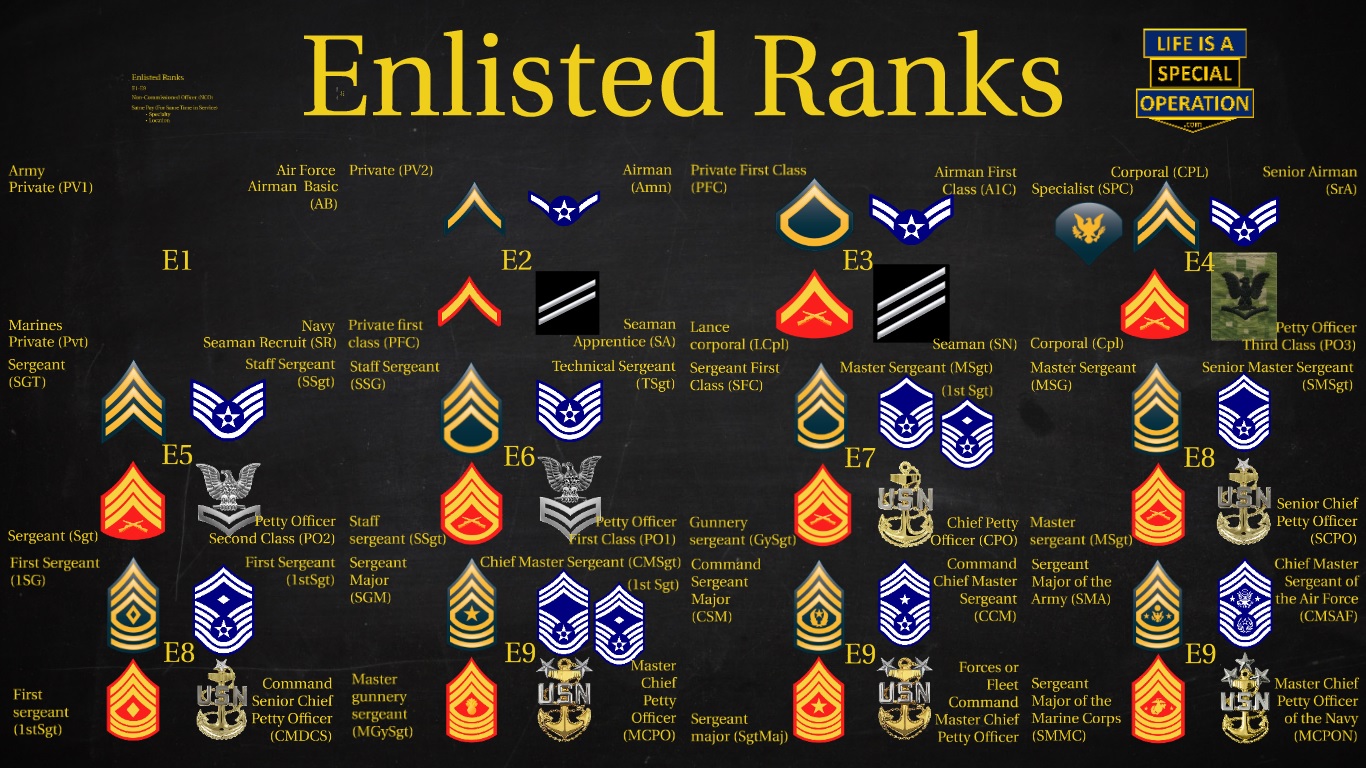
U.S. Military Enlisted Ranks in Order (E-1 to E-9): All Branches Rank Chart & Pay Grades
Understanding military ranks in order—including overall military ranks, enlisted ranks, and how they appear in a complete military ranks chart—is essential to understanding how the U.S. military actually works.
The enlisted men and women of the United States military are the backbone of the force. Without the enlisted, there is no Army, Navy, Air Force, Marine Corps, Space Force, or Coast Guard. Officers may command, plan, and resource the mission, but enlisted service members make the mission happen.
Within the broader military ranks hierarchy, enlisted ranks form the foundation of execution, discipline, and technical expertise across every branch of service.
You can fight a war without many things. You can even fight a war with very few officers. But you cannot fight, sail, fly, maintain, rescue, patrol, communicate, secure, shoot, repair, launch, recover, or survive without the enlisted force.
From E-1 to E-9, enlisted ranks span the full spectrum of military experience—from junior service members learning the basics to senior noncommissioned officers who lead formations, enforce standards, train the force, and carry decades of operational knowledge.
In any complete military ranks chart—from enlisted (E-1 to E-9), to warrant officers (W-1 to W-5), to commissioned officers (O-1 to O-10)—the enlisted force is the engine that turns plans into action.
This guide explains U.S. military enlisted ranks in order across all branches. It includes a complete military rank chart, breaks down enlisted pay grades, compares ranks across the services, and shows why enlisted leaders are the true drivers of military effectiveness.
Executive Summary
(A quick summary for busy humans and smart machines.)
- This article explains U.S. military enlisted ranks in order, from E-1 to E-9, across the Army, Marine Corps, Navy, Air Force, Space Force, and Coast Guard.
- Enlisted ranks are the foundation of the military. Junior enlisted members learn the profession, noncommissioned officers and petty officers lead daily execution, and senior enlisted leaders advise commanders, enforce standards, and protect the culture of the force.
- The key enlisted pay grades are E-1 through E-9. The exact rank titles differ by branch, but the basic progression is similar: learn, become useful, become trusted, lead people, lead systems, and advise commanders.
- This guide includes a military ranks chart, branch-by-branch enlisted rank explanations, pay-grade comparisons, promotion basics, enlisted-versus-officer differences, and frequently asked questions.
- I created a YouTube video on this subject, “U.S. Military (All Branches) ENLISTED Ranks Explained,” which has received more than 8 million views. That level of interest proves something important: people want clear, practical explanations of military ranks.
Table of Contents
- Executive Summary
- Watch: U.S. Military Enlisted Ranks Explained
- Context & Credibility
- Quick Definitions
- U.S. Military Ranks in Order: The Big Picture
- Military Ranks by Order: Complete Military Rank Chart
- Military Ranking Levels Explained
- How Enlisted Ranks Work in the Military
- The Difference Between Rank and Pay Grade
- Complete List of U.S. Military Enlisted Ranks in Order
- Army Enlisted Ranks
- Marine Corps Enlisted Ranks
- Navy Enlisted Ranks
- Air Force Enlisted Ranks
- Space Force Enlisted Ranks
- Coast Guard Enlisted Ranks
- Enlisted vs Officer Ranks
- Why Enlisted Leaders Matter So Much
- How Promotions Work in Enlisted Ranks
- Military Pay by Rank
- Explore Each Branch in Detail
- Frequently Asked Questions About U.S. Military Enlisted Ranks
- Key Takeaways
- About the Author
- Final Thoughts
Watch: U.S. Military Enlisted Ranks Explained
I created a YouTube video titled “Enlisted Ranks: Military Ranks By Order (All Branches E-1 to E-9)” that has been viewed more than 2.8 million times. That video confirmed something I already suspected: people are deeply interested in military ranks, but many explanations are either too shallow, too confusing, or too branch-specific. This article builds on that video and gives you a more complete, structured reference.Context & Credibility
I had the honor of serving as an officer in the U.S. Army Special Forces, where I worked alongside and depended on enlisted professionals from across the military. I served with Army NCOs, Marine Raiders, Navy sailors, Air Force special operators, Coast Guardsmen, and Space Force enlisted leaders in training, operational, joint, intelligence, and deployed environments. That experience shaped how I view the enlisted force. In Special Forces, I learned quickly that enlisted leaders are not simply “lower ranking people.” They are the technical experts, tactical leaders, trainers, problem-solvers, culture carriers, and truth-tellers who make the military function. A good officer listens to the enlisted. A great officer knows he would be helpless without them. That is why I have nothing but respect for the enlisted force—and why this article is written the way it is.Quick Definitions
Key Terms You Should Know
Before we go deeper, here are the key terms.
Enlisted Rank
An enlisted rank is a military title held by an enlisted service member, such as Private, Sergeant, Petty Officer, Chief Master Sergeant, or Master Chief Petty Officer.
Pay Grade
A pay grade is the standardized military compensation level. For enlisted members, pay grades run from E-1 through E-9. The U.S. military uses pay grades to standardize compensation across services.
NCO
NCO means Noncommissioned Officer. In the Army, Marine Corps, Air Force, and Space Force, NCOs are enlisted leaders who supervise, train, correct, and lead other enlisted members.
Petty Officer
In the Navy and Coast Guard, the enlisted leadership structure uses Petty Officer ranks instead of the Army-style NCO language. Petty Officers are enlisted leaders, usually E-4 through E-6.
Chief
In the Navy and Coast Guard, Chief Petty Officer is a major senior enlisted leadership threshold. In the Air Force and Space Force, Chief Master Sergeant is the highest regular enlisted rank.
U.S. Military Ranks in Order: The Big Picture
Before focusing only on enlisted ranks, it helps to see the full U.S. military rank structure.
The U.S. military has three broad rank categories:
- Enlisted ranks — E-1 to E-9
- Warrant officer ranks — W-1 to W-5
- Commissioned officer ranks — O-1 to O-10
This article focuses on enlisted ranks, but the full structure helps you understand where enlisted members fit in the larger military system.
Military Ranks by Order: Complete Military Rank Chart (All Branches, E-1 to O-10)
The chart below gives a simplified, side-by-side comparison of U.S. military ranks by pay grade across the Army, Marine Corps, Navy, Air Force, Space Force, and Coast Guard. It includes enlisted ranks, warrant officer ranks, and commissioned officer ranks in one long chart so you can scroll from E-1 through O-10.
| Pay Grade | Army | Marine Corps | Navy | Air Force | Space Force | Coast Guard |
| E-1 | Private | Private | Seaman Recruit | Airman Basic | Specialist 1 | Seaman Recruit |
| E-2 | Private Second Class | Private First Class | Seaman Apprentice | Airman | Specialist 2 | Seaman Apprentice |
| E-3 | Private First Class | Lance Corporal | Seaman | Airman First Class | Specialist 3 | Seaman |
| E-4 | Specialist / Corporal | Corporal | Petty Officer Third Class | Senior Airman | Specialist 4 | Petty Officer Third Class |
| E-5 | Sergeant | Sergeant | Petty Officer Second Class | Staff Sergeant | Sergeant | Petty Officer Second Class |
| E-6 | Staff Sergeant | Staff Sergeant | Petty Officer First Class | Technical Sergeant | Technical Sergeant | Petty Officer First Class |
| E-7 | Sergeant First Class | Gunnery Sergeant | Chief Petty Officer | Master Sergeant | Master Sergeant | Chief Petty Officer |
| E-8 | Master Sergeant / First Sergeant | Master Sergeant / First Sergeant | Senior Chief Petty Officer | Senior Master Sergeant / First Sergeant | Senior Master Sergeant | Senior Chief Petty Officer |
| E-9 | Sergeant Major / Command Sergeant Major | Master Gunnery Sergeant / Sergeant Major | Master Chief Petty Officer | Chief Master Sergeant / Command Chief Master Sergeant | Chief Master Sergeant | Master Chief Petty Officer |
| E-9 Special | Sergeant Major of the Army | Sergeant Major of the Marine Corps | Master Chief Petty Officer of the Navy | Chief Master Sergeant of the Air Force | Chief Master Sergeant of the Space Force | Master Chief Petty Officer of the Coast Guard |
| W-1 | Warrant Officer 1 | Warrant Officer | Warrant Officer 1 | Warrant Officer 1 | Not currently used | Not currently used |
| W-2 | Chief Warrant Officer 2 | Chief Warrant Officer 2 | Chief Warrant Officer 2 | Chief Warrant Officer 2 | Not currently used | Chief Warrant Officer 2 |
| W-3 | Chief Warrant Officer 3 | Chief Warrant Officer 3 | Chief Warrant Officer 3 | Chief Warrant Officer 3 | Not currently used | Chief Warrant Officer 3 |
| W-4 | Chief Warrant Officer 4 | Chief Warrant Officer 4 | Chief Warrant Officer 4 | Chief Warrant Officer 4 | Not currently used | Chief Warrant Officer 4 |
| W-5 | Chief Warrant Officer 5 | Chief Warrant Officer 5 | Chief Warrant Officer 5 | Chief Warrant Officer 5 | Not currently used | Not currently used |
| O-1 | Second Lieutenant | Second Lieutenant | Ensign | Second Lieutenant | Second Lieutenant | Ensign |
| O-2 | First Lieutenant | First Lieutenant | Lieutenant Junior Grade | First Lieutenant | First Lieutenant | Lieutenant Junior Grade |
| O-3 | Captain | Captain | Lieutenant | Captain | Captain | Lieutenant |
| O-4 | Major | Major | Lieutenant Commander | Major | Major | Lieutenant Commander |
| O-5 | Lieutenant Colonel | Lieutenant Colonel | Commander | Lieutenant Colonel | Lieutenant Colonel | Commander |
| O-6 | Colonel | Colonel | Captain | Colonel | Colonel | Captain |
| O-7 | Brigadier General | Brigadier General | Rear Admiral Lower Half | Brigadier General | Brigadier General | Rear Admiral Lower Half |
| O-8 | Major General | Major General | Rear Admiral Upper Half | Major General | Major General | Rear Admiral Upper Half |
| O-9 | Lieutenant General | Lieutenant General | Vice Admiral | Lieutenant General | Lieutenant General | Vice Admiral |
| O-10 | General | General | Admiral | General | General | Admiral |
Note: The Air Force has reintroduced warrant officers, but the program is still developing and specialty-specific. The Space Force does not currently use warrant officer ranks. The Coast Guard currently uses Chief Warrant Officer 2 through Chief Warrant Officer 4, but not Warrant Officer 1 or Chief Warrant Officer 5.
Military Ranking Levels Explained
Military enlisted ranks are best understood in levels.
Across the services, the names differ, but the leadership progression is remarkably similar.
Junior Enlisted: E-1 to E-3 or E-4
Junior enlisted members are learning the military profession. They are expected to absorb discipline, customs, technical skills, physical standards, military culture, and basic reliability.
In some branches, E-4 is still junior enlisted. In others, E-4 is already a formal leadership rank.
NCOs and Petty Officers: E-4 to E-6
This is where enlisted leadership begins.
Army Sergeants, Marine Corporals, Air Force Staff Sergeants, Space Force Sergeants, Navy Petty Officers, and Coast Guard Petty Officers all carry real responsibility. They train junior members, enforce standards, supervise work, and translate orders into action.
Senior Enlisted Leaders: E-7 to E-9
Senior enlisted leaders are the backbone of institutional military leadership.
They develop NCOs and petty officers, advise commanders, maintain standards, manage readiness, protect the culture, and tell the truth when the organization needs to hear it.

Modern Athlete Strength Systems (MASS)
Warfighter
My #1 Recommendation for Military & Functional Fitness
WARFIGHTER is created by Modern Athlete Strength Systems (MASS), a company owned and operated by fellow Green Berets and supported by a network of elite athletes and physical fitness professionals.
Use code LIFEISASPECOP at checkout for a FREE 7-day trial and 10% off.
How Enlisted Ranks Work in the Military
The enlisted journey usually follows a predictable pattern:
- Learn the service
- Become useful
- Become technically competent
- Become trusted
- Lead other people
- Lead systems and organizations
- Advise officers and commanders
- Protect standards and culture
That progression matters because the military does not run on titles. It runs on competence, trust, discipline, and execution.
A Private, Seaman Recruit, Airman Basic, Specialist 1, or Seaman Apprentice may be brand new. But every senior enlisted leader once started there.
The rank is not the point. The growth is the point.
The Difference Between Rank and Pay Grade
Many people use the terms rank and pay grade interchangeably, but they are not the same thing.
A pay grade is a standardized classification used across all branches of the U.S. military to determine compensation and general level of responsibility. Pay grades are labeled with a letter and number:
- E = Enlisted (E-1 through E-9)
- W = Warrant Officer (W-1 through W-5)
- O = Commissioned Officer (O-1 through O-10)
A rank, on the other hand, is the specific title used within each branch. Even when service members share the same pay grade, their rank titles can differ depending on the branch of service.
Example: Same Pay Grade, Different Rank Titles
| Pay Grade | Army | Marine Corps | Navy | Air Force | Space Force |
| E-3 | Private First Class | Lance Corporal | Seaman | Airman First Class | Specialist 3 |
| E-5 | Sergeant | Sergeant | Petty Officer Second Class | Staff Sergeant | Sergeant |
In both examples above, each service member is in the same pay grade, meaning they are paid according to the same general scale and operate at a similar level of responsibility. However, their rank titles are different because each branch has its own naming conventions and traditions.
In simple terms: pay grade determines your pay—rank is what you’re called.
Complete List of U.S. Military Enlisted Ranks in Order
Here is the full enlisted structure by pay grade.
E-1: Entry-Level Enlisted
E-1 is the starting point. Service members at this level are learning basic military life, discipline, customs, training requirements, and how to function inside a chain of command.
They are not expected to know everything. They are expected to listen, learn, work hard, and become reliable.
E-2: Developing Junior Enlisted
At E-2, expectations rise slightly. The service member should be less confused, more useful, and more familiar with daily military routines.
The key word at this level is reliability.
E-3: Experienced Junior Enlisted
At E-3, a service member should be a functioning member of the team. They are still junior, but they should understand the basics and begin building real professional credibility.
A strong E-3 is already preparing for future leadership.
E-4: Senior Junior Enlisted or First-Level Leader
E-4 is one of the most interesting pay grades in the military because it means different things in different branches.
In the Army, an E-4 may be a Specialist or a Corporal. In the Marine Corps, an E-4 Corporal is a true NCO. In the Navy and Coast Guard, E-4 is Petty Officer Third Class. In the Air Force, E-4 is Senior Airman. In the Space Force, E-4 is Specialist 4.
This is often the transition point from personal performance to early leadership.
E-5: Core Enlisted Leader
E-5 is one of the most important leadership levels in the military.
Army Sergeants, Marine Sergeants, Air Force Staff Sergeants, Space Force Sergeants, Navy Petty Officers Second Class, and Coast Guard Petty Officers Second Class lead people directly.
They are close enough to know the troops and senior enough to correct them.
A strong E-5 can change a team.
A weak E-5 can damage one.
E-6: Experienced Enlisted Leader
E-6 leaders are expected to supervise larger teams, mentor junior leaders, manage work, maintain readiness, and solve problems before they reach higher headquarters.
This is where enlisted leadership becomes more mature.
E-7: Senior Enlisted Threshold
E-7 is a major career milestone.
Army Sergeants First Class, Marine Gunnery Sergeants, Navy Chiefs, Air Force Master Sergeants, Space Force Master Sergeants, and Coast Guard Chiefs carry serious responsibility.
They are no longer just doing the work. They are shaping the people and systems that make the work possible.
E-8: Senior Organizational Leader
E-8 leaders operate at a broader organizational level.
They advise commanders, mentor E-7s and E-6s, manage readiness, correct cultural problems, and help senior leaders understand what is really happening inside the unit.
E-9: Highest Regular Enlisted Grade
E-9 is the highest regular enlisted pay grade.
These leaders operate at the strategic enlisted level. They advise senior commanders, represent the enlisted force, preserve standards, mentor senior leaders, and help shape the future of the service.
At the top of each branch is a special senior enlisted advisor position, such as Sergeant Major of the Army, Master Chief Petty Officer of the Navy, Chief Master Sergeant of the Air Force, and similar roles.
Army Enlisted Ranks
Army enlisted ranks run from Private to Sergeant Major.
The Army enlisted force is built around the Noncommissioned Officer (NCO) Corps. The Army places enormous emphasis on Sergeants, Staff Sergeants, Sergeants First Class, First Sergeants, and Command Sergeants Major.
The Army’s E-4 split is especially important:
- Specialist is typically a skilled junior enlisted soldier focused on technical proficiency.
- Corporal is a junior NCO with formal leadership authority.
This distinction reflects a broader truth: leadership in the Army begins early, and responsibility is tied to performance, not just time in service.
The Army runs on NCOs. A good Army NCO trains soldiers, enforces standards, builds discipline, and turns commander’s intent into action.
In my own Army and Special Forces career, I saw repeatedly that the NCO Corps is not a supporting cast—it is the engine of the Army.
👉 I’ve written a dedicated, in-depth article on Army enlisted ranks. If you want a complete breakdown, go here:
https://lifeisaspecialoperation.com/military-army-enlisted-ranks/
Marine Corps Enlisted Ranks
Marine Corps enlisted ranks run from Private to Sergeant Major or Master Gunnery Sergeant.
The Marine Corps places unusually strong cultural weight on enlisted leadership, especially at the Corporal and Sergeant level.
A Marine Corporal is not “just an E-4.” A Corporal is a Marine NCO. That matters.
Marine NCOs lead fire teams, squads, and sections. They enforce discipline aggressively, train Marines hard, and protect the warfighting culture of the Corps.
At E-8 and E-9, the Marine Corps has two senior enlisted paths:
- Master Sergeant / Master Gunnery Sergeant — technical and occupational leadership
- First Sergeant / Sergeant Major — command senior enlisted leadership
The Marine Corps understands something every branch should remember: culture is protected at the lowest level by enlisted leaders who refuse to accept weak standards.
👉 I’ve written a dedicated, in-depth article on Marine Corps enlisted ranks. If you want a complete breakdown, go here: (article written but not yet published)
Navy Enlisted Ranks
Navy enlisted ranks run from Seaman Recruit to Master Chief Petty Officer.
The Navy is built around technical skill, maritime tradition, rating expertise, and the Chief Petty Officer community.
In the Navy, enlisted members are identified not only by rank but also by rating. A sailor might be a Boatswain’s Mate, Hospital Corpsman, Intelligence Specialist, Gunner’s Mate, or Aviation Machinist’s Mate.
The Navy’s defining leadership threshold is Chief Petty Officer (E-7).
Becoming a Chief is more than making E-7—it means entering a distinct senior enlisted leadership culture. The Chief’s Mess is one of the defining institutions of the Navy.
A good Chief is a truth-teller, mentor, technical expert, and standard-bearer.
The Navy does not run without Chiefs.
👉 I’ve written a dedicated, in-depth article on Navy enlisted ranks. If you want a complete breakdown, go here: (article written but not yet published)
Air Force Enlisted Ranks
Air Force enlisted ranks run from Airman Basic to Chief Master Sergeant.
The Air Force enlisted system emphasizes technical excellence, disciplined execution, and professional development across highly specialized career fields.
Junior enlisted Airmen learn their Air Force Specialty Code and become competent technicians. NCOs lead teams and work centers. Senior NCOs manage systems, readiness, and people at scale.
The Air Force’s senior enlisted structure includes:
- Master Sergeant
- Senior Master Sergeant
- Chief Master Sergeant
- Chief Master Sergeant of the Air Force
Air Force enlisted members operate across aircraft maintenance, cyber, intelligence, communications, logistics, security forces, medical support, and special operations roles.
I worked with Air Force enlisted professionals throughout my career, including TACPs, PJs, CCTs, and maintainers. The good ones were not “support”—they were decisive capability.
👉 I’ve written a dedicated, in-depth article on Air Force enlisted ranks. If you want a complete breakdown, go here:
https://lifeisaspecialoperation.com/military-air-force-enlisted-ranks/
Space Force Enlisted Ranks
Space Force enlisted ranks are the newest in the U.S. military.
The Space Force uses service-specific enlisted rank names, including Specialist 1 through Specialist 4, Sergeant, Technical Sergeant, Master Sergeant, Senior Master Sergeant, and Chief Master Sergeant.
The Space Force is small, technical, and strategically important.
Its enlisted Guardians support missions involving space operations, cyber, intelligence, missile warning, satellite systems, communications, and command-and-control.
Because the Space Force is highly technical, enlisted credibility depends heavily on precision, judgment, and mission understanding.
A junior Guardian must become technically useful. A Sergeant must lead technical execution. A Chief must advise leaders in complex, sensitive, and often classified mission environments.
This is not science fiction. It is technical military work with national security consequences.
👉 I’ve written a dedicated, in-depth article on Space Force enlisted ranks. If you want a complete breakdown, go here: (article written but not yet published)
Coast Guard Enlisted Ranks
Coast Guard enlisted ranks run from Seaman Recruit to Master Chief Petty Officer.
The Coast Guard is unique because it is a military service, maritime law enforcement organization, homeland security force, rescue service, and national defense partner.
Coast Guard enlisted members stand watch, crew cutters, maintain boats and aircraft, conduct search and rescue, support maritime law enforcement, inspect vessels, respond to disasters, and protect ports and waterways.
Like the Navy, the Coast Guard uses Petty Officer and Chief Petty Officer ranks.
Because the Coast Guard is small and often operates in small crews, enlisted members may carry significant responsibility early.
A Coast Guard Petty Officer may be leading people, standing critical watches, supporting boardings, maintaining systems, or helping execute search-and-rescue missions when lives are on the line.
The Coast Guard runs on practical, calm, responsible enlisted professionals.
👉 I’ve written a dedicated, in-depth article on Coast Guard enlisted ranks. If you want a complete breakdown, go here: (article written but not yet published)
Enlisted vs Officer Ranks
The simplest explanation is this:
Enlisted members execute the mission, develop technical and tactical expertise, train the force, enforce standards, and lead daily work.
Officers command, plan, resource, manage, and make broader organizational decisions.
But that explanation is too simple if it makes enlisted members sound less important.
A brand-new officer may outrank a senior enlisted leader by rank structure, but that does not mean the officer understands the unit, mission, equipment, people, culture, or risks better than the enlisted leader.
Smart officers learn from enlisted leaders.
Great officers rely on them.
The best military teams are built on a healthy partnership between commissioned authority and enlisted experience.
Officers may have command authority.
But enlisted leaders often carry the truth.
Why Enlisted Leaders Matter So Much
Enlisted leaders matter because they are close to reality.
They know:
- Who is trained
- Who is pretending
- Who is exhausted
- Who needs correction
- Who is ready for more responsibility
- Which equipment is broken
- Which plan sounds good but will fail
- Which young service member needs mentorship
- Which leader is losing the trust of the team
A good enlisted leader can save a mission before it fails.
A good enlisted leader can save a young service member before they destroy their career.
A good enlisted leader can save an officer from making a foolish decision.
That is why I respect the enlisted force so deeply.
The military does not survive because everyone has a title.
It survives because enlisted professionals make hard things work under pressure.
How Promotions Work in Enlisted Ranks
Promotion systems vary by branch, but the general pattern is similar.
Early Enlisted Promotions
Early promotions are often more predictable. If a service member meets standards, avoids trouble, completes required training, and performs adequately, they may advance through early ranks on a more routine timeline.
NCO and Petty Officer Promotions
Promotion into enlisted leadership becomes more competitive.
At this level, performance, job competence, physical readiness, evaluations, leadership potential, testing, recommendations, and service needs may all matter.
Senior Enlisted Promotions
Promotion to E-7, E-8, and E-9 is selective.
Senior enlisted leaders are not simply people who stayed long enough. They are chosen because the service believes they can lead, advise, mentor, enforce standards, and represent the enlisted force at higher levels.
Showing up and waiting is not a career strategy.
The best enlisted members build reputation, competence, trust, and leadership long before the promotion board sees their record.
Military Pay by Rank
Understanding military ranks is only part of the picture. Pay also matters.
Military pay is based primarily on:
- Pay grade
- Years of service
- Allowances
- Special pays
- Duty location
- Family status
- Career field or assignment
A new E-1 does not make the same base pay as an experienced E-7. An E-5 with more years of service may earn more than an E-5 with fewer years of service.
If you are interested in military pay, start here:
Full Military Pay Guide
Enlisted Pay by Rank
| Rank | Link |
| E-1 Pay 2026 | https://lifeisaspecialoperation.com/e1-pay-2026/ |
| E-2 Pay 2026 | https://lifeisaspecialoperation.com/e2-pay-2026/ |
| E-3 Pay 2026 | https://lifeisaspecialoperation.com/e3-pay-2026/ |
| E-4 Pay 2026 | https://lifeisaspecialoperation.com/e4-pay-2026/ |
| E-5 Pay 2026 | https://lifeisaspecialoperation.com/e5-pay-2026/ |
| E-6 Pay 2026 | https://lifeisaspecialoperation.com/e6-pay-2026/ |
| E-7 Pay 2026 | https://lifeisaspecialoperation.com/e7-pay-2026/ |
| E-8 Pay 2026 | https://lifeisaspecialoperation.com/e8-pay-2026/ |
| E-9 Pay 2026 | https://lifeisaspecialoperation.com/e9-pay-2026/ |
These pay articles help explain what military compensation actually looks like as enlisted members promote through the ranks.
Explore Each Branch in Detail
This article gives you the master overview. For deeper branch-specific explanations, read the individual guides:
- Army Enlisted Ranks
- Marine Corps Enlisted Ranks
- Navy Enlisted Ranks
- Air Force Enlisted Ranks
- Space Force Enlisted Ranks
- Coast Guard Enlisted Ranks
Each branch has its own culture, traditions, rank titles, promotion systems, and leadership expectations.
Frequently Asked Questions About U.S. Military Enlisted Ranks
What are military ranks in order?
Military ranks are organized by pay grade and authority. Enlisted ranks run from E-1 to E-9, warrant officer ranks run from W-1 to W-5, and commissioned officer ranks run from O-1 to O-10. This article focuses primarily on enlisted ranks.
What are U.S. military enlisted ranks from lowest to highest?
U.S. military enlisted ranks run from E-1 at the lowest level to E-9 at the highest regular enlisted level. The exact rank titles differ by branch, but the structure is similar across the military. Junior enlisted members learn the profession, NCOs and Petty Officers lead daily work, and senior enlisted leaders advise commanders.
What is the enlisted rank structure in the military?
The enlisted rank structure generally includes junior enlisted ranks, NCO or Petty Officer ranks, and senior enlisted ranks. Junior enlisted members focus on learning and reliability. NCOs, Petty Officers, and senior enlisted leaders focus on leadership, standards, readiness, and mission execution.
What is E-4 in the military?
E-4 is a transitional enlisted pay grade. In the Army, E-4 may be Specialist or Corporal. In the Marine Corps, E-4 is Corporal and is a true NCO rank. In the Navy and Coast Guard, E-4 is Petty Officer Third Class. In the Air Force, E-4 is Senior Airman, and in the Space Force, E-4 is Specialist 4.
What are the different military ranking levels?
The main military ranking levels are enlisted, warrant officer, and commissioned officer. Within the enlisted force, the practical levels are junior enlisted, NCO or Petty Officer, and senior enlisted. Each level brings more responsibility, authority, and leadership expectation.
What is the difference between enlisted and officer ranks?
Enlisted members execute the mission, develop technical expertise, train the force, and lead daily work. Officers hold command authority, plan operations, manage resources, and make broader organizational decisions. The military works best when officers respect enlisted experience and enlisted leaders provide honest, professional advice.
Do enlisted members lead in the military?
Yes. Enlisted members lead constantly. NCOs, Petty Officers, Chiefs, Sergeants Major, Master Chiefs, and Chief Master Sergeants train people, enforce standards, manage readiness, correct problems, and advise officers. In many units, enlisted leadership is where most daily military discipline is actually built.
What is the highest enlisted rank in the military?
The highest regular enlisted pay grade is E-9. Each branch also has a top senior enlisted advisor, such as Sergeant Major of the Army, Sergeant Major of the Marine Corps, Master Chief Petty Officer of the Navy, Chief Master Sergeant of the Air Force, Chief Master Sergeant of the Space Force, and Master Chief Petty Officer of the Coast Guard.
How do enlisted promotions work?
Enlisted promotions depend on branch, career field, performance, time in service, time in grade, evaluations, testing, boards, qualifications, and service needs. Early promotions are often more predictable. Later promotions become more competitive and selective.
What is a military ranks chart?
A military ranks chart compares ranks across branches by pay grade. This is useful because different services use different rank titles for the same pay grade. For example, an Army Sergeant, Marine Sergeant, Air Force Staff Sergeant, Space Force Sergeant, Navy Petty Officer Second Class, and Coast Guard Petty Officer Second Class may all be E-5.
Is there a video that explains U.S. military enlisted ranks?
Yes. I created a YouTube video titled “U.S. Military (All Branches) ENLISTED Ranks Explained” that has more than 2.8 million views. The video provides a clear overview of enlisted ranks across all branches, while this article gives a more detailed reference.
Can enlisted members become officers?
Yes. Enlisted members can become officers through programs such as Officer Candidate School, service academies, ROTC pathways, direct commissioning programs, and branch-specific enlisted-to-officer programs. Prior enlisted officers often bring valuable credibility because they understand military life from the enlisted side.
Why are enlisted ranks important?
Enlisted ranks are important because they show responsibility, authority, experience, and leadership progression. They help military members understand who is learning, who is qualified, who leads, who supervises, and who advises commanders. Rank clarity matters because confusion in military organizations can create real problems.
Key Takeaways
- S. military enlisted ranks run from E-1 to E-9.
- The enlisted force is the backbone of every branch.
- Junior enlisted members learn the profession and build reliability.
- NCOs and Petty Officers lead daily mission execution.
- Senior enlisted leaders advise officers, enforce standards, and protect the culture.
- Rank and pay grade are related, but they are not always the same thing.
- Different branches use different titles, traditions, and leadership structures.
- Without enlisted service members, there is no functioning military.
About the Author
Christopher Littlestone is a retired U.S. Army Special Forces (Green Beret) Lieutenant Colonel, Airborne Ranger, and Combat Diver who had the honor of serving and working alongside officers, warrant officers, and enlisted professionals across the Army, Navy, Marine Corps, Air Force, Space Force, and Coast Guard.
He is the founder of Life Is a Special Operation, a platform dedicated to teaching leadership, planning, mindset, security, and performance based on real-world military experience. His YouTube channel has grown to more than 380,000 subscribers and over 47 million views.
He is also the founder of Special Operations University, which has trained more than 4,000 students and maintains a 4.9 Trustpilot rating.
Final Thoughts
The enlisted force is not secondary to the military.
The enlisted force is the military.
They stand watch, maintain aircraft, crew ships, patrol borders, guard bases, repair weapons, launch missions, secure networks, rescue strangers, train young troops, correct bad habits, mentor future leaders, and make commanders’ plans real.
Officers matter. Plans matter. Strategy matters.
But when the ramp drops, the ship sails, the aircraft launches, the convoy moves, the radio cracks, the system fails, the weather turns, or the enemy gets a vote—the mission depends on enlisted professionals who know what they are doing.
If you are interested in preparing for military service, I encourage you to train your body, sharpen your mindset, and learn how real leaders think and plan.
Here are resources to help you succeed:
- Military Leadership Course – Become the leader everyone respects.
- Military Planning Course – Learn how to plan like your life depends on it.
- Train Up – Arrive prepared for military or Special Operations training.
- Special Operations Mindset – Develop a champion’s mindset.
- Fitness Programs – Build the body and discipline to dominate your day.
Life is a Special Operation.
Are you ready for it?

Watch our YouTube videos on this exact topic.
These three videos have earned more than 5.2 million combined views to date.
Learn the Tools and Strategies of the Military & Elite Special Operations Community
Our Most Popular Courses / Services

Training Preparation
Arrive Prepared for Military & Special Operations Training

Special Operations Mindset
Develop the Champion Mindset of the Best Trained and Most Elite Forces in the World

Fitness
Get into Amazing Shape

Elite Performance Skills
Win - Lead - Succeed