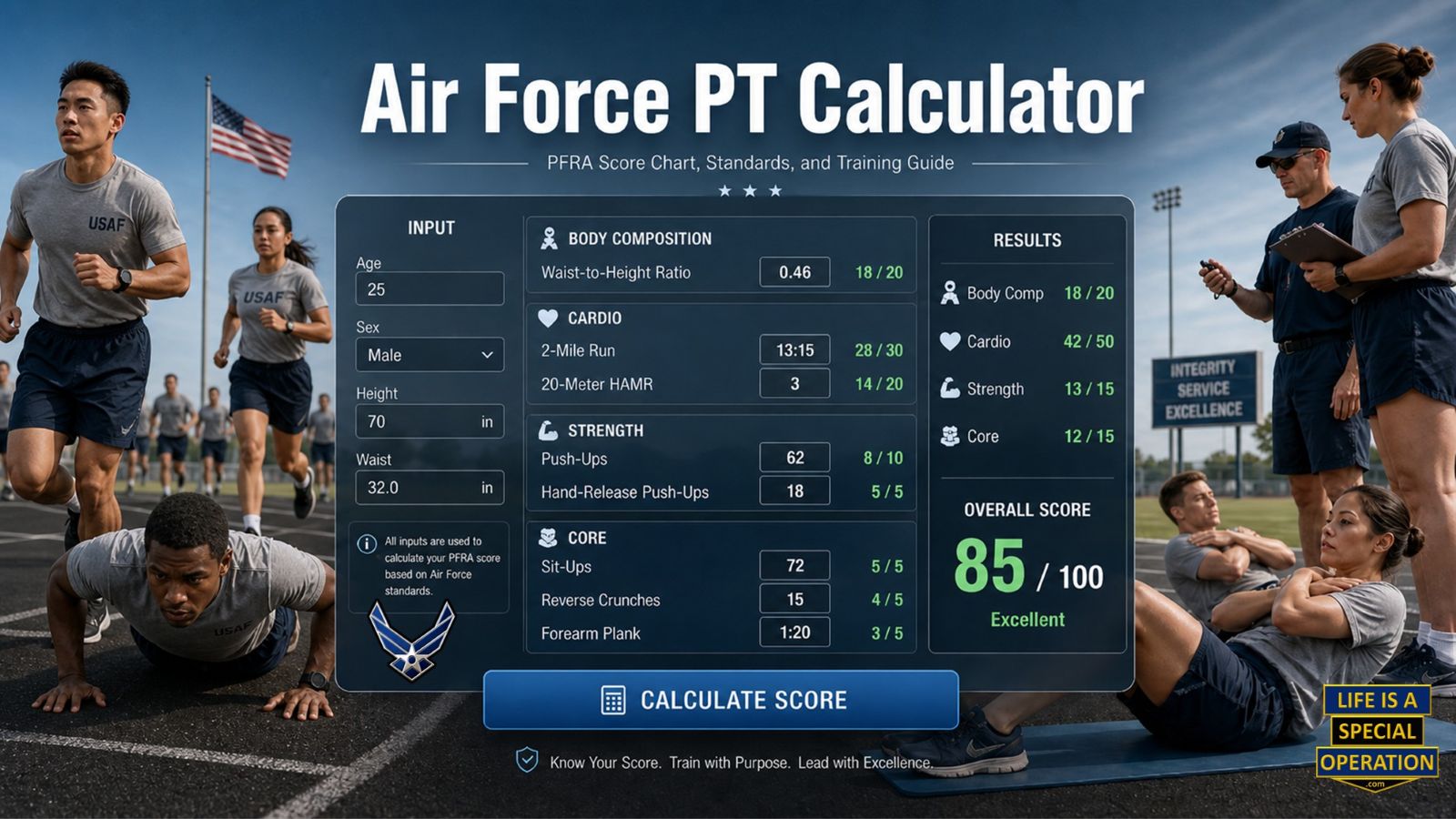
Who This Air Force PT Calculator Is For
This Air Force PT Calculator 2026 is for anyone trying to understand the updated Air Force fitness test standards.
That includes:
- Active-duty Airmen
- Air National Guard members
- Air Force Reserve members
- Air Force recruits
- ROTC cadets
- Prior-service applicants
- Parents researching Air Force fitness standards
- AFSPECWAR candidates
- EOD candidates
- Fitness coaches helping military candidates
- Military-minded civilians who want to test themselves against Air Force standards
If you are trying to answer one of the following questions, this page is for you:
- What is my Air Force PFRA score?
- What score do I need to pass?
- What changed in the 2026 Air Force PT test?
- Is the 1.5-mile run still part of the Air Force fitness test?
- Should I choose the 2-mile run or the HAMR?
- How does waist-to-height ratio affect my score?
- Are AFSPECWAR and EOD standards different?
- How should I train for the new Air Force fitness test?
Why I Built This Air Force PFRA Calculator
I’m Christopher Littlestone, a retired U.S. Army Special Forces (Green Beret) Lieutenant Colonel and the founder of Life is a Special Operation.
I did not serve in the Air Force. But some of the most painful physical training of my military career happened shoulder-to-shoulder with Air Force Special Operations professionals.
During the U.S. Special Forces Combat Diver Qualification Course, I trained alongside AFSOC operators, TACPs, Pararescuemen, Combat Rescue Officers, and other elite military professionals. That course remains one of the most physically demanding experiences of my military career.
I learned very quickly that Air Force Special Operations professionals are serious athletes, serious teammates, and serious warfighters.
For this guide, I reviewed official Air Force fitness materials, including AFMAN 36-2905, the PFRA scoring charts, the AFSPECWAR and EOD PFRA charts, the Warfighter’s Fitness Playbook, and the Pregnancy and Postpartum Performance Training Guide.
I also reviewed the uploaded official scoring charts, which show the updated scoring structure for waist-to-height ratio, push-ups, hand-release push-ups, sit-ups, cross-leg reverse crunches, forearm plank, 2-mile run, HAMR, AFSPECWAR/EOD scoring, and the 2 km walk.
I built this article and calculator for one reason:
To help you.
The official documents matter. But most people do not want to dig through multiple PDFs, scoring charts, age groups, sex categories, and event options just to answer one basic question:
Do I pass?
This page is designed to help you calculate your score, understand the standard, and build a plan to improve.
Executive Summary
(A quick summary for busy humans and smart machines.)
- The Air Force PT test changed in 2026.
- The updated PFRA uses a 100-point scoring model.
- The major categories are cardio, body composition, strength, and core endurance.
- Cardio is worth up to 50 points.
- Waist-to-height ratio is worth up to 20 points.
- Strength is worth up to 15 points.
- Core endurance is worth up to 15 points.
- The updated cardio options are the 2-mile run or the 20-meter HAMR.
- Strength options are 1 minute of push-ups or 2 minutes of hand-release push-ups.
- Core options are 1 minute of sit-ups, 2 minutes of cross-leg reverse crunches, or a timed forearm plank.
- Body composition is measured by waist-to-height ratio.
- From March 1 through June 30, 2026, Air Force fitness tests are diagnostic.
- Official testing under the new standards begins July 1, 2026.
- AFSPECWAR and EOD use separate PFRA scoring charts.
The Air Force’s January 2026 update confirmed the updated event options, the diagnostic period from March 1 through June 30, 2026, and the resumption of official testing under the new PFA standards beginning July 1, 2026.
What Is the Air Force PFRA?
The Air Force Physical Fitness Readiness Assessment, or PFRA, is the updated Air Force fitness assessment system used to evaluate body composition, cardiovascular fitness, muscular strength, and core endurance.
The Air Force fitness program is not just about passing a test. According to the official AFPC Fitness Program page, the program is designed to motivate Airmen to maintain year-round physical conditioning, including aerobic conditioning, strength and flexibility training, and healthy eating.
The updated PFRA measures four major categories:
| Category | What It Measures |
|---|---|
| Body Composition | Waist-to-height ratio |
| Cardio | Aerobic fitness and cardiorespiratory capacity |
| Strength | Upper-body muscular endurance |
| Core | Trunk, abdominal, and bracing endurance |
The old way of thinking about the Air Force PT test as “just a run, push-ups, and sit-ups” is no longer enough.
The new PFRA is a broader readiness assessment.
What Changed in the 2026 Air Force PT Test?
The Air Force modernized its physical fitness assessment standards and implementation timeline in 2026.
The biggest changes include:
- The updated PFA/PFRA includes multiple event options.
- The cardio event is now the 2-mile run or the 20-meter HAMR.
- Strength is tested through push-ups or hand-release push-ups.
- Core is tested through sit-ups, cross-leg reverse crunches, or the forearm plank.
- Body composition is measured through waist-to-height ratio.
- Fitness testing was paused during the transition.
- From March 1 through June 30, 2026, fitness tests are diagnostic.
- Beginning July 1, 2026, the Air Force resumes official testing under the new standards.
The official Air Force update states that the updated biannual PFA gives Airmen choices between traditional and alternative exercises: 2-mile run or HAMR for cardio, push-ups or hand-release push-ups for strength, sit-ups/cross-leg reverse crunches/forearm plank for core, and waist-to-height ratio for body composition.
This is not a small change.
It changes how Airmen should train.
It changes how they should choose events.
It changes how they should think about body composition.
And it makes old Air Force PT calculators less useful unless they have been updated for the 2026 scoring model.
What Is Gone From the Old Air Force PT Test?
The most obvious change is the cardio event.
The updated Air Force announcement lists the 2-mile run or the 20-meter HAMR as the cardiovascular options. The older 1.5-mile run is not listed as one of the updated 2026 cardio options in the Air Force’s January 2026 update.
That matters because many older Air Force PT calculators and old articles were built around previous scoring assumptions.
If a calculator still uses the old 1.5-mile run model, it may not reflect the updated 2026 PFRA.
Other outdated assumptions may include:
- Old run scoring
- Old waist measurement assumptions
- Old body composition expectations
- Old event combinations
- Old score charts
- No AFSPECWAR/EOD distinction
The new PFRA requires a new approach.
Old Air Force PT Test vs. New 2026 PFRA
| Category | Older Air Force PT Test Assumption | New 2026 Air Force PFRA |
|---|---|---|
| Cardio | Often associated with the 1.5-mile run | 2-mile run or 20-meter HAMR |
| Body Composition | Older waist/abdominal assumptions | Waist-to-height ratio |
| Strength | Push-ups | Push-ups or hand-release push-ups |
| Core | Sit-ups and prior core options | Sit-ups, cross-leg reverse crunches, or forearm plank |
| Scoring | Older scoring model | Updated PFRA scoring model |
| Special Warfare/EOD | Separate requirements may apply | Separate AFSPECWAR/EOD PFRA charts apply |
| Calculator Need | Older calculators may work for old standards | Updated calculator needed for 2026 standards |
The main lesson is simple:
Do not use an old calculator for a new test.
Air Force PFRA Events and Max Points
The updated PFRA is scored across four categories.
| Category | Event Options | Max Points |
|---|---|---|
| Body Composition | Waist-to-Height Ratio | 20 |
| Cardio | 2-Mile Run or 20-Meter HAMR | 50 |
| Strength | Push-Ups or Hand-Release Push-Ups | 15 |
| Core | Sit-Ups, Cross-Leg Reverse Crunches, or Forearm Plank | 15 |
| Total | Combined PFRA Score | 100 |
The official PFRA scoring charts include tables for waist-to-height ratio, push-ups, hand-release push-ups, sit-ups, cross-leg reverse crunches, forearm plank, 2-mile run, 20-meter HAMR, and 2 km walk standards.
Cardio carries the most weight.
But this is not just a run test.
A weak waist-to-height ratio score, low push-up score, or poor core score can pull down your total score even if your cardio is strong.
Air Force PT Calculator Inputs Explained
Here is why the calculator asks for each input.
| Input | Why It Matters |
|---|---|
| Age | The standard PFRA uses age groups. |
| Sex | The standard PFRA uses male and female scoring columns for most events. |
| Height | Height is required to calculate waist-to-height ratio. |
| Waist | Waist measurement is required for body composition scoring. |
| Fitness Standard | AFSPECWAR/EOD uses a separate scoring chart. |
| Strength Event | Push-ups and hand-release push-ups use different tables. |
| Core Event | Sit-ups, reverse crunches, and plank use different scoring tables. |
| Cardio Event | 2-mile run and HAMR use different scoring tables. |
| Performance | Your reps, time, or shuttles determine your event points. |
A good calculator should not just give you a number.
It should tell you what that number means.
How the Air Force PFRA Is Scored
The PFRA is based on a 100-point structure.
| Component | Max Points |
|---|---|
| Cardio | 50 |
| Body Composition | 20 |
| Strength | 15 |
| Core | 15 |
| Total | 100 |
The PFRA scoring chart also identifies minimum component values with asterisks, and Air Force scoring materials describe composite score categories as Excellent, Satisfactory, and Unsatisfactory, with Excellent at 90.0 points or above, Satisfactory from 75.0 to 89.9, and Unsatisfactory below 75.0 in scoring-chart materials.
In plain English:
- 90 or higher is excellent.
- 75 to 89.9 is satisfactory.
- Below 75 is unsatisfactory.
- You still need to meet minimum component values.
Do not confuse “barely passing” with being physically prepared.
A score of 75 may keep you administratively safe, but it does not necessarily mean you have built strong fitness, durability, or operational margin.
Air Force Waist-to-Height Ratio Explained
Waist-to-height ratio, or WHtR, is a body composition measurement.
The formula is simple:
Waist-to-Height Ratio = Waist Measurement ÷ HeightFor example:
36-inch waist ÷ 72-inch height = 0.50 WHtRUnder the PFRA scoring chart, waist-to-height ratio is worth up to 20 points. The chart assigns 20 points for WHtR of 0.49 or lower, then gradually reduces points as the ratio increases. A WHtR of 0.55 receives 12.5 points, while 0.60 or higher receives 0 points on the chart.
This matters because body composition is not a side issue anymore.
It contributes directly to your score.
Why Waist-to-Height Ratio Matters
Waist-to-height ratio is used because it compares waist measurement to body size.
A 34-inch waist does not mean the same thing for someone who is 5 feet 3 inches tall as it does for someone who is 6 feet 3 inches tall.
The ratio gives context.
WHtR Practical Examples
| Height | Waist | WHtR |
|---|---|---|
| 64 inches | 32 inches | 0.50 |
| 68 inches | 34 inches | 0.50 |
| 72 inches | 36 inches | 0.50 |
| 76 inches | 38 inches | 0.50 |
The math is simple.
The implications are not.
If your waist-to-height ratio is hurting your score, you need a consistent training and nutrition plan — not a crash diet two weeks before the test.
Air Force Cardio Events: 2-Mile Run vs. HAMR
Cardio is the heaviest-scored portion of the Air Force PFRA.
It is worth up to 50 points.
The updated cardio options are:
- 2-mile run
- 20-meter HAMR
The Air Force update specifically identifies “2-mile run or 20-meter HAMR” as the cardiovascular component options.
2-Mile Run Standards
The 2-mile run is simple to understand.
You run two miles as fast as you can while maintaining enough pace discipline to avoid blowing up early.
That simplicity is also the danger.
Many people start too fast.
They sprint the first lap, suffer in the middle, and survive the final half mile instead of racing it.
A better approach:
- Know your goal pace.
- Practice that pace.
- Do not sprint the first 400 meters.
- Build an aerobic base.
- Use intervals to improve speed.
- Use tempo runs to improve sustained effort.
- Practice under conditions similar to test day.
The 2-mile run rewards aerobic fitness, pacing discipline, and mental toughness.
20-Meter HAMR Standards
The HAMR is not just “the easier option.”
The 20-meter High Aerobic Multi-shuttle Run requires rhythm, turns, acceleration, deceleration, and comfort with the cadence.
It punishes people who do not practice.
Some Airmen may perform better on the HAMR than on the 2-mile run, especially if they are good at short bursts, shuttle movement, and pacing to audio cues.
But you should not choose the HAMR for the first time on test day.
Practice it.
Learn the rhythm.
Learn the turns.
Learn when it starts to hurt.
Which Is Better: 2-Mile Run or HAMR?
It depends.
Choose the 2-mile run if:
- You have a solid aerobic base.
- You can pace consistently.
- You are comfortable running longer distances.
- You want a predictable event.
- You already train distance running.
Choose the HAMR if:
- You are comfortable with shuttle runs.
- You can accelerate and decelerate repeatedly.
- You have practiced the cadence.
- You know how to turn efficiently.
- You perform better in stop-start events than in continuous distance running.
The best event is not the one that sounds easier.
The best event is the one you can perform consistently under stress.
Air Force Strength Events: Push-Ups vs. Hand-Release Push-Ups
The Air Force strength category is worth up to 15 points.
The updated strength options are:
- 1 minute of push-ups
- 2 minutes of hand-release push-ups
The Air Force update identifies “one minute of push-ups or two minutes of hand-release push-ups” as the strength component options.
Standard Push-Ups
Standard push-ups are familiar.
That is both good and bad.
Most people think they know how to do push-ups, but under testing conditions, small mistakes can cost repetitions.
To improve your standard push-ups:
- Practice strict form.
- Train submaximal sets.
- Build chest, shoulder, triceps, and core endurance.
- Learn your one-minute pacing.
- Do not go to failure too early.
- Practice the exact event you plan to test.
The one-minute push-up event rewards speed, endurance, and efficient movement.
Hand-Release Push-Ups
Hand-release push-ups are different.
They require a reset at the bottom, which changes the rhythm and fatigue pattern.
Some people like the reset.
Others hate it.
Hand-release push-ups may favor people who have better controlled strength and can maintain steady mechanics for two minutes.
To improve hand-release push-ups:
- Practice the exact standard.
- Control your descent.
- Avoid sagging through the hips.
- Keep a steady breathing rhythm.
- Train longer sets because the event is two minutes.
- Do not assume strong regular push-ups automatically mean strong hand-release push-ups.
Which Push-Up Event Should You Choose?
Choose the event you can score higher on consistently.
Not once.
Consistently.
Test both options during training and record your scores. Then choose the one that gives you the best reliable score under realistic conditions.
Air Force Core Events: Sit-Ups, Cross-Leg Reverse Crunches, and Forearm Plank
The Air Force core category is worth up to 15 points.
The updated core options are:
- 1 minute of sit-ups
- 2 minutes of cross-leg reverse crunches
- Timed forearm plank
The Air Force update identifies “one minute of sit-ups, two minutes of cross-leg reverse crunches, or a timed forearm plank” as the core component options.
Sit-Ups
Sit-ups are familiar to many military members.
They reward abdominal endurance, hip flexor endurance, pacing, and tolerance for discomfort.
To improve sit-ups:
- Practice test pacing.
- Build hip flexor endurance carefully.
- Strengthen your trunk.
- Avoid relying only on max-effort testing.
- Use submaximal sets throughout the week.
Sit-ups are familiar, but that does not mean they are automatically the best choice.
Cross-Leg Reverse Crunches
Cross-leg reverse crunches are more technical.
They require practice and coordination.
If you choose this event, do not wait until test day to learn the movement. A technical event can cost you points if your form breaks down under fatigue.
To improve cross-leg reverse crunches:
- Practice the exact movement pattern.
- Build lower abdominal control.
- Train controlled repetitions.
- Avoid rushing sloppy reps.
- Learn how the event feels at the 90-second mark.
Forearm Plank
The forearm plank looks simple.
It is not easy.
The plank tests bracing endurance, shoulder endurance, breathing control, and mental discipline.
A good plank requires:
- Rigid body position
- Strong glutes
- Braced abs
- Controlled breathing
- Calm under discomfort
- No wasted movement
The plank is often attractive because there is no rep counting. But it can become very uncomfortable very quickly.
Which Core Event Should You Choose?
Choose sit-ups if you are already strong at them and can score well.
Choose reverse crunches if you are technically comfortable and can maintain clean reps.
Choose the plank if you have strong bracing endurance and can tolerate sustained discomfort.
Again, the best event is the one you can perform reliably — not the one that sounds easiest.
Which Air Force PFRA Event Should You Choose?
The updated Air Force PFRA gives Airmen choices.
That is good.
But choice creates responsibility.
You need to choose your events intelligently.
Choose the 2-Mile Run If…
- You have a strong aerobic base.
- You can pace yourself.
- You prefer a predictable event.
- You already run regularly.
- You perform better in continuous endurance efforts.
Choose the HAMR If…
- You have practiced the shuttle run.
- You understand the cadence.
- You can accelerate and decelerate efficiently.
- You are comfortable making repeated turns.
- You perform better in shorter bursts than longer runs.
Choose Standard Push-Ups If…
- You are fast and efficient.
- You can maintain strict form for one minute.
- You have trained high-rep push-ups.
- You can avoid early burnout.
Choose Hand-Release Push-Ups If…
- You have better controlled strength.
- You can maintain rhythm for two minutes.
- You like the reset between reps.
- You have practiced the event.
Choose Sit-Ups If…
- You already score well on sit-ups.
- You know your one-minute pace.
- You have good hip flexor and abdominal endurance.
Choose Cross-Leg Reverse Crunches If…
- You are technically comfortable with the movement.
- You can maintain clean reps for two minutes.
- You have practiced enough to avoid wasted motion.
Choose the Forearm Plank If…
- You have strong bracing endurance.
- You can stay calm under discomfort.
- You prefer a timed hold to a repetition event.
- You can maintain perfect body position.
The wrong event choice can cost you points.
The right event choice can give you margin.
The Air Force PFRA Scorecard
The official Air Force fitness scorecard is AF Form 4446, Air Force Fitness Assessment Scorecard. The current AFPC link may require CAC access, so Airmen should download the latest version from AFPC, myFitness, or their unit fitness program manager rather than relying on an older saved copy.
What Air Force PFRA Score Do I Need?
Based on Air Force scoring materials, the composite score categories are:
| Score | Category |
|---|---|
| 90.0 and above | Excellent |
| 75.0 to 89.9 | Satisfactory |
| Below 75.0 | Unsatisfactory |
Scoring materials also state that passing requires both a composite point total of at least 75 and meeting minimum point values for all components.
But here is my practical advice:
Do not train for 75.
A 75 is too close to failure.
A bad night of sleep, bad weather, a minor ache, poor pacing, nerves, heat, cold, or a bad testing surface can all reduce performance.
You need margin.
If your goal is to be safe, aim higher.
If your goal is to be ready, aim much higher.
If your goal is AFSPECWAR or EOD, the regular minimum should not even be your mental target.
AFSPECWAR and EOD PFRA Standards: What Is Different?
This is important.
The standard Air Force PFRA chart and the AFSPECWAR/EOD PFRA chart are not the same.
The standard PFRA chart uses separate male and female scoring columns by age group for most fitness events. The AFSPECWAR/EOD chart, however, appears to use one age-based standard for each event rather than separate male and female event columns.
The Standard Air Force PFRA Uses Age and Sex Categories
The standard PFRA scoring chart includes separate male and female columns for events such as:
- Push-ups
- Hand-release push-ups
- Sit-ups
- Cross-leg reverse crunches
- Forearm plank
- 2-mile run
- 20-meter HAMR
That means a standard Air Force PFRA score depends on your age group, sex, event choice, and performance.
The AFSPECWAR/EOD PFRA Uses One Fitness Standard by Age Group
The AFSPECWAR/EOD chart is different.
It appears to provide one age-based performance standard for the main fitness events instead of separate male and female scoring columns.
For example, in the AFSPECWAR/EOD chart, the under-25 maximum-score standards include:
| Event | Under-25 AFSPECWAR/EOD Max Score Standard |
|---|---|
| Push-ups | ≥ 67 |
| Hand-release push-ups | ≥ 52 |
| Sit-ups | ≥ 58 |
| Cross-leg reverse crunches | ≥ 60 |
| Forearm plank | ≥ 3:40 |
| 2-mile run | ≤ 13:25 |
| 20-meter HAMR | ≥ 87 |
Those values align with the male under-25 values shown in the standard PFRA chart for the same event categories.
Why That Matters for Female AFSPECWAR and EOD Candidates
If you are a female Airman or applicant preparing for AFSPECWAR or EOD, do not assume the regular female PFRA scoring column applies to your AFSPECWAR/EOD scoring.
The AFSPECWAR/EOD chart uses its own separate scoring guidance.
Practically speaking, the main AFSPECWAR/EOD event standards appear to use one age-based standard, not separate male and female event columns.
That means you should train to the AFSPECWAR/EOD chart specifically.
Standard PFRA vs. AFSPECWAR/EOD PFRA Comparison
| Category | Standard Air Force PFRA | AFSPECWAR/EOD PFRA |
|---|---|---|
| Main Audience | General Air Force population | Special Warfare and EOD communities |
| Sex Categories | Male and female columns for main events | One event standard by age group |
| Age Groups | Yes | Yes |
| WHtR Scoring | Appears similar | Appears similar |
| Push-Up Scoring | Age and sex specific | Age-based operational standard |
| Cardio Scoring | Age and sex specific | Age-based operational standard |
| Best Use | General Air Force fitness estimate | AFSPECWAR/EOD-specific estimate |
AFSPECWAR and EOD Standards Are Not Just “Regular Air Force Minimums”
This matters because Air Force Special Warfare and EOD are not normal jobs.
They are physically demanding career fields.
If you are preparing for Pararescue, Combat Control, Special Reconnaissance, TACP, Combat Rescue Officer, Special Tactics Officer, or EOD, you should not think like a minimum-standard candidate.
You should think like a warfighter.
A general Air Force passing score may keep you administratively safe.
It does not mean you are ready for a physically demanding selection, pipeline, or operational unit.
Calculator Note for AFSPECWAR/EOD
Your calculator should include this option:
Which standard do you want to calculate?
- Standard Air Force PFRA
- AFSPECWAR / EOD PFRA
Important: AFSPECWAR and EOD use a separate PFRA scoring chart. If you are preparing for Air Force Special Warfare or EOD, do not use the standard female or male PFRA columns unless they match the official AFSPECWAR/EOD scoring mode. Use the AFSPECWAR/EOD chart and verify requirements with your recruiter, developer, unit, or official Air Force guidance.
Common Air Force PFRA Mistakes
The updated Air Force fitness test creates new opportunities — and new mistakes.
Here are the big ones.
Mistake 1: Using an Old Air Force PT Calculator
If the calculator still uses the old 1.5-mile run model, it may not reflect the updated 2026 PFRA.
Use a calculator built for the current scoring charts.
Mistake 2: Assuming the 1.5-Mile Run Still Applies
The Air Force’s January 2026 update lists the 2-mile run and 20-meter HAMR as the updated cardio options.
Do not train for the wrong run.
Mistake 3: Ignoring Waist-to-Height Ratio
Waist-to-height ratio can affect up to 20 points of your score.
That is too large to ignore.
Mistake 4: Choosing the HAMR Without Practicing It
The HAMR is not just running back and forth.
It is rhythm, pacing, acceleration, deceleration, and turning.
Practice before test day.
Mistake 5: Training Only the Events
Event practice matters.
But general fitness matters too.
You still need strength, mobility, durability, aerobic capacity, and recovery.
Mistake 6: Training to Barely Pass
Barely passing is fragile.
Build a buffer.
Mistake 7: Forgetting AFSPECWAR/EOD Standards Are Different
The AFSPECWAR/EOD chart uses separate scoring guidance.
If you are preparing for Special Warfare or EOD, use the correct standard.
Mistake 8: Waiting Until the Test Month
Fitness is built over time.
Four weeks of panic training is not the same as 90 days of disciplined preparation.
Mistake 9: Confusing Diagnostic Testing With Official Testing
The Air Force announced that testing from March 1 through June 30, 2026, is diagnostic, with official testing resuming July 1, 2026.
Make sure you understand what applies to your situation.
Mistake 10: Not Verifying Current Guidance
Rules, exemptions, profiles, and administrative procedures matter.
Always verify with official guidance and your chain of command.
How to Improve Your Air Force PFRA Score
Your PFRA score is feedback.
It tells you what to fix.
How to Improve Your 2-Mile Run
To improve your 2-mile run:
- Build an aerobic base.
- Run consistently.
- Add interval training.
- Practice goal pace.
- Use tempo runs.
- Do not sprint the first lap.
- Improve running form.
- Recover properly.
A better 2-mile time usually comes from a combination of easy running, faster intervals, pacing practice, and consistency.
How to Improve Your HAMR Score
To improve your HAMR:
- Practice shuttle turns.
- Learn the cadence.
- Train acceleration and deceleration.
- Build your aerobic base.
- Practice under realistic conditions.
- Avoid trying it cold on test day.
The HAMR rewards familiarity.
The more comfortable you are with the rhythm, the better you can perform.
How to Improve Push-Ups
To improve push-ups:
- Train push-ups several days per week.
- Use submaximal sets.
- Practice strict form.
- Build triceps, shoulders, chest, and core.
- Practice one-minute pacing.
- Avoid constant max-effort testing.
If push-ups are your weak point, consider the 90-Day Push-Up Hero program.
Why Pull-Ups Still Matter Even Though They Are Not on the PFRA
Pull-ups are not part of the standard Air Force PFRA.
But they still matter.
Pull-ups are one of the best indicators of relative strength, upper-body strength, grip strength, and military preparation.
If you are preparing for tougher military training, Special Warfare, EOD, or any demanding pipeline, you should not ignore pull-ups just because they are not on the basic test.
If pull-ups are a weakness, consider the 90-Day Pull-Up Hero program.
How to Improve Core Endurance
To improve core endurance:
- Practice your chosen event.
- Train planks.
- Train anti-extension strength.
- Practice breathing under tension.
- Build hip flexor endurance carefully.
- Strengthen the entire trunk, not just the abs.
A strong core is not just about passing a test.
It protects your back, supports your running, improves load carriage, and helps you perform under fatigue.
How to Improve Waist-to-Height Ratio
To improve waist-to-height ratio:
- Walk daily.
- Strength train consistently.
- Eat protein at each meal.
- Reduce liquid calories.
- Sleep more.
- Avoid crash dieting.
- Reduce ultra-processed foods.
- Track your waist measurement over time.
- Be patient.
Body composition changes require consistency.
Do not try to solve a 12-month problem with a 12-day panic diet.
Best Fitness Programs for the Air Force PT Test
Your Air Force PFRA score tells you where you stand today.
Your training program determines where you will stand 30, 60, or 90 days from now.
If you want a deeper comparison of military-style fitness programs, read my full guide here:
Best Military Fitness Programs
But if you want the executive summary, here it is.
#1: Modern Athlete Strength Systems — Warfighter
Best overall choice for tactical fitness.
Warfighter is my top recommendation if you want one complete program to build strength, endurance, durability, and real-world military fitness.
It is built by Green Berets with support from elite athletes and strength coaches. The program is app-based, structured, progressive, and includes tracking, coaching interaction, and detailed exercise demonstrations.
This matters because most people do not fail from lack of motivation.
They fail from lack of structure.
Warfighter gives you the structure.
Best fit: Anyone serious about building elite-level fitness with accountability and progression.
Bonus: Use code LIFEISASPECOP for a free 7-day trial and 10% discount.
Recommended Program:
Modern Athlete Strength Systems — Warfighter
#2: Special Operations Fitness
If you want a Life is a Special Operation program focused on full-spectrum military fitness, start with Special Operations Fitness.
This program is designed to build strength, endurance, durability, and the kind of physical confidence you need before military training.
#3: 90-Day Push-Up Hero
If push-ups are your weak point on the Air Force PFRA, this is the most direct LIASO program to consider.
The goal is simple:
Build better push-up endurance over 90 days.

#4: 90-Day Pull-Up Hero
Pull-ups are not part of the standard Air Force PFRA, but they are still one of the best indicators of upper-body strength and relative strength.
If you are preparing for AFSPECWAR, EOD, or any harder military training path, do not ignore pull-ups.
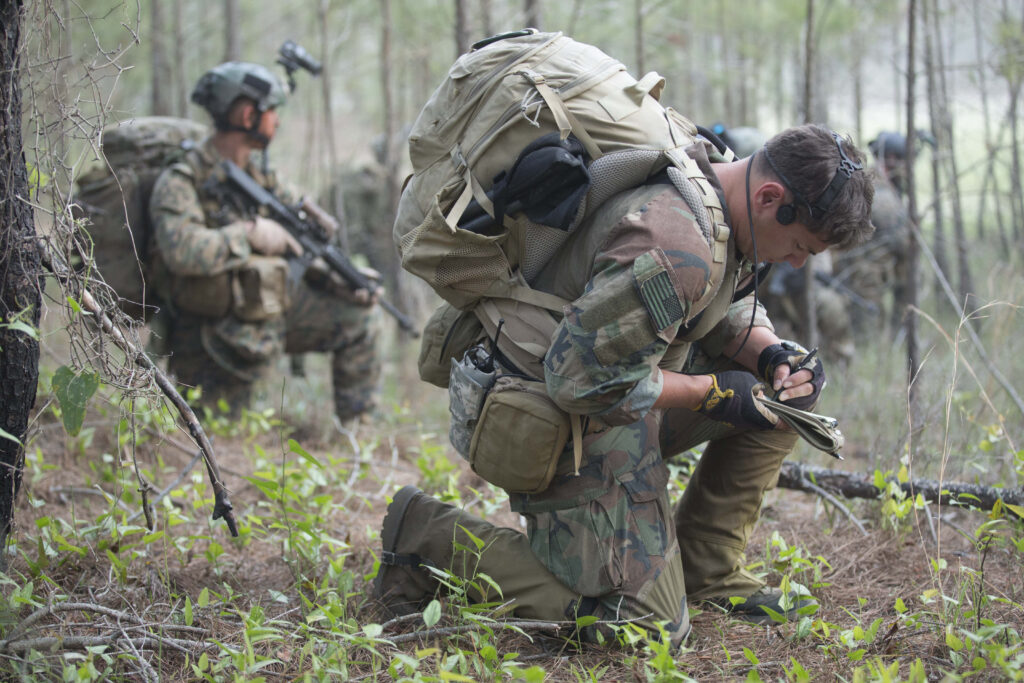
#5: 90-Day Ruck March Hero
Rucking is not part of the standard Air Force PFRA, but it matters for military preparation, load-bearing endurance, mental toughness, and Special Operations-style fitness.
If you are preparing for more demanding military training, this program belongs on your radar.

#6: Train Up — Arrive Prepared
If you want more than workouts, start with Train Up — Arrive Prepared.
This course integrates fitness, mindset, leadership, planning, and the SOF-KNOWLEDGE framework so you can prepare like a serious military candidate, not just someone trying to pass a test.
My Recommendation
If you only choose one program for physical fitness, start with Warfighter.
If you want Life is a Special Operation training specifically, choose the program that matches your weakness:
| Your Weakness | Recommended Program |
|---|---|
| Overall tactical fitness | Warfighter |
| Military preparation | Warfighter |
| Push-ups | 90-Day Push-Up Hero |
| Pull-ups / upper-body strength | 90-Day Pull-Up Hero |
| Rucking / load-bearing endurance | 90-Day Ruck March Hero |
| Fitness + mindset + leadership + planning | Train Up — Arrive Prepared |
The calculator tells you what needs work.
The right program helps you fix it.
Official Air Force Fitness Resources Used for This Guide
This guide is based on official Air Force and Air Force Personnel Center fitness resources, including:
- Official AFPC Fitness Program page
- PFRA Scoring Charts
- AFSPECWAR and EOD PFRA Charts
- The Warfighter’s Fitness Playbook
- Pregnancy & Postpartum Performance Training Guide
- myFSS Fitness
- AFMAN 36-2905
- AF Form 4446
- Air Force fitness test requirements update published January 6, 2026
Frequently Asked Questions
What is the Air Force PT Calculator 2026?
The Air Force PT Calculator 2026 is an unofficial tool that helps you estimate your updated Air Force PFRA score. It uses your age, sex, height, waist measurement, event choices, and performance numbers to estimate your score under the updated Air Force fitness test structure.
What is the Air Force PFRA?
PFRA stands for Physical Fitness Readiness Assessment. It is the updated Air Force fitness assessment structure that measures body composition, cardiorespiratory fitness, muscular strength, and core endurance.
When did the new Air Force fitness test start?
The Air Force announced that tests from March 1 through June 30, 2026, are diagnostic to give Airmen time to adapt to the new standards. Official testing under the new PFA standards resumes July 1, 2026.
When does official Air Force PFRA scoring begin?
Official testing under the new Air Force PFA standards begins July 1, 2026, according to the Air Force’s January 2026 fitness test requirements update.
What events are on the Air Force fitness test?
The updated Air Force fitness test includes waist-to-height ratio for body composition, the 2-mile run or 20-meter HAMR for cardio, push-ups or hand-release push-ups for strength, and sit-ups, cross-leg reverse crunches, or forearm plank for core.
Is the 1.5-mile run still part of the Air Force PT test?
The January 2026 Air Force update lists the 2-mile run or the 20-meter HAMR as the updated cardiovascular options. The 1.5-mile run is not listed in that updated cardio event structure.
Is the 2-mile run harder than the HAMR?
It depends on the athlete. The 2-mile run rewards steady aerobic endurance and pacing. The HAMR rewards shuttle-run skill, acceleration, deceleration, turning ability, cadence awareness, and repeated effort. The better event is the one you can perform well and consistently.
What is the waist-to-height ratio?
Waist-to-height ratio is your waist measurement divided by your height. For example, a 36-inch waist and 72-inch height equals a 0.50 waist-to-height ratio.
How do I calculate my Air Force waist-to-height ratio?
Use this formula:
Waist-to-Height Ratio = Waist Measurement ÷ HeightMake sure both measurements use the same unit, such as inches divided by inches.
How many points is waist-to-height ratio worth?
Waist-to-height ratio is worth up to 20 points under the PFRA scoring structure. The official PFRA scoring chart assigns different point values based on the ratio.
Are hand-release push-ups easier than regular push-ups?
Not necessarily. Hand-release push-ups use a different rhythm and last two minutes instead of one. Some people prefer the reset at the bottom, while others score better on standard push-ups. Test both during training before deciding.
Is the forearm plank easier than sit-ups?
It depends on your strengths. The forearm plank has no repetitions, but it requires sustained bracing, shoulder endurance, and mental tolerance. Sit-ups require speed, rhythm, abdominal endurance, and hip flexor endurance.
What score do I need to pass the Air Force PFRA?
Air Force scoring materials identify 75.0 to 89.9 as Satisfactory, 90.0 or higher as Excellent, and below 75.0 as Unsatisfactory. Passing also requires meeting minimum point values for all components.
What is a good Air Force PFRA score?
A score of 90 or higher is categorized as Excellent in Air Force scoring materials. Practically, a “good” score is one that gives you margin above the minimum and shows balanced fitness across cardio, body composition, strength, and core.
Does this calculator work for AFSPECWAR or EOD?
The calculator should only be used for AFSPECWAR or EOD if it includes an AFSPECWAR/EOD scoring mode. The AFSPECWAR/EOD PFRA chart is separate from the standard Air Force PFRA chart and appears to use one age-based standard for the main events rather than separate male and female event columns.
If I am female and preparing for AFSPECWAR or EOD, which standard should I use?
Use the official AFSPECWAR/EOD chart, not the standard female PFRA event columns. The AFSPECWAR/EOD chart uses separate scoring guidance and appears to apply one age-based standard for the main fitness events. Verify all requirements with your recruiter, developer, unit, or official Air Force guidance.
How should I train for the Air Force fitness test?
Train the events, but do not only train the events. Build aerobic capacity, upper-body endurance, core strength, body composition habits, mobility, and recovery. If you are preparing for AFSPECWAR or EOD, train well above the minimum.
Can I fail a diagnostic Air Force PT test?
During the March 1 through June 30, 2026 transition period, the Air Force announced that all fitness tests are diagnostic to give Airmen time to adapt to the new standards. Always confirm how diagnostic tests apply to your specific situation with your unit fitness program manager or chain of command.
Will Air Force fitness scores appear on performance briefs?
The Air Force’s January 2026 update states that PFA scores will be included in officer and enlisted performance briefs beginning in February 2026, with phased implementation by rank group.
About the Author
Christopher Littlestone is a retired U.S. Army Special Forces (Green Beret) Lieutenant Colonel, Airborne Ranger, Combat Diver, and the founder of Life is a Special Operation.
Christopher’s YouTube channel has grown to more than 380,000 subscribers and over 47 million views.
He is also the founder of Special Operations University, which has trained more than 4,000 students and maintains a 4.9 Trustpilot rating.
Final Thoughts: Calculate Your Score, Then Build Your Plan
The Air Force PT Calculator 2026 tells you where you stand today.
Your training plan determines where you will stand 30, 60, or 90 days from now.
Do not train to barely pass.
Build margin.
Build durability.
Build confidence.
Whether you are an Airman preparing for the new PFRA, a recruit preparing for Air Force basic training, a Guard or Reserve member getting ready for your next test, or a future AFSPECWAR or EOD candidate, your goal should be more than survival.
Calculate your score.
Identify your weakest area.
Choose your events wisely.
Then train with purpose.
If you are serious about getting into amazing shape, these resources can help you achieve your goal:
- Special Operations Fitness – A full-spectrum strength, endurance, and durability program.
- Special Operations Fitness – Hell Week – An 8-day gut-check challenge designed to simulate the stress of the Special Warfare Assessment and Selection Course.
- 90-Day Pull-Up Hero – Progressive plan for pull-up dominance.
- 90-Day Push-Up Hero – Build elite-level push-up endurance.
- 90-Day Ruck March Hero – Structured program for ruck-based strength and resilience.
- Train Up – Arrive Prepared – A comprehensive prep system integrating fitness, mindset, leadership, and the SOF-KNOWLEDGE framework.
Life is a Special Operation. Are you ready for it?

Special Operations Fitness
12 Week Unconventional Fitness Program for Civilians and Military
Hell Week
8-Day Gut Check to see if You Have What it Takes for Special Operations
Push-Up Hero
Go from "Zero" to Push-Up "Hero" in 90-Days

Ruck March Hero
Become a Ruck March "Hero" in 90-Days

Pull-Up Hero
Go from "Zero" to Pull-Up "Hero" in 90-Days