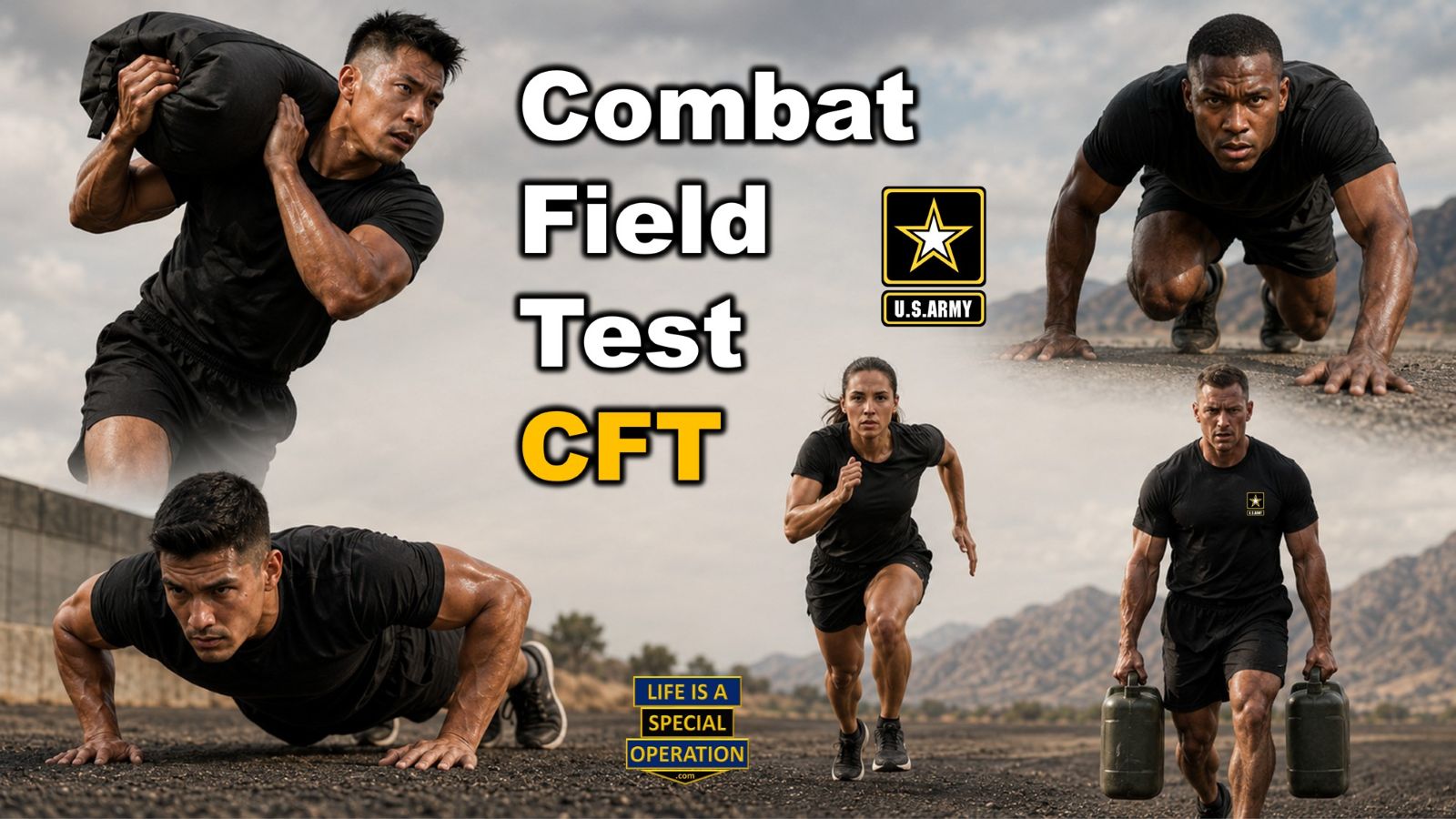
Combat Field Test Standards
The main CFT standard is simple:
Complete all seven events in 30 minutes or less.
The CFT is:
- Pass/fail
- Continuous
- Scored by total time
- Not points-based
- Required for designated combat specialty Soldiers
- Not a substitute for the AFT
Army Directive 2026-07 says the CFT is a pass/fail test with no points, and that Soldiers must complete each event before moving to the next. If a Soldier cannot complete an event, the test is terminated and recorded as a failure.
So do not overcomplicate this.
If you complete the full sequence in 30 minutes or less, you pass.
If you do not, you fail.
Dead-Stop Push-Up vs. Hand-Release Push-Up
One likely confusion point is the difference between the CFT dead-stop push-up and the AFT hand-release push-up.
The Army Fitness Test uses the Hand-Release Push-Up. ATP 7-22.01 describes the AFT as a five-event test that includes the 3 Repetition Maximum Deadlift, Hand-Release Push-Up, Sprint-Drag-Carry, Plank, and 2-Mile Run.
The Combat Field Test uses 30 dead-stop push-ups as one event inside a continuous sequence.
Do not just train push-ups when fresh. For the CFT, practice push-ups after running, because that is when they happen.
CFT vs. AFT: What Is the Difference?
The CFT and the AFT are not the same test.
The Army Fitness Test, or AFT, is the Army’s physical fitness test of record. The Army says the AFT became the official test of record on June 1, 2025, replacing the Army Combat Fitness Test. (U.S. Army)
The Combat Field Test, or CFT, is an additional combat specialty requirement.
| Test | Full Name | Purpose | Scoring | Who Takes It? |
|---|---|---|---|---|
| AFT | Army Fitness Test | Army fitness test of record | Points-based | Army-wide |
| CFT | Combat Field Test | Combat specialty readiness | Pass/fail by total time | Designated combat specialty Soldiers |
| ACFT | Army Combat Fitness Test | Former test of record | Points-based | Replaced by AFT |
| Army PT Test | Informal phrase | Common search term | Depends on context | Usually refers to the current Army fitness test |
Army Directive 2026-07 is very clear: the CFT is not a substitute for the AFT.
For many combat specialty Soldiers, the practical answer is simple:
You may need to care about both.
ACFT vs. CFT: Why Soldiers Are Confused
The acronyms are confusing.
The ACFT was the Army Combat Fitness Test.
The CFT is the Combat Field Test.
The ACFT was the old test of record. The CFT is a new combat specialty requirement.
The ACFT had scored events. The CFT has one clock.
The ACFT was replaced by the AFT. The CFT does not replace the AFT.
Army PT Test vs. Combat Field Test
“Army PT test” is informal language.
For decades, Soldiers have used “PT test” to mean whatever the current Army fitness test happened to be. Today, that usually points toward the Army Fitness Test, or AFT.
The Combat Field Test is different.
The CFT is not the general Army PT test. It is a combat-focused requirement for designated combat specialty Soldiers.
If you are looking for your Army fitness test score, use the Army Fitness Test Calculator or Army PT Test Calculator.
If you are in a designated combat specialty, learn the CFT too.
Who Has to Take the Combat Field Test?
The Combat Field Test applies to Soldiers serving in designated combat specialties.
Army Directive 2026-07 lists the combat specialties in Enclosure 2.
| Branch / Specialty Area | MOS / AOC |
|---|---|
| Infantry | 11A, 11B, 11C, 11Z |
| Engineer | 12A, 12B, 12D |
| Field Artillery | 13A, 13F |
| Special Forces | 180A, 18A, 18B, 18C, 18D, 18E, 18F, 18Z |
| Armor / Cavalry | 19A, 19C, 19D, 19K, 19Z |
| Explosive Ordnance Disposal | 89D, 89E |
If your MOS or AOC appears on that list, the CFT matters.
Confirm current requirements with your chain of command, because implementation details may vary by component, duty status, and current Army guidance.
Combat Field Test Implementation Timeline
The CFT is active now, but the Army created a transition period.
Army Directive 2026-07 states that the implementation period provides a one-year transition when no administrative action will be taken solely because of a failed CFT or a permanent profile that prevents a Soldier from taking the CFT. Full implementation begins 365 days from the directive date, when failure may result in administrative action, including flagging and potential reclassification.
| Period | Meaning |
|---|---|
| April 2026 | CFT implementation begins |
| First 365 days | Transition / diagnostic period |
| After 365 days | Full implementation and administrative consequences |
The smart Soldier does not wait.
The transition period is the time to train.
What Happens If a Soldier Fails the CFT?
During the transition period, the directive provides a one-year window before full administrative consequences begin solely because of a failed CFT.
After full implementation, the consequences become more serious. Army Directive 2026-07 says Soldiers in combat specialties who fail the CFT will be flagged and enrolled in reconditioning training, and must retake the test within 90 days, or 180 days for certain Reserve Component Soldiers. Continued failure can lead to reclassification, utilization action, or other administrative consequences.
In plain English:
During the transition period, failure is feedback. After full implementation, failure can become a career problem.
Soldiers on Profiles and the Combat Field Test
Army Directive 2026-07 also addresses Soldiers on permanent and temporary profiles.
Soldiers in combat specialties with permanent profiles that prevent them from performing any primary event on the AFT are ineligible to complete the CFT and may be evaluated for MOS or AOC reclassification. Soldiers on temporary profiles, including pregnancy and postpartum profiles, follow their profiles and AFT guidance until they can take the CFT; the directive states that CFT event modifications are not available for Soldiers on profiles.
This is important.
The CFT is not designed as a modified-event points test.
It is a combat specialty requirement.
How to Train for the Combat Field Test
The CFT is simple on paper: seven events, one clock, 30 minutes.
But simple does not mean easy.
1. Train Under Fatigue
Do not train every event fresh. The CFT is a continuous test, so your body has to perform while tired.
Use combinations like run + push-ups, sprint + carry, crawl + run, and sandbag + final run.
2. Practice Push-Ups After Running
The CFT requires 30 dead-stop push-ups after the first mile.
If you only practice push-ups fresh, you are not preparing for the real event.
3. Build Load-Carrying Capacity
The water-can carry will test grip, posture, trunk strength, and loaded movement.
Use farmer’s carries, kettlebell carries, sandbag carries, rucking, and loaded walking intervals.
4. Train Sandbag Lifts
The sandbag lift is awkward by design.
Practice lifting odd objects safely and repeatedly, especially when breathing hard.
5. Crawl and Rush
Crawling and rushing are combat movements, not gym movements.
Practice getting low, moving, getting up, and accelerating again.
6. Train the Whole Sequence
Eventually, rehearse the full sequence or partial versions of it.
Do not let test day be the first time you connect all seven events together.
Train as you fight.
Best Physical Fitness Programs to Prepare for the Combat Field Test
The CFT requires running, push-ups, sprinting, lifting, carrying, crawling, rushing, and running again under fatigue.
Random workouts are not enough.
You need structure.
#1: Modern Athlete Strength Systems — Warfighter
Best overall choice for tactical fitness.
Warfighter is my top recommendation if you want one complete program to prepare for the Combat Field Test, Army Fitness Test, military training, or Special Operations preparation.
It is built by Green Berets with support from elite athletes and strength coaches. The program is app-based, structured, progressive, and includes tracking, coaching interaction, and detailed exercise demonstrations.
This matters because most people do not fail from lack of motivation.
They fail from lack of structure.
Warfighter gives you the structure.
Best fit: Anyone serious about building tactical fitness with accountability and progression.
Bonus: Use code LIFEISASPECOP for a free 7-day trial and 10% discount.
Recommended Program: Modern Athlete Strength Systems — Warfighter
#2: Special Operations Fitness
If you want a Life is a Special Operation program focused on full-spectrum military fitness, start with Special Operations Fitness.
The CFT rewards Soldiers who can run, push, sprint, lift, carry, crawl, rush, and keep moving. This program is designed to build strength, endurance, durability, and the physical confidence needed before serious military training.
Best fit: Soldiers, recruits, and military candidates who want broad military fitness instead of narrow event-specific training.
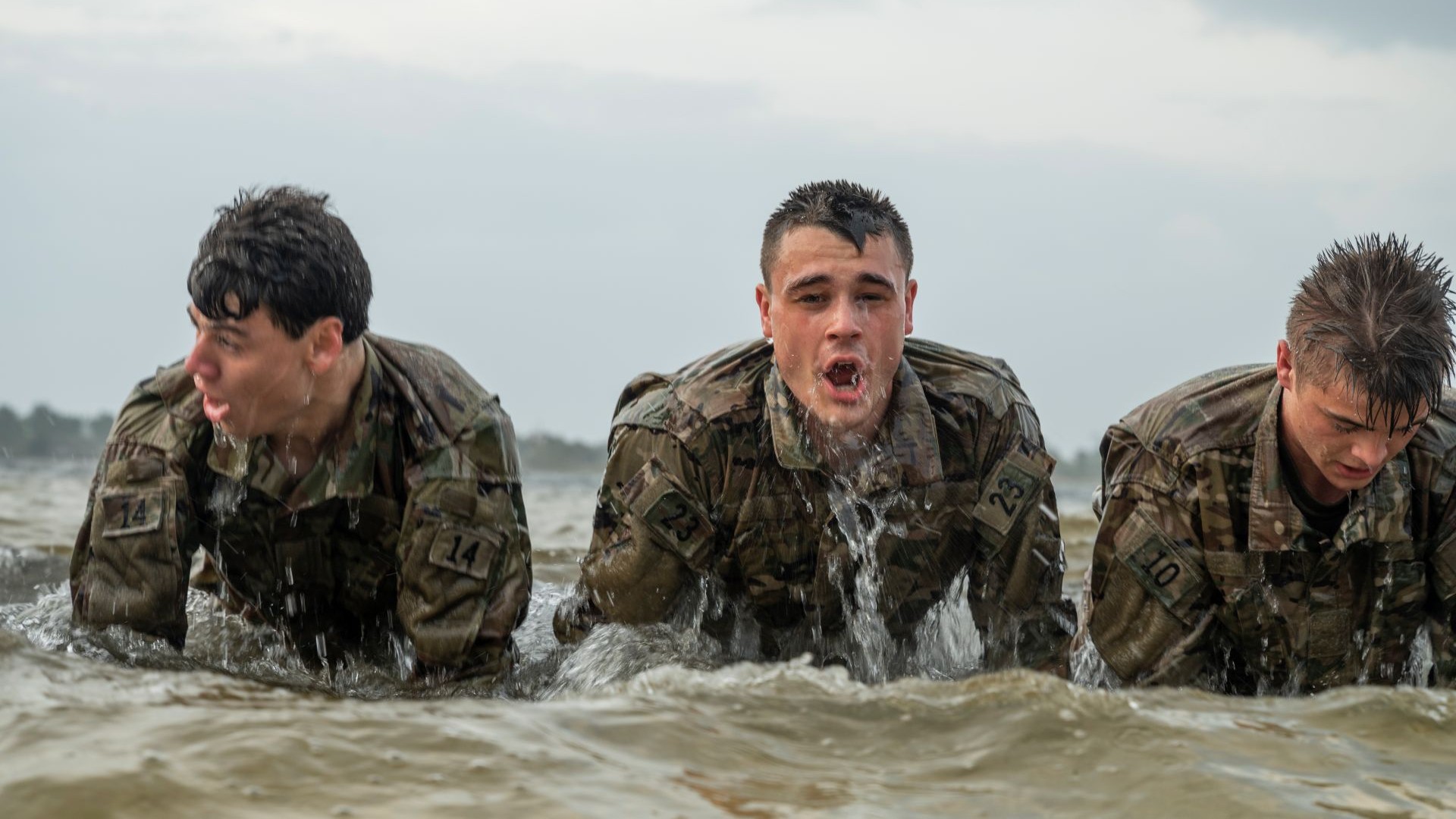
#3: 90-Day Push-Up Hero
If dead-stop push-ups are your weak point, this is the most direct Life is a Special Operation program to consider.
The CFT requires 30 dead-stop push-ups after the first 1-mile run. The goal is simple: build better push-up endurance over 90 days.
Best fit: Anyone who struggles with push-ups, upper-body endurance, or maintaining clean standards under fatigue.

#4: 90-Day Ruck March Hero
Rucking is not one of the seven CFT events, but load-bearing endurance absolutely matters.
The CFT includes sandbag lifts, water-can carries, crawling, rushing, and running in boots. If you have weak feet, weak hips, poor trunk strength, or no loaded-movement base, the test will expose it.
Best fit: Soldiers and candidates who need better durability, loaded movement, and mental toughness.

#5: 90-Day Pull-Up Hero
Pull-ups are not part of the Combat Field Test, but they are still one of the best indicators of relative upper-body strength.
If you are preparing for Infantry, Special Forces, Ranger School, Air Assault, Airborne, or any harder military training path, do not ignore pull-ups.
Best fit: Anyone preparing for harder military schools, Special Operations selection, or upper-body strength improvement.

#6: Train Up — Arrive Prepared
If you want more than workouts, start with Train Up — Arrive Prepared.
This course integrates fitness, mindset, leadership, planning, and the SOF-KNOWLEDGE framework so you can prepare like a serious military candidate, not just someone trying to pass a test.
Best fit: Future Soldiers, junior leaders, and serious candidates who want a complete preparation framework.
My Recommendation
If you only choose one program for physical fitness, start with Warfighter.
If you want Life is a Special Operation training specifically, choose the program that matches your weakness:
| Your Weakness | Recommended Program |
|---|---|
| Overall tactical fitness | Warfighter |
| Combat Field Test Preparation | Warfighter |
| Push-ups / upper-body endurance | 90-Day Push-Up Hero |
| Load-bearing endurance / durability | 90-Day Ruck March Hero |
| Pull-ups / relative strength | 90-Day Pull-Up Hero |
| Fitness + mindset + leadership + planning | Train Up — Arrive Prepared |
The CFT tells you whether you can move under fatigue.
The right program helps you build the strength, endurance, durability, and structure to do it.
Frequently Asked Questions
What is the Combat Field Test?
The Combat Field Test, or CFT, is a new Army fitness requirement for Soldiers in designated combat specialties. It is a seven-event continuous test designed to measure combat-relevant physical ability under fatigue.
What does CFT stand for in the Army?
CFT stands for Combat Field Test. It should not be confused with the old ACFT, which stood for Army Combat Fitness Test.
What are the seven Combat Field Test events?
The seven CFT events are a 1-mile run, 30 dead-stop push-ups, a 100-meter sprint, 16 sandbag lifts, a 50-meter water-can carry, a 50-meter movement drill, and a final 1-mile run. The events are completed in that order as one continuous test.
What is the Combat Field Test time standard?
The current CFT standard is 30 minutes or less. The test is scored by total cumulative time, not by individual event points.
Is the Combat Field Test pass/fail?
Yes. The Combat Field Test is pass/fail. Soldiers do not receive a point score for each event; they either complete the full sequence within the required time or they fail.
Is the Combat Field Test replacing the Army Fitness Test?
No. The CFT does not replace the Army Fitness Test. The AFT remains the Army’s fitness test of record, while the CFT is an additional requirement for designated combat specialty Soldiers.
What is the difference between the AFT and the CFT?
The AFT is the Army Fitness Test and is the Army’s general test of record. The CFT is a combat specialty test with seven continuous events and a pass/fail 30-minute standard.
What is the difference between the ACFT and the CFT?
The ACFT was the Army Combat Fitness Test, which has been replaced by the Army Fitness Test. The CFT is the Combat Field Test, a separate combat-focused requirement for designated combat specialty Soldiers.
Who has to take the Combat Field Test?
The CFT applies to Soldiers serving in designated combat specialties. These include Infantry, Combat Engineer, Field Artillery, Special Forces, Armor, Cavalry, Army Diver, and Explosive Ordnance Disposal specialties.
What MOSs are included in the Combat Field Test requirement?
The official list includes 11A, 11B, 11C, 11Z, 12A, 12B, 12D, 13A, 13F, 180A, 18A, 18B, 18C, 18D, 18E, 18F, 18Z, 19A, 19C, 19D, 19K, 19Z, 89D, and 89E. Soldiers should confirm current requirements with their chain of command and official Army guidance.
When does the Combat Field Test become fully enforceable?
Army Directive 2026-07 describes a one-year implementation period. After full implementation, failure to pass the CFT may result in administrative action, including flagging and potential reclassification.
Can Soldiers on profile take a modified CFT?
Army Directive 2026-07 states that CFT event modifications are not available for Soldiers on profiles. Soldiers with temporary profiles follow their profile and AFT guidance until they can take the CFT.
How should I train for the Combat Field Test?
Train the way the test is built: under fatigue and in sequence. Combine running, dead-stop push-ups, sprinting, sandbag work, loaded carries, crawling, rushing, and final-mile conditioning.
Is rucking part of the Combat Field Test?
No, rucking is not one of the seven official CFT events. However, rucking can help build load-bearing endurance, foot and leg durability, trunk strength, and mental toughness.
Official Documents Used for This Guide
This guide is based on official Army sources and supporting documents, including:
- Army Directive 2026-07: Army Physical Fitness Standards
- HQDA EXORD 103-26: Combat Field Test
- CFT Testing Guidance
- Army Combat Field Test implementation guidance
- ATP 7-22.01: Holistic Health and Fitness Testing, March 2026
- Official Army public announcements and CFT reporting
These documents matter because the Army fitness landscape has changed. The AFT, ACFT, CFT, Army PT test, and combat specialty standards are easy to confuse unless you look at the actual guidance.
About the Author
Christopher Littlestone is a retired U.S. Army Special Forces (Green Beret) Lieutenant Colonel, Airborne Ranger, Combat Diver, and the founder of Life is a Special Operation.
Christopher’s YouTube channel has grown to more than 380,000 subscribers and over 47 million views.
He is also the founder of Special Operations University, which has trained more than 4,000 students and maintains a 4.9 Trustpilot ratings.
Final Thoughts
The Combat Field Test is simple:
Seven events.
One clock.
Thirty minutes.
But simple does not mean easy.
If you are in a combat specialty, use the implementation period wisely. Train under fatigue. Practice the actual movements. Build strength, endurance, durability, and loaded movement capacity before the test starts affecting careers.
If you need help getting into exceptional shape, here are my recommended programs:
- Warfighter — My #1 recommended fitness program for overall tactical fitness.
- Special Operations Fitness – A full-spectrum strength, endurance, and durability program.
- Special Operations Fitness – Hell Week – An 8-day gut-check challenge designed to simulate the stress of the Special Warfare Assessment and Selection Course.
- 90-Day Pull-Up Hero – Progressive plan for pull-up dominance.
- 90-Day Push-Up Hero – Build elite-level push-up endurance.
- 90-Day Ruck March Hero – Structured program for ruck-based strength and resilience.
- Train Up – Arrive Prepared – A comprehensive prep system integrating fitness, mindset, leadership, and the SOF-KNOWLEDGE framework.
Life is a Special Operation. Are you ready for it?

Special Operations Fitness
12 Week Unconventional Fitness Program for Civilians and Military
Hell Week
8-Day Gut Check to see if You Have What it Takes for Special Operations
Push-Up Hero
Go from "Zero" to Push-Up "Hero" in 90-Days
Ruck March Hero
Become a Ruck March "Hero" in 90-Days
Pull-Up Hero
Go from "Zero" to Pull-Up "Hero" in 90-Days