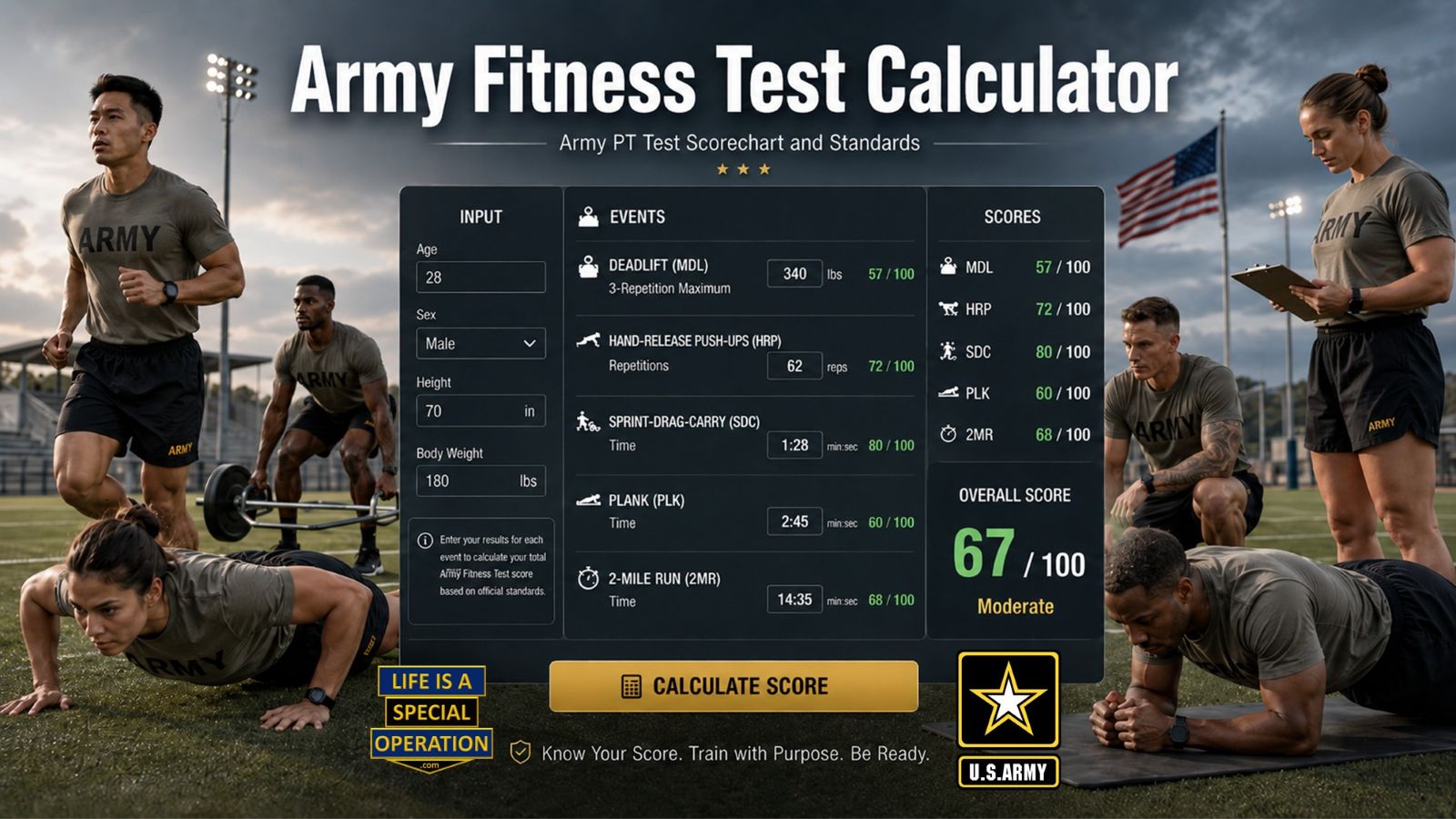
Executive Summary
The Army Fitness Test, or AFT, is the Army’s current physical fitness test of record.
The AFT replaced the Army Combat Fitness Test as the Army’s test of record on June 1, 2025. The official Army AFT page describes the test as designed to improve warfighting readiness, reduce injury risk, and enhance physical performance.
The Army Fitness Test has five events:
- 3 Repetition Maximum Deadlift
- Hand-Release Push-Up
- Sprint-Drag-Carry
- Plank
- 2-Mile Run
Each event is worth up to 100 points, for a maximum total score of 500 points. Soldiers generally need at least 60 points per event to pass. Soldiers in combat specialties must meet the combat standard, which requires at least 60 points per event and a minimum total score of 350.
The calculator above estimates your event scores, total score, pass/fail status, strongest event, weakest event, and recommended training focus.
This article was written by Christopher Littlestone, a retired U.S. Army Special Forces (Green Beret) Lieutenant Colonel, Airborne Ranger, Combat Diver, and founder of Life is a Special Operation.
Table of Contents
- Army Fitness Test Calculator
- Executive Summary
- What Is the Army Fitness Test?
- Army PT Test Calculator
- Army Fitness Test Events
- Army Fitness Test Standards
- Army Fitness Test Score Chart
- Army Fitness Test Scoring Tables
- Army Fitness Test Passing Score
- Army Fitness Test Deadlift
- Army Fitness Test Push-Ups
- Army Fitness Test Sprint-Drag-Carry
- Army Fitness Test Plank
- Army Fitness Test 2-Mile Run
- Army Fitness Test Alternate Events
- AFT vs. ACFT vs. CFT: What Is the Difference?
- Who Has to Take the Combat Field Test?
- Army Fitness Test Training Plan
- Best Physical Fitness Programs for the Army Fitness Test
- Frequently Asked Questions
- Official Documents Used for This Guide
- About the Author
- Final Thoughts
What Is the Army Fitness Test?
The Army Fitness Test, or AFT, is the Army’s current physical fitness test of record.
It replaced the Army Combat Fitness Test and is now the test Soldiers use to measure physical readiness across five events: deadlift, hand-release push-ups, sprint-drag-carry, plank, and the 2-mile run.
ATP 7-22.01 says the AFT is designed to reflect baseline Soldier physical readiness linked to warrior tasks, battle drills, and common Soldier tasks. It assesses muscular strength, muscular endurance, aerobic endurance, explosive power, anaerobic endurance, speed, agility, flexibility, balance, and coordination.
In plain English, the AFT is not just a gym test.
It is supposed to measure whether a Soldier has the strength, endurance, power, and durability to perform physically demanding military tasks.
Army PT Test Calculator
Many Soldiers still call it the Army PT test.
That is understandable.
For decades, Soldiers used phrases like Army PT test, APFT, ACFT, PT card, PT score, and PT test calculator. But the official name of the current test is now the Army Fitness Test, or AFT.
Army Fitness Test Events
The Army Fitness Test has five events.
| Event | What It Measures | Practical Meaning |
|---|---|---|
| 3 Repetition Maximum Deadlift | Lower-body strength | Lifting, carrying, casualty movement, and load carriage |
| Hand-Release Push-Up | Upper-body muscular endurance | Pushing, getting off the ground, and fighting from prone |
| Sprint-Drag-Carry | Anaerobic endurance, speed, agility, and power | Explosive movement under fatigue |
| Plank | Core strength and endurance | Bracing, trunk stability, and durability |
| 2-Mile Run | Aerobic endurance | Sustained movement and recovery |
ATP 7-22.01 identifies the five AFT events as the 3 Repetition Maximum Deadlift, Hand-Release Push-Up, Sprint-Drag-Carry, Plank, and 2-Mile Run.
The GoArmy fitness page also lists the same five AFT events and describes the Sprint-Drag-Carry as five 50-meter shuttles using two 40-pound kettlebells and a 90-pound sled.
Army Fitness Test Standards
The Army Fitness Test standards depend on whether the Soldier is being evaluated under the general standard or the combat standard.
The general standard is performance-normed by age and sex.
The combat standard applies to Soldiers in designated combat specialties. ATP 7-22.01 states that Soldiers in combat specialties must achieve a minimum of 60 points per event and an overall minimum score of 350.
That distinction matters.
A Soldier who scores exactly 60 points on all five events earns a total score of 300. That may meet the basic event minimum, but it does not meet the 350-point combat standard.
Here is the practical difference:
| Standard | Minimum Event Requirement | Minimum Total Score | Who It Applies To |
|---|---|---|---|
| General Standard | 60 points per event | 300 total if all events are passed at 60 | Most Soldiers |
| Combat Standard | 60 points per event | 350 total | Soldiers in designated combat specialties |
The minimum standard may keep you administratively safe.
It does not necessarily mean you are physically prepared for hard field training, rucking, combat tasks, selection-style environments, or life in a physically demanding unit.
Army Fitness Test Score Chart
The Army Fitness Test score chart converts your raw performance into points.
Raw performance means things like:
- Deadlift weight
- Push-up repetitions
- Sprint-Drag-Carry time
- Plank time
- 2-mile run time
Each event is worth up to 100 points.
The total AFT score is the sum of your five event scores.
22–26-Year-Old Male AFT Performance Targets
If you are a 22–26-year-old male Soldier, this table gives you a practical snapshot of what passing, strong, excellent, and max-level performance looks like.
| Goal | MDL | HRP | SDC | Plank | 2-Mile Run | Total if Balanced |
|---|---|---|---|---|---|---|
| Pass / Minimum | 150 lbs | 14 reps | 2:31 | 1:25 | 19:45 | 300 / 500 |
| Strong / 80%+ | ~250 lbs | 37 reps | ~1:53 | 2:30 | ~17:13 | 400 / 500 |
| Excellent / 90%+ | ~300 lbs | 48 reps | 1:43 | 3:03 | 15:38 | 450 / 500 |
| Max Score | 350 lbs | 61 reps | 1:30 | 3:35 | 13:25 | 500 / 500 |
This is not a replacement for the calculator or the official score chart.
It is a quick way to understand the performance levels.
The calculator gives you your exact score.
This table gives you the standard you should be training toward.
Army Fitness Test Scoring Tables
The official Army Fitness Test scoring tables are important, but they are not easy to use quickly.
That is why this calculator exists.
The scoring tables convert raw performance into points for each event:
| Event | Raw Score Type | Example |
|---|---|---|
| Maximum Deadlift | Pounds lifted for 3 reps | 250 lbs |
| Hand-Release Push-Up | Correct reps in 2 minutes | 37 reps |
| Sprint-Drag-Carry | Time | 1:53 |
| Plank | Time held | 2:30 |
| 2-Mile Run | Run time | 17:13 |
The official score tables include age groups from 17–21 through over 62 and scoring categories for men and women.
The calculator does the conversion for you.
Instead of reading across multiple large charts, you enter your event results and get an estimated score immediately.
Army Fitness Test Passing Score
The basic passing requirement is simple:
You need to pass every event.
ATP 7-22.01 states that Soldiers who fail to achieve the minimum passing score on any event are considered test failures.
For most Soldiers, that means at least 60 points per event.
For Soldiers in combat specialties, the standard is higher because they must also meet the overall combat standard of 350 points.
| Result | Meaning |
|---|---|
| Less than 60 on any event | Test failure |
| 60 points on all five events | 300 total points |
| 350+ total with at least 60 per event | Combat standard threshold |
| 500 total | Maximum score |
Here is the important point:
Do not train for 60.
A 60-point performance gives you no margin.
Bad sleep, bad weather, stress, poor pacing, dehydration, a rough testing surface, or a minor ache can all reduce your score.
If you are serious, build a buffer.
Army Fitness Test Deadlift
The first Army Fitness Test event is the 3 Repetition Maximum Deadlift, or MDL.
The MDL measures lower-body strength, grip strength, trunk stability, and the ability to lift heavy loads from the ground. GoArmy describes the MDL as measuring muscular strength through lower-body, grip, and core strength.
This event matters because Soldiers lift heavy things.
Ammo cans.
Rucksacks.
Equipment.
Casualties.
Vehicles stuck in bad places.
The deadlift is not just a gym movement. It is one of the most practical strength tests in the Army Fitness Test.
Common Deadlift Mistakes
Common mistakes include:
- Rounding the back
- Letting the knees collapse inward
- Picking a weight based on ego instead of ability
- Failing to warm up properly
- Losing position under fatigue
Deadlift Training Tip
Train the deadlift, but do not only train the deadlift.
Build your posterior chain, grip, bracing, hamstrings, glutes, and lower back. Use progressive strength training, but protect your form.
A strong deadlift with bad technique is a future injury.
A strong deadlift with disciplined technique is a weapon.
Army Fitness Test Push-Ups
The second Army Fitness Test event is the Hand-Release Push-Up, or HRP.
The HRP is a two-minute event that measures upper-body muscular endurance. GoArmy describes the HRP as measuring upper-body endurance and also supporting upper-body and core strength training.
This is not the old-school push-up where you bounce through sloppy repetitions.
The hand-release push-up requires control, body alignment, and repeatable mechanics.
Common Push-Up Mistakes
Common mistakes include:
- Sagging through the hips
- Failing to fully extend at the top
- Losing a straight body line
- Moving too fast with poor form
- Training regular push-ups but not practicing the hand-release standard
Push-Up Training Tip
If hand-release push-ups are your weak point, practice the exact event.
You need chest, shoulders, triceps, upper-back control, and core stiffness. Submaximal sets work well because they build volume without constantly destroying you.
Do not test yourself every day.
Train yourself.
Army Fitness Test Sprint-Drag-Carry
The third Army Fitness Test event is the Sprint-Drag-Carry, or SDC.
This is one of the most important events on the test because it exposes weakness quickly.
The Sprint-Drag-Carry includes five 50-meter shuttles:
- Sprint
- Drag
- Lateral
- Carry
- Sprint
GoArmy describes the SDC as five 50-meter shuttles performed as fast as possible using two 40-pound kettlebells and a 90-pound sled.
This event tests speed, agility, power, anaerobic endurance, leg drive, grip, and the ability to keep moving when your body wants to stop.
Common Sprint-Drag-Carry Mistakes
Common mistakes include:
- Poor transitions
- Weak sled drag
- Slow direction changes
- Not practicing lateral movement
- Training only steady-state running
- Underestimating how much the event hurts
Sprint-Drag-Carry Training Tip
Train short, hard efforts.
Use shuttle runs, sled drags, loaded carries, hill sprints, and interval work. Practice transitions because wasted seconds add up quickly.
The SDC rewards fitness.
It also rewards familiarity.
If test day is the first time you have practiced the full event, you are already behind.
Army Fitness Test Plank
The fourth Army Fitness Test event is the Plank, or PLK.
The plank measures core strength and endurance.
It looks simple.
It is not easy.
A good plank requires bracing, breathing, shoulder endurance, glute tension, mental discipline, and the ability to stay calm under discomfort.
Common Plank Mistakes
Common mistakes include:
- Sagging hips
- Piking the hips too high
- Holding the breath
- Letting the shoulders collapse
- Shaking mentally before the body actually fails
Plank Training Tip
Train the plank directly, but also train the qualities behind it.
Use plank intervals, side planks, dead bugs, loaded carries, anti-extension core work, and controlled breathing under tension.
The plank is not just an abdominal exercise.
It is a test of disciplined suffering.
Army Fitness Test 2-Mile Run
The fifth Army Fitness Test event is the 2-Mile Run, or 2MR.
The 2-mile run measures aerobic endurance. GoArmy describes it as a two-mile run for time on a measured, generally flat course and says it assesses aerobic endurance.
The 2-mile run is simple.
That does not mean it is easy.
And on the Army Fitness Test, the run comes after the deadlift, hand-release push-ups, sprint-drag-carry, and plank.
That matters.
You are not running fresh.
You are running after fatigue has already started to accumulate.
Common 2-Mile Run Mistakes
Common mistakes include:
- Starting too fast
- Never practicing goal pace
- Only running slow distance
- Avoiding intervals
- Not running after leg fatigue
- Ignoring body weight, recovery, and mobility
2-Mile Run Training Tip
A better 2-mile run usually requires a mix of:
- Easy runs
- Intervals
- Tempo runs
- Goal-pace work
- Strides
- Recovery
- Consistency
Do not just “run more.”
Run with a plan.
Army Fitness Test Alternate Events
Some Soldiers on permanent profiles may take alternate aerobic events instead of the 2-mile run.
ATP 7-22.01 identifies four alternate aerobic endurance events for eligible Soldiers on permanent profiles:
- 5,000-meter row
- 12,000-meter bike
- 1,000-meter swim
- 2.5-mile walk
These alternate events are not simply personal preferences.
They are for Soldiers with permanent medical profiles that prohibit the 2-mile run. Temporary profiles are different.
If you are on a profile, confirm your requirements with your unit, your profile, and current Army guidance.
| Alternate Event | Distance |
|---|---|
| Row | 5,000 meters |
| Bike | 12,000 meters |
| Swim | 1,000 meters |
| Walk | 2.5 miles |
The primary calculator on this page is built around the standard five-event Army Fitness Test. Alternate event support may be added separately.
AFT vs. ACFT vs. CFT: What Is the Difference?
A lot of Soldiers are still confused by the terminology.
That is understandable.
The names have changed, and the Army has added new guidance for combat specialties.
| Term | Meaning | Current Role |
|---|---|---|
| AFT | Army Fitness Test | Current Army physical fitness test of record |
| ACFT | Army Combat Fitness Test | Former test of record replaced by the AFT |
| CFT | Combat Field Test | Additional pass/fail test for combat specialty Soldiers |
| Army PT Test | Informal phrase many Soldiers still use | Common way people refer to the Army fitness test |
The Army Fitness Test is the current test of record.
The Combat Field Test is different.
Army Directive 2026-07 establishes the CFT as an Army fitness requirement for Soldiers in combat specialties and states that the CFT is not a substitute for the AFT.
That means the CFT does not replace the Army Fitness Test.
For combat specialty Soldiers, it adds another requirement.
Read my full guide to the Combat Field Test here: Army Combat Field Test Guide
Who Has to Take the Combat Field Test?
The Combat Field Test applies to Soldiers serving in designated combat specialties.
Army Directive 2026-07 lists combat specialties such as infantry, combat engineer, field artillery, Special Forces, armor, cavalry scout, EOD, and related officer, warrant officer, and enlisted specialties.
The CFT is a pass/fail test.
It is not scored with points like the Army Fitness Test.
The directive states that the CFT consists of seven events performed in sequence:
- 1-mile run
- 30 dead-stop push-ups
- 100-meter sprint
- 16 sandbag lifts with a 40-pound sandbag to a 65-inch platform
- 50-meter carry of two 5-gallon Army water cans, each weighing 40 pounds
- 50-meter movement drill with high crawl and rush
- Second 1-mile run
The CFT is important, but do not confuse it with the AFT.
The Army Fitness Test is still the test you calculate on this page.
The Combat Field Test is a separate combat specialty requirement.
Army Fitness Test Training Plan
Your Army Fitness Test score is feedback.
It tells you where you stand.
Your training plan determines where you go next.
Train the Weakest Event First
Do not train your favorite event first.
Train the event that is costing you the most points.
If your 2-mile run is weak, run with structure.
If your deadlift is weak, build strength.
If your Sprint-Drag-Carry is weak, train power, shuttles, sleds, carries, and transitions.
The calculator tells you what needs work.
Your plan should fix that weakness first.
Build Strength and Endurance Together
The Army Fitness Test punishes one-dimensional athletes.
A strong Soldier who cannot run will suffer.
A good runner who cannot lift, drag, or carry will suffer.
A high-scoring AFT athlete needs strength, endurance, speed, power, grip, trunk stability, and recovery.
Do not train like a bodybuilder.
Do not train like a distance runner only.
Train like a Soldier.
Practice the Test Sequence
The Army Fitness Test is not five unrelated workouts.
It is a sequence.
You deadlift, push, sprint, drag, carry, plank, and then run.
That order matters.
You need to know what your body feels like when you run after the earlier events.
Practice the sequence periodically so test day does not surprise you.
Run After Leg Fatigue
The 2-mile run comes after leg fatigue has already started.
That means your 2-mile run training should not always happen fresh.
Sometimes you should run after lower-body work.
Sometimes you should run after sleds, carries, or intervals.
Be smart.
Do not destroy yourself.
But do prepare your body for the reality of the test.
Protect Recovery and Avoid Injury
Panic training breaks people.
Good training builds people.
If you are behind, do not try to solve six months of neglect in two weeks. Build a plan. Sleep. Hydrate. Warm up. Progress gradually. Recover like an adult.
You are not just trying to pass one test.
You are trying to become harder to kill, harder to injure, and harder to quit.
Best Physical Fitness Programs for the Army Fitness Test
The calculator tells you what needs work.
The right program helps you fix it.
If you want to improve your Army Fitness Test score, choose the program that matches your weakness.
| Your Weakness | Recommended Program |
|---|---|
| Overall tactical fitness | Warfighter |
| Combat Field Test Preparation | Warfighter |
| Push-ups / upper-body endurance | 90-Day Push-Up Hero |
| Load-bearing endurance / durability | 90-Day Ruck March Hero |
| Pull-ups / relative strength | 90-Day Pull-Up Hero |
| Fitness + mindset + leadership + planning | Train Up — Arrive Prepared |
#1: Modern Athlete Strength Systems — Warfighter
Best overall choice for tactical fitness.
Warfighter is my top recommendation if you want one complete program to prepare for the Combat Field Test, Army Fitness Test, military training, or Special Operations preparation.
It is built by Green Berets with support from elite athletes and strength coaches. The program is app-based, structured, progressive, and includes tracking, coaching interaction, and detailed exercise demonstrations.
This matters because most people do not fail from lack of motivation.
They fail from lack of structure.
Warfighter gives you the structure.
Best fit: Anyone serious about building tactical fitness with accountability and progression.
Bonus: Use code LIFEISASPECOP for a free 7-day trial and 10% discount.
Hyperlink: Modern Athlete Strength Systems — Warfighter
#2: Special Operations Fitness
If you want a Life is a Special Operation program focused on full-spectrum military fitness, start with Special Operations Fitness.
This program is designed to build strength, endurance, durability, and the physical confidence needed before serious military training.
Best fit: Soldiers, recruits, and military candidates who want broad military fitness instead of narrow event-specific training.
#3: 90-Day Push-Up Hero
If push-ups are your weak point, this is the most direct Life is a Special Operation program to consider.
Best fit: Anyone who struggles with push-ups, upper-body endurance, or maintaining clean standards under fatigue.

#4: 90-Day Ruck March Hero
Rucking is not one of the seven AFT events, but load-bearing endurance absolutely matters.
Best fit: Soldiers and candidates who need better durability, loaded movement, and mental toughness.

#5: 90-Day Pull-Up Hero
If you are preparing for Infantry, Special Forces, Ranger School, Air Assault, Airborne, or any harder military training path, do not ignore pull-ups.
Best fit: Anyone preparing for harder military schools, Special Operations selection, or upper-body strength improvement.

#6: Train Up — Arrive Prepared
If you want more than workouts, start with Train Up — Arrive Prepared.
This course integrates fitness, mindset, leadership, planning, and the SOF-KNOWLEDGE framework so you can prepare like a serious military candidate, not just someone trying to pass a test.
Best fit: Future Soldiers, junior leaders, and serious candidates who want a complete preparation framework.
Frequently Asked Questions
What is the Army Fitness Test?
The Army Fitness Test, or AFT, is the Army’s current physical fitness test of record. It has five events: 3 Repetition Maximum Deadlift, Hand-Release Push-Up, Sprint-Drag-Carry, Plank, and 2-Mile Run.
Is the Army Fitness Test the same as the ACFT?
No. The Army Fitness Test replaced the Army Combat Fitness Test as the Army’s test of record. Many people still use older language, but the current test is the AFT.
What is the new Army PT test called?
The new Army PT test is officially called the Army Fitness Test, or AFT. Many Soldiers still say Army PT test, but the current official name is Army Fitness Test.
Is there an Army Fitness Test calculator?
Yes. The calculator on this page estimates your AFT event scores, total score, pass/fail status, strongest event, weakest event, and training focus. It is an unofficial calculator, so always verify your score with current Army guidance.
What are the Army Fitness Test events?
The Army Fitness Test events are the 3 Repetition Maximum Deadlift, Hand-Release Push-Up, Sprint-Drag-Carry, Plank, and 2-Mile Run. Each event is worth up to 100 points.
What is a passing Army Fitness Test score?
Soldiers generally need at least 60 points per event to pass. Soldiers in combat specialties must also meet the combat standard, which requires at least 60 points per event and an overall minimum score of 350.
What is the Army Fitness Test score chart?
The Army Fitness Test score chart converts raw performance into points. For example, it converts deadlift pounds, push-up reps, Sprint-Drag-Carry time, plank time, and 2-mile run time into event scores.
What are the Army Fitness Test standards?
Army Fitness Test standards include the general standard and the combat standard. The general standard is based on age and sex, while the combat standard applies to Soldiers in designated combat specialties.
What is the Army Fitness Test 2-mile run standard?
The 2-mile run standard depends on your age, sex, and scoring category. For example, in the 22–26-year-old male category, a 19:45 2-mile run is the 60-point minimum, while a 13:25 earns 100 points according to the Army Fitness Test score tables.
What are the Army Fitness Test standards for women?
The Army Fitness Test includes women’s scoring standards based on age and event performance under the general standard. Women in combat specialties should verify whether combat standard requirements apply to their MOS or area of concentration.
What is the Army Fitness Test combat standard?
The combat standard applies to Soldiers in designated combat specialties. ATP 7-22.01 states that combat specialty Soldiers must score at least 60 points per event and earn a minimum total score of 350.
What is the difference between the Army Fitness Test and the Combat Field Test?
The Army Fitness Test is the Army’s physical fitness test of record. The Combat Field Test is a separate pass/fail test required for Soldiers in designated combat specialties and is not a substitute for the AFT.
What are the Army Fitness Test alternate events?
The alternate aerobic events are the 5,000-meter row, 12,000-meter bike, 1,000-meter swim, and 2.5-mile walk. These events apply to eligible Soldiers on permanent profiles, not simply to Soldiers who prefer not to run.
How should I train for the Army Fitness Test?
Train your weakest event first, but do not ignore the rest of the test. A good AFT training plan should build strength, endurance, speed, power, grip, trunk stability, and the ability to perform while fatigued.
What is the best fitness program for the Army Fitness Test?
For overall tactical fitness, I recommend Warfighter. If you want a Life is a Special Operation program, choose the one that matches your weakness: push-ups, pull-ups, rucking, full-spectrum fitness, or broader military preparation.
Official Documents Used for This Guide
This guide was built using official Army fitness resources and the source documents reviewed for this article, including:
- Official Army Fitness Test information
- GoArmy AFT event descriptions
- Army Fitness Test Score Tables
- ATP 7-22.01, Holistic Health and Fitness Testing, March 2026
- Army Directive 2026-07, Army Physical Fitness Standards
- Current Army Fitness Test scoring guidance
The official score tables identify the Army Fitness Test scoring charts as approved 15 May 2025 and effective 1 June 2025.
ATP 7-22.01 provides the Army’s doctrine for AFT administration, event standards, scoring, alternate aerobic events, and testing procedures.
Army Directive 2026-07 provides the current Combat Field Test policy for combat specialties and clarifies that the CFT is not a substitute for the AFT.
About the Author
Christopher Littlestone is a retired U.S. Army Special Forces (Green Beret) Lieutenant Colonel, Airborne Ranger, Combat Diver, and the founder of Life is a Special Operation.
Christopher’s YouTube channel has grown to more than 380,000 subscribers and over 47 million views.
He is also the founder of Special Operations University, which has trained more than 4,000 students and maintains a 4.9 Trustpilot ratings.
Final Thoughts
The Army Fitness Test is simple to understand, but not always easy to pass.
Five events.
One score.
Real consequences.
Use the calculator to identify your weak points. Then train with structure, discipline, and purpose.
If you need help getting into exceptional shape, here are my recommended programs:
- Warfighter — My #1 recommended fitness program for overall tactical fitness.
- Special Operations Fitness – A full-spectrum strength, endurance, and durability program.
- Special Operations Fitness – Hell Week – An 8-day gut-check challenge designed to simulate the stress of the Special Warfare Assessment and Selection Course.
- 90-Day Pull-Up Hero – Progressive plan for pull-up dominance.
- 90-Day Push-Up Hero – Build elite-level push-up endurance.
- 90-Day Ruck March Hero – Structured program for ruck-based strength and resilience.
- Train Up – Arrive Prepared – A comprehensive prep system integrating fitness, mindset, leadership, and the SOF-KNOWLEDGE framework.
Life is a Special Operation. Are you ready for it?

Special Operations Fitness
12 Week Unconventional Fitness Program for Civilians and Military
Hell Week
8-Day Gut Check to see if You Have What it Takes for Special Operations
Push-Up Hero
Go from "Zero" to Push-Up "Hero" in 90-Days
Ruck March Hero
Become a Ruck March "Hero" in 90-Days
Pull-Up Hero
Go from "Zero" to Pull-Up "Hero" in 90-Days