
The Ultimate Guide to U.S. Military Basic Training
Stepping into basic training is one of the most transformative experiences a person can face. It’s where civilians are forged into service members. It’s daunting, intense, and full of unknowns. But with the right understanding and preparation, you can walk in with confidence instead of fear.
In this guide, I’ll break down what to expect, branch by branch, and give you practical strategies to prepare and succeed. As a retired special operations (Green Beret) Lieutenant Colonel, I’ve had the honor of working alongside countless service members from all branches. I’ve seen firsthand the power and necessity of basic training in building resilience, character, and competence. My goal here is to give you a realistic, clear, and helpful view of what lies ahead.
A Brief History of Basic Training
The concept of basic training has existed as long as organized armies have had to transform civilians into warriors. In U.S. military history, “boot camp” or “basic training” became formalized in the 20th century as mass enlistment during world wars required efficient, uniform training programs.
Over time, each branch developed its own training style and curriculum to match its mission. Yet the core idea remains the same: take someone with limited military background, instill discipline, foundational skills, unit cohesion, and introduce them to the culture and expectations of service.

The Purpose of Basic Training
Basic training does more than get you physically fit. Its goals include:
- Building discipline, teamwork, and mental toughness
- Teaching fundamental soldier/sailor/airman/marine skills (weapons, navigation, first aid)
- Introducing military culture, structure, and values
- Identifying and correcting weaknesses early
- Creating unit cohesion and a shared identity
Think of basic training as the foundation upon which your entire military career will rest. If that foundation is weak, everything built on top can falter.
Army Basic Training
Locations & Branches
Army basic training is called Basic Combat Training (BCT). You may attend one of these training posts:
- Fort Benning (Georgia) — now Fort Moore
- Fort Jackson (South Carolina)
- Fort Leonard Wood (Missouri)
- Fort Sill (Oklahoma)
If your job (MOS) is in a combat arm like infantry, tank, or engineer, your training might convert to OSUT (One Station Unit Training), where basic training and advanced training are combined continuously with the same unit. That can last longer, sometimes 13–22 weeks.

Duration & Phases
- Standard BCT is about 10 weeks long.
- It is typically organized into four phases:
- Yellow (Weeks 1–2): Arrival, orientation, adapting to military life
- Red (Weeks 3–4): Weapons training, fieldcraft, basic soldier tasks
- White (Weeks 5–7): Marksmanship, combat skills, small unit tactics
- Blue (Weeks 8–10): Final tests, field training exercise, culminating “Forge” exercise
- For those in OSUT, you may continue training beyond these phases with no break, working directly in your MOS.
Memorable Events / Significant Tests
- The Forge: A culminating multi-day field exercise that tests everything you’ve learned
- Night Infiltration Course: Moving under stress, in the dark
- Final physical fitness tests and weapons qualification
- Gas chamber / chemical defense training
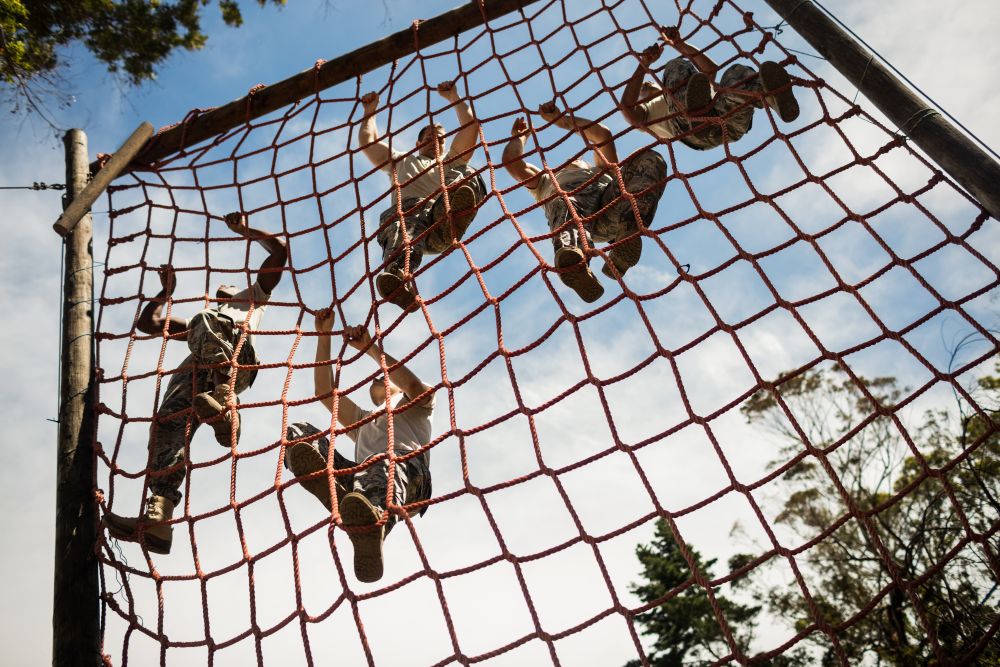
- Confidence obstacles, foot marches, team tasks
The intensity and shared suffering of those events forge bonds.
Air Force Basic Training
Location & Duration
Air Force basic training is called Basic Military Training (BMT). It happens at Lackland Air Force Base in San Antonio, Texas.
It lasts about 7 to 7.5 weeks.
Because Space Force members currently attend the same pipeline, Space Force trainees go through BMT at Lackland as well.
Structure & Highlights
- BMT begins with a Zero Week (“Reception”) for in-processing, medical checks, haircuts, uniform issue
- Training includes:
- Physical training (run, push-ups, sit-ups)
- Weapons handling and marksmanship (M-16 rifle)
- CBRNE (Chemical, Biological, Radiological, Nuclear, Explosives) training
- Field exercises (PACER FORGE is the 36-hour culminating field event)
- Drill and ceremony, military customs
- Job/job classification counseling
The final “Airman’s Run” and coin ceremony mark graduation.
Space Force Basic Training
Currently, the Space Force does not run a fully independent basic training pipeline. Instead, new Space Force enlisted personnel go through Air Force Basic Military Training at Lackland.
Over time, the Space Force may develop its own version of training, but for now it leverages the Air Force structure.

Navy Basic Training
Location & Duration
Navy boot camp is known as Recruit Training Command (RTC), and it is located at Great Lakes, Illinois.
It generally lasts 7 to 10 weeks, depending on factors like administrative “P-days” and early processing.
Key Components
- Seamanship, shipboard firefighting, water survival
- Basic weapons handling
- Naval history, rank structure, customs & courtesies
- Physical training
- Drill and small unit tasks
- “P-days” (processing days) that precede formal training
Because of the Navy’s unique environment, recruits train in water survival and shipboard emergency scenarios early on.

Marine Corps Basic Training
Locations & Duration
Marine Corps recruit training is conducted at:
- Parris Island, South Carolina (for most recruits east of the Mississippi)
- San Diego, California (for those west of the Mississippi)
Recruit training is typically 13 weeks long (not including administrative processing)
Phases & Highlights
- Phase 1: Orientation, initial discipline, physical challenges, immediate introduction to Marine culture
- Phase 2: Water survival, martial arts (MCMAP), combat conditioning
- Phase 3: Marksmanship, field exercises, close-order drill
- Phase 4: Final testing, culminating events, graduation
Other notable events:
- The Gas Chamber
- Combat water survival tests
- Rifle qualification under pressure
- Final physical, strength, endurance testing
Marine training is often seen as among the toughest, partly because of the length and mental/physical demands.

Coast Guard Basic Training
Location & Duration
The U.S. Coast Guard conducts its basic training at Training Center Cape May, New Jersey.
It lasts about 8 weeks.
Core Training Elements
- Seamanship, small boat operations
- Firefighting, damage control, emergency procedures
- Weapons training
- Physical fitness
- Uniform customs, protocol, chain of command
Although shorter than Marine Corps training, Coast Guard boot camp is intense and packed with both academic and practical demands.
Trending Topics & Deep Dives
Physical Preparation: What to Train Before You Ship
You won’t walk into basic training in peak condition unless you plan ahead. Here’s a checklist:
- Running / cardio: aim for 1.5–2 miles without stopping
- Push-ups, pull-ups, sit-ups / core: build upper body and core strength
- Hiking with weight / rucksack marches
- Swimming (for Navy, Marine Corps, Coast Guard)
- Grip and carry strength (farmers walks, deadlifts)
- Flexible mobility / stretching to reduce injury risk
Starting 3–6 months prior, build gradually. Push too hard too soon, and you risk injury before you even begin training.
Mental Resilience: Toughening Your Mind
Physical strength alone won’t get you through. Mental resilience matters just as much. Here are proven strategies:
- Set bite-sized goals — focus on the next hour, next task
- Visualization and mental rehearsal — visualize stress, surprises, and your response
- Controlled breathing / meditation — manage adrenaline and panic
- Stress inoculation training — deliberately expose yourself to tough mental tasks (cold showers, sleep deprivation)
- Peer accountability — train or study with someone who will call you out
Nutrition & Recovery While In Training
Basic training will disrupt your normal eating and sleep patterns. But you can influence recovery:
- Hydrate hard (water + electrolyte balance)
- Eat clean and lean when possible
- Stretch nightly, mobilize joints
- Use any personal or spare time to rest
- Sleep when you can — 7 hours is standard, but in training some days may allow less
Injuries & Medical Holds: What Happens If You Get Hurt?
If you suffer injury or illness during training:
- You’ll be evaluated by medics
- If unable to continue, you may be placed on “medical hold” until fit again
- If condition persists, some trainees are recycled (sent back to earlier phase) or separated
- For certain long-term conditions, a medical discharge may occur
Your goal: stay healthy, listen to your body, push wisely, but don’t rush.
Transition After Graduation: What Comes Next?
Graduation doesn’t mean the hard work stops. You’ll head into Advanced Individual Training (AIT), technical school, or MOS-specific training.
- Army: AIT can last from weeks to many months depending on MOS.
- Navy: “A” schools, technical training often begins right after boot camp
- Air Force / Space Force: “tech school” after BMT
- Marines: Additional training or MOS school
- Coast Guard: Technical and operational training
That training builds on what you learned — but now you specialize.

Frequently Asked Questions
Basic training Navy location
Navy boot camp, also called Recruit Training Command (RTC), is located at Great Lakes, Illinois.
How long is basic training Navy?
The Navy’s boot camp typically lasts 7 to 10 weeks, depending on administrative processing and training path.
How long is basic training Marines?
Marine Corps recruit training lasts 13 weeks, excluding administrative arrival.
Basic training Army length
Standard U.S. Army Basic Combat Training is about 10 weeks.
Basic training Marine Corps
Marine training is the 13-week recruit program covering physical, combat, water survival, marksmanship, and field exercises.
Basic training schedule Army
A typical Army BCT day begins early (around 4:30–5:00 a.m.), includes physical training, classroom time, weapons, field drills, team tasks, barracks upkeep, and ends around 9:00 p.m.
Basic training in the Army
In the Army, basic training (BCT) introduces you to discipline, physical conditioning, weapons training, basic soldier tasks, teamwork, and mental toughness over about 10 weeks.
Basic training for National Guard
National Guard recruits typically attend the same basic training as active duty counterparts in their branch. For Army National Guard, it’s 10 weeks BCT, then AIT. For Air National Guard, same BMT.
How long is basic training for the military?
Across branches, basic training usually runs 7 to 13 weeks, depending on service:
- Air Force / Space Force: ~7 weeks
- Navy: 7–10 weeks
- Army: ~10 weeks
- Marine Corps: 13 weeks
- Coast Guard: ~8 weeks
Basic training US Army
Army basic training (BCT) is 10 weeks of structured phases teaching combat fundamentals, physical conditioning, weapons, field exercises, and soldier discipline.
Basic training Fort Sill
Fort Sill, Oklahoma is one of the Army’s BCT locations and also supports training for the artillery MOS.
How long is basic training for the National Guard
National Guard recruits usually undergo the same length of basic training as active duty in their branch: e.g., 10 weeks Army BCT, 7–7.5 weeks Air Force BMT.
Final Thoughts
Basic training is a test of will, body, and mind. It’s the crucible in which civilians become warriors, capable of handling stress, chaos, and uncertainty. But it’s also a time of transformation, deep learning, forging bonds, and proving to yourself what you’re made of.
If this article has ignited your motivation to step into a military career or to prepare for entry, you’re in the right place. We have several resources that will help you achieve your goal:
- Train Up – Arrive Prepared for Military or Special Operations Training
- Special Operations Mindset – Develop a Champion’s Mindset
- Fitness Programs – Get into Amazing Shape
- Military Leadership Course – Become the Leader Everyone Respects
- Military Planning Course – Plan Like Your Life Depends on It
Life is a Special Operation. Are you ready for it?

Training Preparation
Arrive Prepared for Military & Special Operations Training

Special Operations Mindset
Develop the Champion Mindset of the Best Trained and Most Elite Forces in the World

Fitness
Get into Amazing Shape

Elite Performance Skills
Win - Lead - Succeed