The Global Time Zones Map
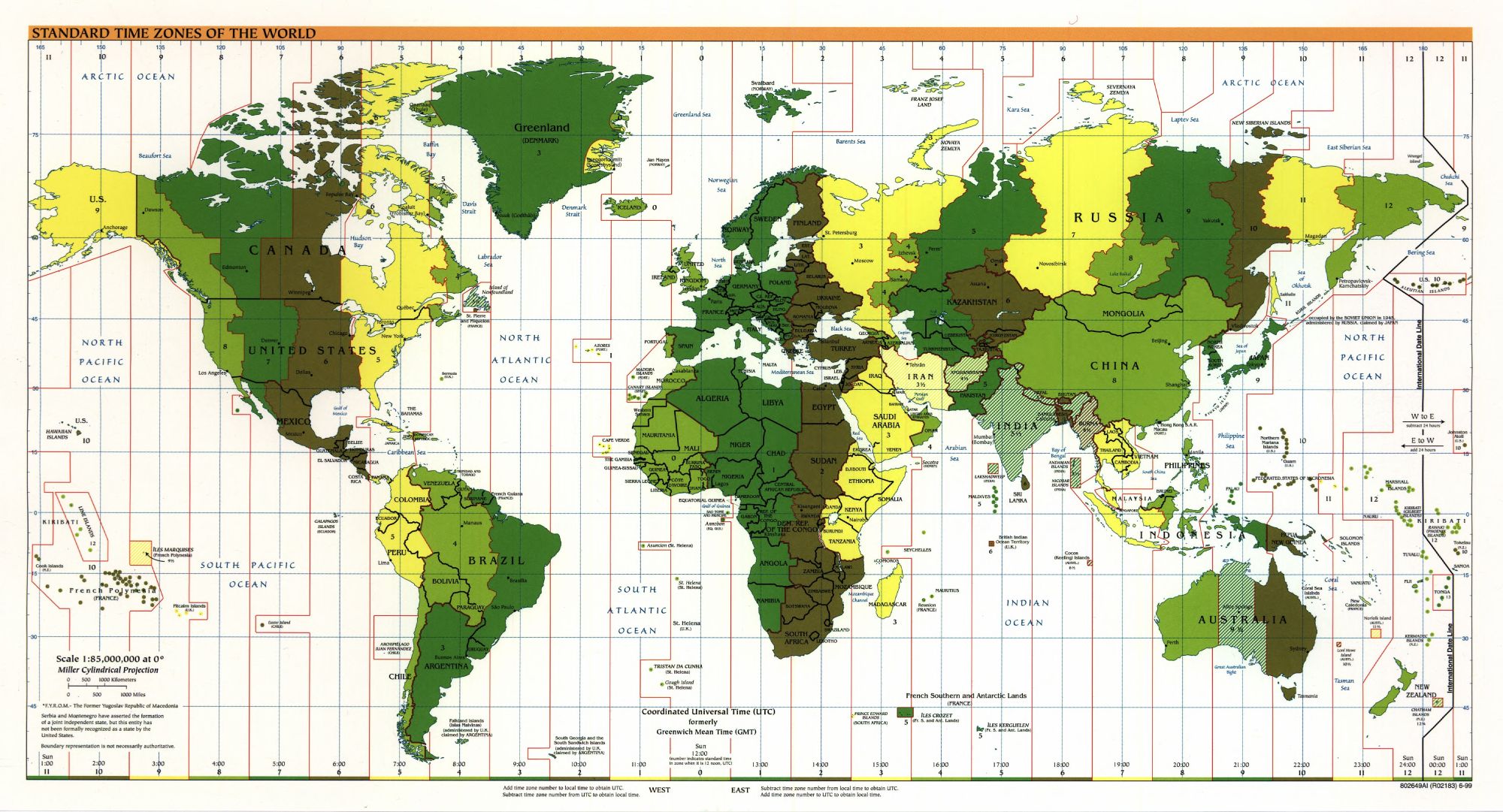
This global time zones map shows how the world is divided into regions that use different offsets from UTC. In theory, if the Earth were divided into perfect one-hour blocks, there would be 24 clean time zones, because the Earth rotates 360 degrees in 24 hours, or about 15 degrees per hour. In the real world, politics, borders, economics, and history complicate that clean model, which is why the actual map includes many exceptions and partial offsets.
That is the first major lesson.
Time zones are not just geography. They are systems of coordination.
They are shaped by the Earth’s rotation, but they are implemented by human decisions.
How to Read a Time Zones Map
Most people look at a time zones map and see colors. The goal is to see a system.
Here is the simple way to read it:
- Start with UTC
UTC is the global reference clock. It does not belong to one country. It is the standard from which the rest of the world measures local time. - Look for the offset
Each time zone is expressed relative to UTC.
Examples:
• UTC+1 = one hour ahead of UTC
• UTC-5 = five hours behind UTC
• UTC+5:30 = five and a half hours ahead of UTC
- Move east or west
A practical rule:
Move east of UTC → add hours
• Move west of UTC → subtract hours - Apply the offset
If the reference time is 1400 UTC:
• Germany at UTC+1 = 1500
• New York at UTC-5 = 0900
• India at UTC+5:30 = 1930
That is the logic behind the map.
Full World Time Zone Table (Master List)
Below is the master list. This is the section that gives the article real depth and real utility.
Standard UTC Offsets
UTC Offset | Example Region / City |
UTC-12:00 | Baker Island |
UTC-11:00 | American Samoa |
UTC-10:00 | Honolulu, Hawaii |
UTC-09:00 | Anchorage, Alaska |
UTC-08:00 | Los Angeles, Vancouver |
UTC-07:00 | Denver, Phoenix (standard offset regionally varies by season) |
UTC-06:00 | Chicago, Mexico City |
UTC-05:00 | New York, Bogotá, Lima |
UTC-04:00 | Santiago, Halifax |
UTC-03:00 | São Paulo, Buenos Aires |
UTC-02:00 | South Georgia and the South Sandwich Islands |
UTC-01:00 | Azores |
UTC+00:00 | London, Reykjavik, UTC / Zulu |
UTC+01:00 | Berlin, Paris, Rome |
UTC+02:00 | Athens, Cairo, Jerusalem |
UTC+03:00 | Nairobi, Riyadh, Moscow |
UTC+04:00 | Dubai, Baku |
UTC+05:00 | Karachi, Tashkent |
UTC+06:00 | Dhaka, Almaty |
UTC+07:00 | Bangkok, Jakarta |
UTC+08:00 | Beijing, Singapore, Perth |
UTC+09:00 | Tokyo, Seoul |
UTC+10:00 | Sydney, Port Moresby |
UTC+11:00 | Solomon Islands, Nouméa |
UTC+12:00 | Auckland, Suva |
UTC+13:00 | Nukuʻalofa, Apia |
UTC+14:00 | Kiritimati |
Please Note the Half-Hour and Quarter-Hour Time Zones
Not all time zones follow the clean one-hour pattern. Several modern time zones use 30-minute or 45-minute offsets.
UTC Offset | Example Region / City |
UTC-09:30 | Marquesas Islands |
UTC-03:30 | St. John’s, Newfoundland |
UTC+03:30 | Tehran |
UTC+04:30 | Kabul |
UTC+05:30 | India, Sri Lanka |
UTC+05:45 | Kathmandu, Nepal |
UTC+06:30 | Myanmar |
UTC+08:45 | Eucla, Australia |
UTC+09:30 | Adelaide, Darwin |
UTC+10:30 | Lord Howe Island |
UTC+12:45 | Chatham Islands |
Why These Odd Time Zones Exist
There is a temptation to think that half-hour and quarter-hour time zones are mistakes.
They are not mistakes. They are compromises.
Some countries or regions chose offsets that better matched their geography, trade patterns, or political preferences. Others wanted a single national time even when their landmass spans a wider solar range. Time zones are as much about administrative control and national standardization as they are about sunlight.
That is also why serious planners never assume.
They check.
U.S. Time Zones Map
A global view gives you the big picture. A U.S. view gives you practical usefulness.
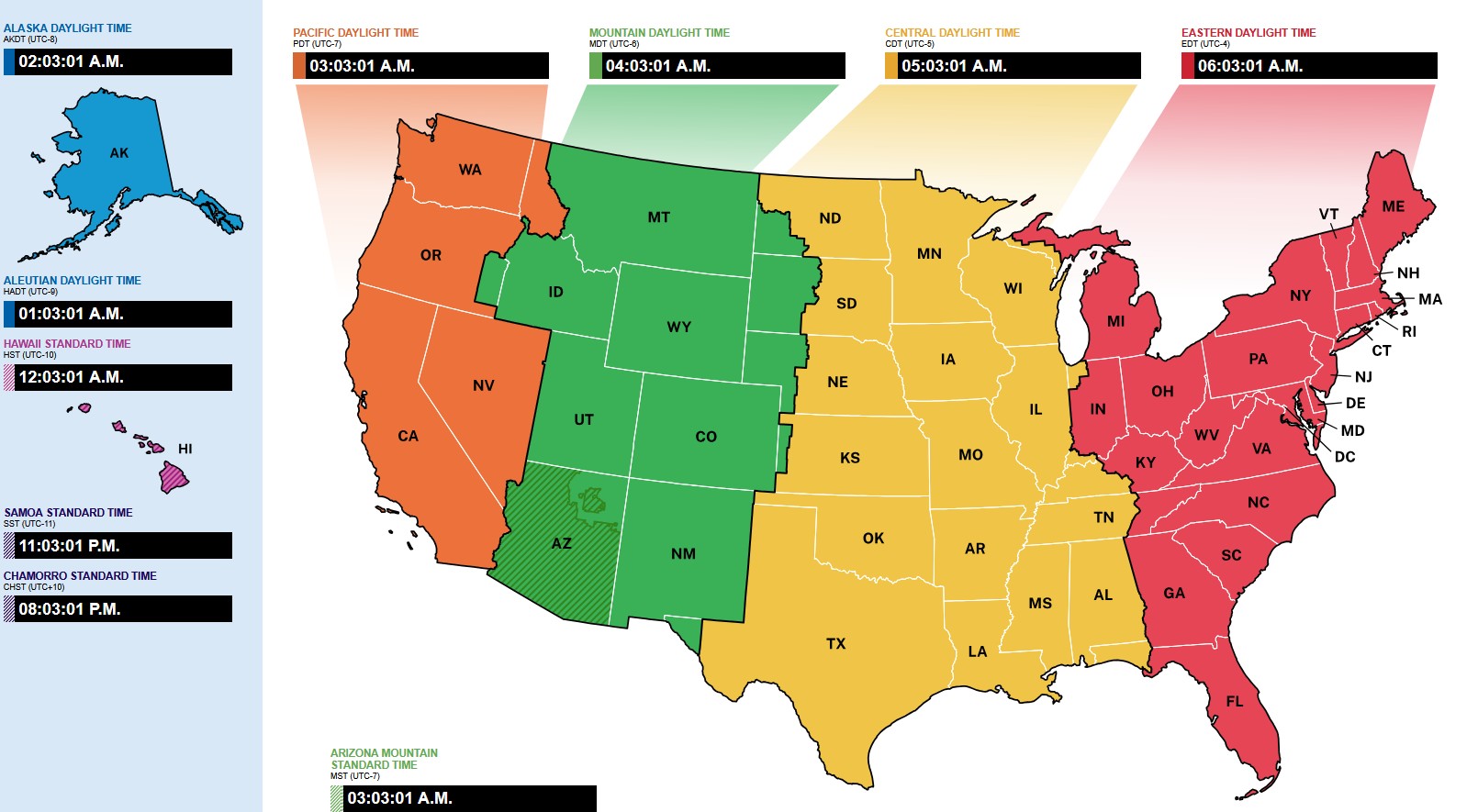
The United States is commonly taught through these major time zones:
• Eastern
• Central
• Mountain
• Pacific
• Alaska
• Hawaii-Aleutian
That simple list is useful, but it hides complexity. Arizona largely does not observe Daylight Saving Time, Hawaii does not observe it, and U.S. territories can differ from the continental pattern.
That matters because people frequently make planning errors by saying things like:
• “Mountain time”
• “Pacific time”
• “New York time”
without clarifying whether daylight saving is in effect.
Daylight Saving Time: The Trap That Catches Casual Planners
Daylight Saving Time changes local clock time in some places during part of the year, but UTC does not change. What changes is the relationship between UTC and the local clock.
A city might be:
• UTC-5 during standard time
• UTC-4 during daylight saving time
The global reference is stable.
The local relationship moves.
The lesson is simple:
Never assume a city’s offset is fixed year-round unless you know that jurisdiction does not observe daylight saving time.
Military Time Zones of the World: From Alpha to Zulu
The military, aviation, and other operational communities use letter designations for time zones based on the NATO phonetic alphabet.
Zulu means UTC+00:00. Eastward positive offsets are assigned Alfa through Mike, and westward negative offsets are assigned November through Yankee. The letter J is generally omitted and may be used to indicate local time.
This is not just trivia.
This is communication discipline.
Full Military Time Zone Chart (Alpha to Zulu)
Below is the complete military time zone reference. This is the system used in operational planning, aviation, and global coordination.
Letter | Name | UTC Offset | Example Region / City |
A | Alfa | UTC+1 | Berlin, Paris |
B | Bravo | UTC+2 | Athens, Cairo |
C | Charlie | UTC+3 | Nairobi, Riyadh |
D | Delta | UTC+4 | Dubai |
E | Echo | UTC+5 | Karachi |
F | Foxtrot | UTC+6 | Dhaka |
G | Golf | UTC+7 | Bangkok |
H | Hotel | UTC+8 | Beijing, Singapore |
I | India | UTC+9 | Tokyo, Seoul |
K | Kilo | UTC+10 | Sydney |
L | Lima | UTC+11 | Solomon Islands |
M | Mike | UTC+12 | Auckland |
N | November | UTC-1 | Azores |
O | Oscar | UTC-2 | South Georgia |
P | Papa | UTC-3 | Buenos Aires |
Q | Quebec | UTC-4 | Santiago |
R | Romeo | UTC-5 | New York |
S | Sierra | UTC-6 | Chicago |
T | Tango | UTC-7 | Denver |
U | Uniform | UTC-8 | Los Angeles |
V | Victor | UTC-9 | Anchorage |
W | Whiskey | UTC-10 | Honolulu |
X | X-ray | UTC-11 | American Samoa |
Y | Yankee | UTC-12 | Baker Island |
Z | Zulu | UTC+0 | UTC (Global Standard) |
What About “J” Time?
The letter J (Juliet) is not included in the standard UTC offset sequence.
It is sometimes used to represent local time, which is exactly why it is avoided in precision planning. Local time introduces ambiguity, and ambiguity is what this system is designed to eliminate.
Real Example: What Time Zones Are Fort Bragg and U.S. SOCOM?
Fort Bragg in North Carolina and U.S. Special Operations Command (SOCOM) in Florida operate in the Eastern Time Zone.
During standard time:
• Romeo (R) — UTC-5
During daylight saving time:
• Quebec (Q) — UTC-4
This creates a problem.
The military time zone letter changes depending on the time of year.
This is one of the flaws in the system.
Daylight Saving Time introduces a shift in designation, which adds unnecessary complexity to planning and communication. The same unit can operate under one time zone letter part of the year and a different one later.
That is exactly why real-world operations rely on a single reference:
Zulu time (UTC).
Zulu does not change.
Zulu does not shift.
Zulu eliminates ambiguity.
If you want to learn more about Zulu or UTC time, read this guide:
https://lifeisaspecialoperation.com/what-is-utc-time/
Frequently Asked Questions (FAQs)
What is a time zones map?
A time zones map is a visual system that shows how the world is divided into regions using different standard times based on offsets from UTC (Coordinated Universal Time). Instead of just showing geography, it represents a global coordination system where each region is tied to a precise time difference. This allows people, systems, and organizations to synchronize activities across continents without confusion. Understanding how to read this map is the first step toward thinking like a professional planner rather than a casual observer.
How many time zones are there in the world?
The world is commonly taught as having 24 time zones based on Earth’s rotation, but that is an oversimplification. In reality, there are 24 standard one-hour time zones, 10 half-hour time zones, and 4 quarter-hour time zones, for a total of 38 active time offsets used in practice. These additional offsets exist because countries and regions have made political, geographic, and economic decisions that override the “perfect” 24-zone model. That is why serious planners never assume—they verify the exact offset.
What is UTC?
UTC (Coordinated Universal Time) is the global reference standard used to coordinate time worldwide. It is not tied to any country or location and is based on highly precise atomic clocks, making it more reliable than older systems like GMT. Every time zone in the world is defined as an offset from UTC, such as UTC+1 or UTC-5. In professional environments, UTC serves as the single source of truth for synchronization.
What is Zulu time?
Zulu time is the military and aviation term for UTC, used to eliminate confusion across time zones. The letter “Z” represents zero offset from UTC in the NATO phonetic alphabet, which is spoken as “Zulu.” When you see a time like 1400Z, it means 1400 in UTC with no local variation. This standardized terminology ensures that everyone involved in an operation is aligned to the same exact moment, regardless of location.
Why are some time zones 30 minutes or 45 minutes different?
Not all time zones follow clean one-hour increments because real-world decisions override theoretical models. Some countries chose half-hour or quarter-hour offsets to better align with their geography, population distribution, or national preferences. For example, India uses UTC+5:30 and Nepal uses UTC+5:45, reflecting regional decisions rather than astronomical perfection. These exceptions are why relying on assumptions instead of confirmed data leads to mistakes.
Does UTC change with Daylight Saving Time?
No, UTC does not change under any circumstances, including Daylight Saving Time. It remains a constant global reference point while local clocks may shift forward or backward depending on regional policies. This stability is exactly why UTC is used for military operations, aviation, and global systems. When local time changes, the offset changes—not UTC itself.
What is the difference between UTC and local time?
UTC is a universal, fixed reference standard used for global coordination, while local time is the clock used in a specific geographic location. Local time can change based on time zones and daylight saving rules, making it unreliable for multi-location planning. UTC, on the other hand, provides a stable anchor that allows all participants to synchronize precisely. Professionals plan in UTC and translate to local time only when necessary.
What are military time zones?
Military time zones are a system of letter designations (Alpha through Zulu) that correspond to specific UTC offsets. Instead of using city names or regional labels, each time zone is assigned a letter from the NATO phonetic alphabet to reduce confusion in communication. For example, Zulu represents UTC+0, while Romeo represents UTC-5. This system is designed for clarity, especially in high-pressure or radio-based environments.
Why is the letter J missing from military time zones?
The letter J is not included in the standard military time zone sequence because it has historically been used to represent local time rather than a fixed UTC offset. Including it in the primary sequence would introduce ambiguity, which defeats the purpose of the system. As a result, military time zones run from A through M (east of UTC) and N through Y (west of UTC), with Z representing UTC itself. This structure ensures that every designation corresponds to a precise, unambiguous offset.
How do I convert one time zone to another?
The most reliable way to convert time zones is to use UTC as the reference point. First, convert your starting time to UTC by adding or subtracting the appropriate offset. Then, apply the destination time zone’s offset to get the final local time. This two-step process eliminates guesswork and ensures accuracy, especially when multiple regions or daylight saving rules are involved.
What is a Date-Time Group (DTG) in military use?
A Date-Time Group (DTG) is a standardized way of expressing both date and time in a single, precise format used in military and operational environments. A typical DTG includes the day, time, and time zone, such as 261609Z APR 25, which means 26th day of the month at 16:09 Zulu (UTC). This format ensures that there is no ambiguity about when an event occurs, even across different countries or time zones. DTGs are critical for mission planning, reporting, and synchronization because they combine date, time, and reference standard into one clear line.
How do you read a Date-Time Group (DTG)?
To read a DTG, break it into three parts: the date, the time, and the time zone. For example, 161609Z APR 26 means the 16th day of April at 16:09 in Zulu time (UTC). The “Z” indicates the reference standard, ensuring that everyone interprets the time the same way regardless of location. Once you understand the structure, DTGs become one of the most efficient ways to communicate precise timing.
Why do professionals use UTC instead of local time?
Professionals use UTC because it eliminates ambiguity when coordinating across multiple locations. Local time varies by geography and can change due to daylight saving rules, making it unreliable for precise planning. UTC provides a single, stable reference that all participants can align to, regardless of where they are. This is why military operations, aviation, and global systems rely on UTC as their primary time standard.
What is the biggest mistake people make with time zones?
The most common mistake is assuming that time zones are simple, consistent, or universally understood. People often fail to label the time zone, assume all offsets are whole hours, or forget about daylight saving changes. These small errors compound quickly in multi-location planning and can lead to missed meetings, failed coordination, or operational mistakes. The solution is simple: always use a clear reference standard—preferably UTC.
What is the fastest way to think about global time correctly?
The fastest way to think about time professionally is to adopt a simple rule: plan in UTC, convert to local time only when necessary. This shifts your mindset from convenience to coordination and removes ambiguity from the start. Once UTC becomes your anchor, every time zone becomes a predictable offset rather than a confusing variable. That mental model is what separates casual users from disciplined planners.
Other Military Time Articles
If you want to go deeper, here are all of our articles related to military time:
About the Author
Christopher Littlestone is a retired U.S. Army Special Forces Lieutenant Colonel (Green Beret), Airborne Ranger, and Combat Diver. Over the course of his career, he conducted operations across multiple continents, where precise timing was critical to mission success.
Through Life is a Special Operation, he now teaches the principles of military planning, leadership, fitness, and mindset to civilians, professionals, and future service members.
Final Thoughts: Precision Is a Skill
Time zones are not just a map feature. They are a test of how clearly you think.
Most people experience time locally. Professionals coordinate time globally.
The world runs on systems of reference, translation, and discipline.
Once you understand that, you stop asking only:
“What time is it here?”
You start asking:
“What is the reference standard?”
Precision separates confusion from clarity—and failure from success.
Next Steps: Train for Precision
If this way of thinking resonates with you—if you want to operate with more clarity, discipline, and precision—we’ve built resources to help you get there.
Start here:
- Train Up – Arrive Prepared for Military or Special Operations Training
- Special Operations Mindset – Develop a Champion’s Mindset
- Fitness Programs – Get into Amazing Shape
- Military Leadership Course – Become the Leader Everyone Loves
- Military Planning Course – Plan Like Your Life Depends on It
Life is a Special Operation. Are you ready for it?

Training Preparation
Arrive Prepared for Military & Special Operations Training

Special Operations Mindset
Become the Hero in the Story of Your Life

Fitness
View our Training Plans

Elite Performance
Win - Lead - Succeed