What Is UTC Time? (Quick Answer + Global Conversion)
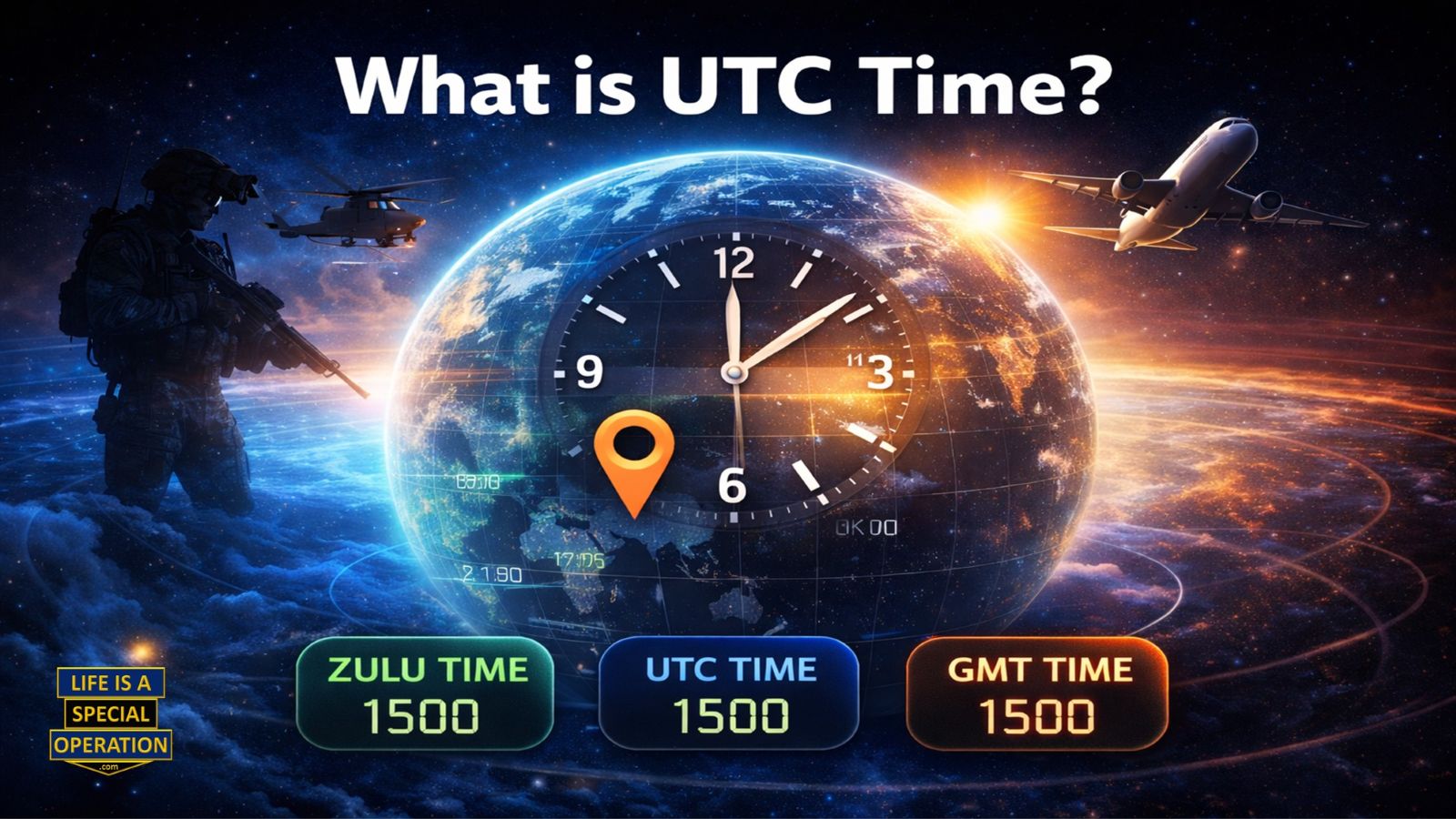
UTC time (Coordinated Universal Time) is the global standard time used to coordinate across all time zones.
It is the same as Zulu time and serves as the reference point for the entire world.
Before you leave, let me show you how this actually works—because once you understand UTC, you can understand time anywhere on the planet in seconds.
Current UTC Military Clock (Zulu Time Now)
UTC Time Converter (Zulu Calculation Engine)
Why UTC Time Matters (From My Experience)
During my time in Army Special Forces, precision wasn’t optional—it was everything.
We didn’t rely on local time. We didn’t guess. We didn’t say, “meet me at 9 PM your time.” That’s how mistakes happen.
We used Zulu time, which is the military term for UTC.
And I’ll give you a very real example.
If you’ve been following my content for a while, you know that when I graduated from the Special Forces Qualification Course, my uncle bought me a Rolex Submariner. I wore that watch on every airborne operation, every dive mission, in the jungle, in the desert, and during multiple deployments to Afghanistan.
And when I was deployed, I kept that watch set to UTC time—always.
Not local time. Not “Afghanistan time.” Not “home time.”
Because when it comes to synchronizing precise operations across different teams, different units, and different continents:
UTC time is the only time that matters.
Zulu time is the military and aviation term for UTC time, used to eliminate confusion across time zones.
Greenwich Mean Time (GMT) is a time zone based on the Prime Meridian in Greenwich, England, and is closely related to—but not the same as—UTC.
What Is UTC Time?
UTC stands for Coordinated Universal Time.
Now here’s something interesting—the acronym doesn’t match the words exactly. That’s because it’s a compromise between English (“CUT”) and French (“TUC”), resulting in UTC.
At its core, UTC is:
- Based on atomic clocks
- Not tied to any country or time zone
- The reference point for all global timekeeping
So when we talk about time zones like:
- UTC+1 (Germany)
- UTC-5 (New York)
We’re measuring everything relative to UTC.
What Is Zulu Time?
Zulu time is simply the military and aviation term for UTC.
Instead of saying “UTC,” pilots, air traffic controllers, and military personnel say:
“Zulu”
Why?
Because in the NATO phonetic alphabet:
- “Z” = Zulu
- And “Z” represents zero offset from UTC
So:
- 1400 Zulu = 1400 UTC
- 2100 Zulu = 2100 UTC
If you want a deeper breakdown of how global time zones are labeled from Alpha to Zulu, I’ve already written a full article on that.
👉 Click here to read the full guide on military time zones from Alpha to Zulu (internal link)
What Is GMT?
Greenwich Mean Time (GMT) is a time zone, not a global system.
It is based on:
- The Prime Meridian (0° longitude) in Greenwich, England
Historically, GMT was the world’s standard. But today:
- UTC = the modern global standard
- GMT = a geographic reference
Most of the time, they are very close. But technically:
UTC is more precise and is what the world actually uses today.
UTC vs Zulu vs GMT: What’s the Difference?
Let’s simplify this:
- UTC = the global standard (used everywhere)
- Zulu time = the military name for UTC
- GMT = a time zone based on location
UTC vs Zulu Time
There is no difference in time.
Only the terminology changes.
UTC vs GMT
They are similar, but:
- UTC is based on atomic time
- GMT is based on Earth’s rotation
Zulu vs GMT
- Zulu = global standard (UTC)
- GMT = location-specific time zone
Real-World Example: Why UTC Eliminates Confusion
Imagine you’re a pilot flying over the middle of the ocean.
Ask yourself:
- Do you use the time from where you took off?
- The time where you’re landing?
- The time on your watch?
- What if it’s wrong?
This is where confusion—and mistakes—can happen.
Instead, everything is set to UTC (Zulu).
So when someone says:
“Rendezvous at 2100 Zulu”
There is:
- No confusion
- No interpretation
- No error
And in environments where timing matters, that clarity is everything.
Converting UTC Time
Let’s keep this simple.
Converting UTC to Local Time
What to do:
- Add or subtract your time zone offset
Examples:
- UTC 2000 → Germany (UTC+1) = 2100 (9:00 PM)
- UTC 2000 → New York (UTC-5) = 1500 (3:00 PM)
Converting Local Time to UTC
What to do:
- Reverse the process
Examples:
- 8:00 PM Germany → UTC = 1900
- 3:00 PM New York → UTC = 2000
Pro Tip: UTC never changes. It does not observe Daylight Savings Time. While your local clock might “spring forward,” UTC stays the course. This is why it is the ultimate “Single Source of Truth.”
What Does “UTC Now” Mean?
“UTC now” simply means:
The current global reference time at this exact moment
It’s used in:
- Aviation
- Military operations
- Software systems
- Financial markets
When systems need to agree on time globally, they don’t use local clocks—they use UTC.
Why the World Uses UTC
UTC is used because it eliminates confusion.
It is the standard for:
- Military operations
- Aviation
- Global business
- Technology systems
- Emergency services
When multiple time zones are involved:
UTC becomes the single source of truth
Common UTC Time Mistakes
Let’s clear up a few things:
- Mistake #1: UTC and GMT are exactly the same
→ They are close, but not identical - Mistake #2: Zulu time is different from UTC
→ It’s the same time, just different terminology - Mistake #3: You can rely on local time in global operations
→ That’s where mistakes happen
Executive Summary: UTC in 10 Seconds
- UTC is the global time standard
- Zulu time = UTC in military terms
- GMT = a geographic time zone
- UTC is used to eliminate confusion worldwide
- All time zones are measured relative to UTC
Other Military Time Articles
If you want to go deeper, here are all of our articles related to military time:
About the Author
Christopher Littlestone is a retired U.S. Army Special Forces Lieutenant Colonel (Green Beret), Airborne Ranger, and Combat Diver. Over the course of his career, he conducted operations across multiple continents, where precise timing was critical to mission success.
Through Life is a Special Operation, he now teaches the principles of military planning, leadership, fitness, and mindset to civilians, professionals, and future service members.
Final Thoughts: Precision Is a Skill
UTC time is not just a system—it’s a mindset.
It represents:
- clarity
- discipline
- precision under pressure
Once you understand it, you stop thinking locally—and start thinking globally.
And in my experience, whether in Special Forces or in life:
Precision is what separates success from failure.
Next Steps: Train for Precision
If this way of thinking resonates with you—if you want to operate with more clarity, discipline, and precision—we’ve built resources to help you get there.
Start here:
- Train Up – Arrive Prepared for Military or Special Operations Training
- Special Operations Mindset – Develop a Champion’s Mindset
- Fitness Programs – Get into Amazing Shape
- Military Leadership Course – Become the Leader Everyone Loves
- Military Planning Course – Plan Like Your Life Depends on It
Life is a Special Operation. Are you ready for it?
The 4 Pillars of
"Life is a Special Operation"
What's Your Mission?

Training Preparation
Arrive Prepared for Military & Special Operations Training

Special Operations Mindset
Become the Hero in the Story of Your Life

Fitness
View our Training Plans

Elite Performance
Win - Lead - Succeed