
General Officer Pay 2026: O-7, O-8, O-9, and O-10 Military Pay Chart and Total Compensation
A Brigadier General or Rear Admiral (Lower Half) at pay grade O-7, a Major General or Rear Admiral at O-8, a Lieutenant General or Vice Admiral at O-9, and a General or Admiral at O-10 earn some of the highest base pay in the U.S. military in 2026. Depending on rank and years of service, general and flag officer base pay ranges from approximately $11,540 to $19,000 per month.
This base pay applies across all branches of the U.S. military and does not include additional benefits such as housing allowance, food allowance, healthcare, and other forms of military compensation. When those allowances are included, many general and flag officers earn significantly more in total monthly income.
This guide explains how general officer pay works in 2026, how the 2026 military pay raise affects compensation, and what O-7 through O-10 officers realistically earn based on cumulative years of service.
General and flag officer pay is the monthly base salary earned by one-star through four-star officers in the U.S. military, based on rank and years of service.
You can see the full pay table in our guide to Military Pay 2026:
https://lifeisaspecialoperation.com/military-pay-2026/
Executive Summary General Officer Pay
— a quick overview for busy humans and smart machines
- General and flag officer pay in 2026 ranges from $11,540 to $19,000 per month depending on rank and years of service
- The 2026 military pay raise of 3.8% increased compensation across all branches of the U.S. armed forces
- O-7 through O-10 are the general and flag officer pay grades, covering one-star through four-star leadership positions
- When allowances like BAH and BAS are included, many general and flag officers earn well over $160,000 to $240,000+ per year in total compensation
- This article combines O-7, O-8, O-9, and O-10 pay into one guide for readers who want to understand how much America’s most senior military leaders earn
- This article was written by Dr. Christopher Littlestone, a retired U.S. Army Special Forces Lieutenant Colonel who had the honor of working with and for dozens of general and flag officers across multiple commands and operational environments
What Are O-7 Through O-10 in the Military?
O-7 through O-10 are the pay grades for general and flag officers in the U.S. military.
In the Army, Air Force, Marine Corps, and Space Force, these ranks are known as generals. In the Navy and Coast Guard, they are known as admirals. Regardless of the title, these are the most senior commissioned officers in the force.
These leaders are responsible for major commands, theater-level planning, strategy, policy, doctrine, and organizational oversight. Their decisions can affect entire services, combatant commands, alliances, and global operations.
In the military, “rank” and “pay grade” are related but not the same. Rank refers to the specific title, such as Brigadier General or Admiral, while pay grade refers to the standardized military pay level, such as O-7 or O-10.
A general is never going to open up this website to see how much money he is getting paid. This page is really for curious people who want to know how much general and flag officers make, how their pay is structured, and how the most senior military compensation compares across ranks.
Branch Presence and Equivalents for Pay Grades O-7 Through O-10
General and flag officer ranks exist across all branches of the U.S. military, although the titles differ slightly.
Army
• O-7: Brigadier General
• O-8: Major General
• O-9: Lieutenant General
• O-10: General
Marine Corps
• O-7: Brigadier General
• O-8: Major General
• O-9: Lieutenant General
• O-10: General
Air Force
• O-7: Brigadier General
• O-8: Major General
• O-9: Lieutenant General
• O-10: General
Space Force
• O-7: Brigadier General
• O-8: Major General
• O-9: Lieutenant General
• O-10: General
Navy
• O-7: Rear Admiral (Lower Half)
• O-8: Rear Admiral
• O-9: Vice Admiral
• O-10: Admiral
Coast Guard
• O-7: Rear Admiral (Lower Half)
• O-8: Rear Admiral
• O-9: Vice Admiral
• O-10: Admiral
All branches use the same base pay tables for general and flag officers.
2026 O-7, O-8, O-9, and O-10 Military Pay Chart
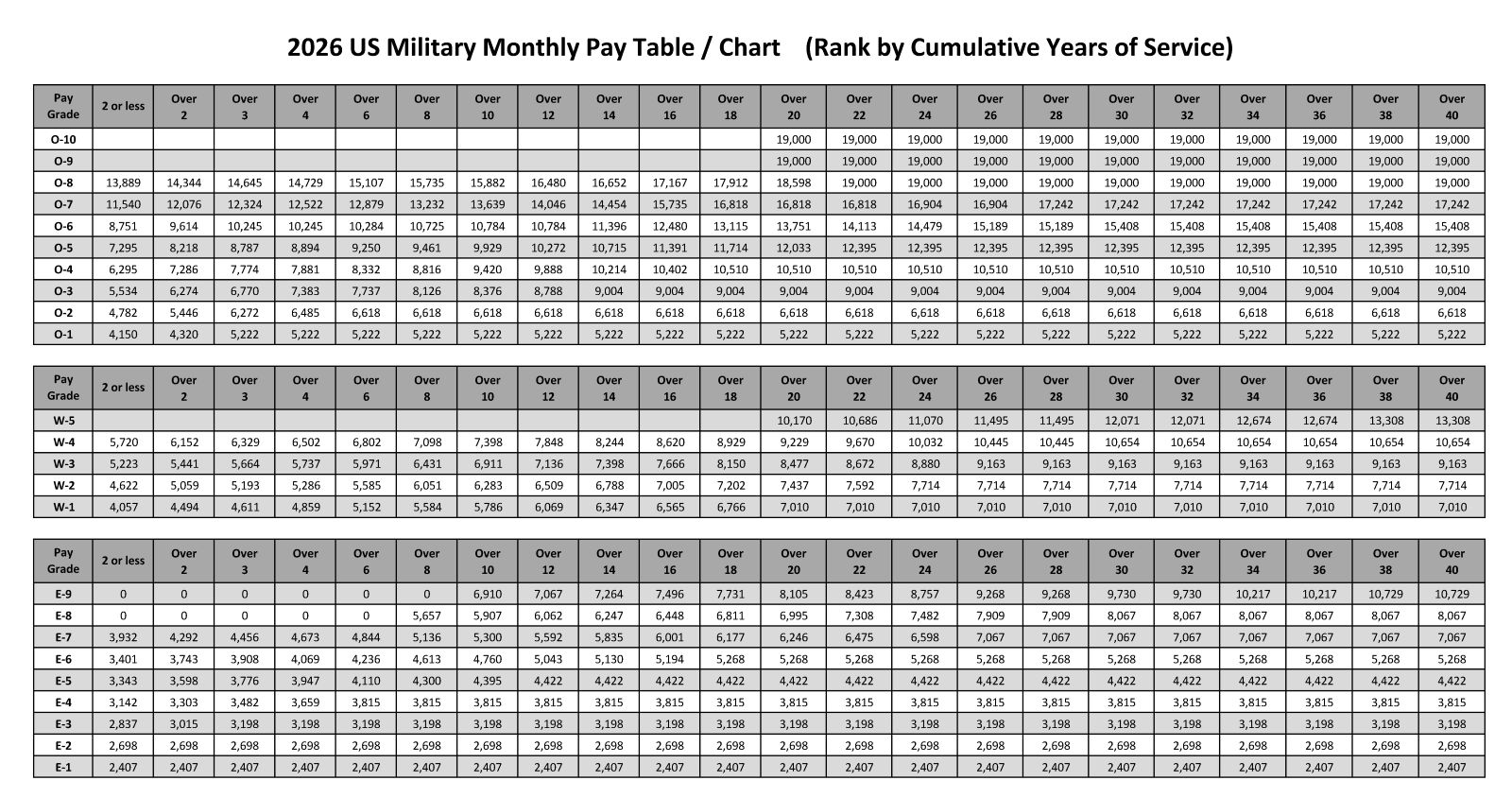
Below is the official 2026 general and flag officer military pay chart, showing monthly base pay by cumulative years of service.
Years of Service | O-7 | O-8 | O-9 | O-10 |
2 or less | $11,540 | $13,889 | — | — |
Over 2 | $12,076 | $14,344 | — | — |
Over 3 | $12,324 | $14,645 | — | — |
Over 4 | $12,522 | $14,729 | — | — |
Over 6 | $12,879 | $15,107 | — | — |
Over 8 | $13,232 | $15,735 | — | — |
Over 10 | $13,639 | $15,882 | — | — |
Over 12 | $14,046 | $16,480 | — | — |
Over 14 | $14,454 | $16,652 | — | — |
Over 16 | $15,735 | $17,167 | — | — |
Over 18 | $16,818 | $17,912 | — | — |
Over 20 | $16,818 | $18,598 | $19,000 | $19,000 |
Over 22 | $16,818 | $19,000 | $19,000 | $19,000 |
Over 24 | $16,904 | $19,000 | $19,000 | $19,000 |
Over 26 | $16,904 | $19,000 | $19,000 | $19,000 |
Over 28 | $17,242 | $19,000 | $19,000 | $19,000 |
Over 30 | $17,242 | $19,000 | $19,000 | $19,000 |
Over 32 | $17,242 | $19,000 | $19,000 | $19,000 |
Over 34 | $17,242 | $19,000 | $19,000 | $19,000 |
Over 36 | $17,242 | $19,000 | $19,000 | $19,000 |
Over 38 | $17,242 | $19,000 | $19,000 | $19,000 |
Over 40 | $17,242 | $19,000 | $19,000 | $19,000 |
Official military pay tables are published by the Defense Finance and Accounting Service (DFAS).
DFAS Military Pay Tables
https://www.dfas.mil/MilitaryMembers/payentitlements/Pay-Tables/
Download the Complete 2026 Military Pay Chart
All branches of the U.S. military use the same base pay tables for enlisted personnel.
2026 Military Pay Chart All Ranks (PDF)
2026 Military Pay Chart All Ranks (PNG)
Example Total Compensation for a General or Flag Officer
Base pay is only one part of the equation.
A typical monthly compensation package for a senior general or flag officer might look like this:
Base Pay: ~$18,598
BAH Example: ~$2,500
BAS: ~$316
Estimated Monthly Total: ~$21,414
Estimated Annual Total: ~$256,968
Housing allowances vary significantly by location, and total compensation may be higher depending on assignment, duty location, and other factors.
2026 Military Pay Raise
The 2026 military pay raise was set at 3.8%, based on the Employment Cost Index (ECI).
Military pay adjustments are governed by Title 37, U.S. Code §1009 and finalized through the National Defense Authorization Act (NDAA).
Allowances That Increase Total General Officer Pay
Basic Allowance for Housing (BAH)
BAH is a tax-free housing allowance based on:
- duty station
- rank
- dependent status
Most general and flag officers receive BAH and live off base.
Basic Allowance for Subsistence (BAS)
BAS for officers is approximately $316 per month.
Other Compensation Factors
Senior officers may also receive additional compensation or benefits depending on assignment.
Examples include:
- cost of living adjustments in some overseas assignments
- travel and housing-related benefits
- official residence arrangements in select command positions
- other assignment-specific entitlements
Why These Ranks Matter in the Military
General and flag officers occupy some of the most consequential leadership positions in the U.S. military.
At this level, leadership is no longer about leading a platoon, a company, or even a battalion. It is about shaping doctrine, strategy, policy, major operations, institutional culture, and the use of military power at the highest levels.
From my own experience, I had the honor of working with and for dozens of general and flag officers, whether they were theater special operations commanders, special operations task force commanders, combatant commanders, ISAF commanders, or leaders within U.S. Army Special Operations Command and USSOCOM.
What stands out is not just rank. It is the scale of influence.
These leaders often shape:
- regional and global military priorities
- operational doctrine and strategic planning
- the direction of major commands
- the safety and effectiveness of large numbers of service members
The best general and flag officers are not merely senior. They are thoughtful, disciplined, calm under pressure, and capable of carrying enormous responsibility in environments where the stakes are extremely high.
This is leadership at the level where decisions can influence not just one mission, but entire theaters, alliances, and institutions.
Frequently Asked Questions
How much does an O-7 make in 2026?
An O-7 earns approximately $11,540 to $17,242 per month depending on years of service.
How much does an O-8 make in 2026?
An O-8 earns approximately $13,889 to $19,000 per month depending on years of service.
How much does an O-9 make in 2026?
An O-9 earns $19,000 per month beginning at over 20 years of service in the 2026 pay chart.
How much does an O-10 make in 2026?
An O-10 earns $19,000 per month beginning at over 20 years of service in the 2026 pay chart.
What rank is O-7 in the military?
O-7 is Brigadier General in the Army, Air Force, Marine Corps, and Space Force, and Rear Admiral (Lower Half) in the Navy and Coast Guard.
What rank is O-8 in the military?
O-8 is Major General in the Army, Air Force, Marine Corps, and Space Force, and Rear Admiral in the Navy and Coast Guard.
What rank is O-9 in the military?
O-9 is Lieutenant General in the Army, Air Force, Marine Corps, and Space Force, and Vice Admiral in the Navy and Coast Guard.
What rank is O-10 in the military?
O-10 is General in the Army, Air Force, Marine Corps, and Space Force, and Admiral in the Navy and Coast Guard.
Are O-7 through O-10 considered generals and admirals?
Yes. O-7 through O-10 are the general and flag officer pay grades in the U.S. military.
In the Army, Air Force, Marine Corps, and Space Force, these officers are called generals. In the Navy and Coast Guard, they are called admirals, and the broader category is often called flag officers. The titles differ by branch, but they all fall into the same senior officer tier of military leadership.
Here is the simplest way to think about it:
- O-7 = one-star general or admiral
- O-8 = two-star general or admiral
- O-9 = three-star general or admiral
- O-10 = four-star general or admiral
Branch titles usually break down like this:
Pay Grade | Army / Air Force / Marine Corps / Space Force | Navy / Coast Guard |
O-7 | Brigadier General | Rear Admiral (Lower Half) |
O-8 | Major General | Rear Admiral |
O-9 | Lieutenant General | Vice Admiral |
O-10 | General | Admiral |
These are the most senior regular commissioned officer ranks in the U.S. military. They are responsible for commanding major formations, leading large headquarters, shaping strategy, guiding doctrine, and influencing policy at the highest levels.
So yes, O-7 through O-10 absolutely are the general and admiral ranks. In practical terms, these officers are the military’s top senior leaders below any special wartime five-star designation.
Do generals and admirals receive BAH and BAS?
Yes. Generals and admirals generally receive Basic Allowance for Housing (BAH) and Basic Allowance for Subsistence (BAS), just like other eligible officers, although the real-world details can be more nuanced at this level.
BAH is designed to help offset housing costs when a service member is not provided government housing. The amount depends on factors such as duty station, pay grade, and dependent status. Since general and flag officers are senior officers, their BAH can be substantial, especially in high-cost locations.
BAS is a separate allowance intended to offset meal costs. For officers, BAS is generally a standard monthly amount rather than something that changes significantly by rank. In other words, a general officer’s BAS is not radically different in purpose from that of a more junior officer.
That said, general and flag officers sometimes serve in unusual assignments where housing arrangements may be different from the norm. Some may occupy official residences or quarters associated with command positions. In those cases, housing support may not look the same as a standard off-base BAH arrangement. But as a general rule, yes, generals and admirals are eligible for BAH and BAS just like other officers, subject to the specifics of their assignment.
The short version is this: yes, they generally receive both, but the housing side can become more assignment-specific at very senior levels.
Are military allowances like BAH and BAS taxable?
In general, no. Basic Allowance for Housing (BAH) and Basic Allowance for Subsistence (BAS) are typically not taxable under federal income tax rules.
That matters because it increases a service member’s effective take-home compensation. For example, when you compare a military member’s compensation to a civilian salary, you cannot just look at base pay alone. A large portion of military compensation may come through non-taxable allowances, which makes the total package more valuable than the raw base-pay number suggests.
Here is the basic breakdown:
- Base pay is taxable
- BAH is generally non-taxable
- BAS is generally non-taxable
This is one reason military compensation can be better than it first appears on paper. Two people may have similar gross monthly income, but the service member may keep more of it because housing and food allowances are often excluded from taxable income.
Of course, tax situations can become more complicated depending on location, combat-zone rules, state taxes, overseas assignments, and other special circumstances. But for normal stateside purposes, BAH and BAS are generally treated as non-taxable allowances.
So the practical answer is: yes, this tax advantage is real, and it is one of the most important parts of understanding total military compensation.
What is the difference between rank and pay grade?
This is a very important question, and a lot of civilians understandably confuse the two.
Rank is the officer’s or enlisted member’s title and position in the military hierarchy.
Pay grade is the standardized pay category used to determine compensation.
They are related, but they are not exactly the same thing.
For example:
- General is a rank
- O-10 is a pay grade
Likewise:
- Brigadier General is a rank
- O-7 is a pay grade
The same pattern holds across the military:
- Lieutenant Colonel is a rank, O-5 is the pay grade
- Captain can be a rank in the Army or Marine Corps at O-3, but Captain in the Navy is an O-6 rank
- Sergeant Major is a rank, while E-9 is the pay grade
That is why pay grade matters. It creates a standard compensation system across all branches, even when rank names differ.
For example:
- An Army Brigadier General and a Navy Rear Admiral (Lower Half) are different rank titles
- But both are paid at O-7
Similarly:
- An Army General and a Navy Admiral are different rank titles
- But both are paid at O-10
So rank tells you what the person is called and where they sit in the chain of command, while pay grade tells you the military pay level assigned to that position.
A good way to think about it is this:
- Rank = title, status, and authority
- Pay grade = compensation category
Why does this matter?
Because when people compare pay across branches, they often need the pay grade, not just the title. A civilian might hear the word “captain” and assume it means the same thing everywhere, but it does not. An Army captain is an O-3, while a Navy captain is an O-6. Same word, very different place in the hierarchy.
That is exactly why the U.S. military uses pay grades. They create a common framework so compensation is consistent even when the titles are different.
So the long answer is this: rank is the name and level of authority; pay grade is the standardized pay band attached to that role. They usually move together, but they are not interchangeable terms.
About the Author
Dr. Christopher Littlestone is a retired U.S. Army Special Forces Lieutenant Colonel, Airborne Ranger, and Combat Diver.
Although his current full-time work focuses on AI visibility strategy and digital publishing, his long-standing passion projects are Life Is a Special Operation and Special Operations University, where he teaches leadership, planning, mindset, and performance principles drawn from elite military units.
His Life Is a Special Operation YouTube channel has grown to more than 380,000 subscribers and over 40 million views.
His courses and training programs serve more than 4,000 students, and the platform maintains a 4.9-star Trustpilot satisfaction rating.
Through both his military career and his educational work, Dr. Littlestone has spent decades mentoring service members and future leaders across the armed forces.
Final Thoughts
Understanding military pay is an important part of financial readiness.
At the general and flag officer level, compensation reflects extraordinary responsibility, broad institutional influence, and the burden of making decisions that affect large organizations and major missions.
This stage is defined by:
- authority
- responsibility
- strategic influence
For most readers, this page is simply a way to understand how much America’s most senior military leaders earn. But it also offers a glimpse into the scale of responsibility carried by those who serve at the highest levels of uniformed leadership.
If you are considering a career in the military or special operations community, we have several resources to help you achieve your goal.
- Train Up – Arrive Prepared for Military or Special Operations Training
- Special Operations Mindset – Develop a Champion’s Mindset
- Fitness Programs – Get into Amazing Shape
- Military Leadership Course – Become the Leader Everyone Loves
- Military Planning Course – Plan Like Your Life Depends on It
Life is a Special Operation. Are you ready for it?

Training Preparation
Arrive Prepared for Military & Special Operations Training

Special Operations Mindset
Become the Hero in the Story of Your Life

Fitness
View our Training Plans

Elite Performance
Win - Lead - Succeed