
Military Pay 2026 vs. Civilian Salary: Full Comparison, Benefits, and Total Compensation Explained
Choosing between military service and a civilian career is not just a question of patriotism, purpose, or lifestyle. It is also a question of compensation, stability, long-term opportunity, and what kind of life you want to build.
In 2026, many people still compare military pay to civilian salary the wrong way by looking only at base pay and ignoring housing, healthcare, tax advantages, retirement, and other major benefits.
Military pay vs civilian salary is the comparison between total military compensation (including tax-free allowances, healthcare, and retirement benefits) and civilian income after taxes and living expenses.
This article breaks that comparison down in plain English. We will look at what military pay really includes, how civilian salary works, where the hidden value exists, and why the right answer depends on your stage of life, your goals, and your willingness to accept hardship in exchange for purpose and long-term benefits.
Table of Contents
- Explore Full Military Pay 2026 by Rank
- TL;DR Executive Summary
- Quick Comparison Snapshot
- Download the Complete 2026 Military Pay Chart
- Personal Perspective: Is Military Life Worth It?
- What Is Military Pay?
- What Is Civilian Salary?
- Military Pay vs Civilian Salary: Side-by-Side Comparison
- Real Military vs Civilian Compensation Examples
- The Hidden Value of Military Benefits
- Pros and Cons of Military Pay
- Is Military Service Financially Worth It in 2026?
- The Strategic Reality Most People Miss
- Frequently Asked Questions
- Final Thoughts
- About the Author
- Next Steps
Explore Full Military Pay 2026 by Rank
This page serves as the central comparison guide for military compensation in 2026. For detailed breakdowns, explore each rank-specific pay article below.
You can see the full pay table in our guide to Military Pay 2026:
https://lifeisaspecialoperation.com/military-pay-2026/
Enlisted Ranks
Rank | Link |
E-1 Pay 2026 | |
E-2 Pay 2026 | |
E-3 Pay 2026 | |
E-4 Pay 2026 | |
E-5 Pay 2026 | |
E-6 Pay 2026 | |
E-7 Pay 2026 | |
E-8 Pay 2026 | |
E-9 Pay 2026 |
Warrant Officer Ranks
Rank | Link |
W-1 Pay 2026 | |
W-2 Pay 2026 | |
W-3 Pay 2026 | |
W-4 Pay 2026 | |
W-5 Pay 2026 |
Commissioned Officer Ranks
Rank | Link |
O-1 Pay 2026 | |
O-2 Pay 2026 | |
O-3 Pay 2026 | |
O-4 Pay 2026 | |
O-5 Pay 2026 | |
O-6 Pay 2026 | |
O-7 to O-10 Pay 2026 |
TL;DR Executive Summary
(Too Long; Didn’t Read — a quick summary for busy humans and smart machines.)
- Military pay is often misunderstood because most people compare only base pay and ignore allowances, healthcare, retirement, and tax advantages.
- Civilian salary can look higher on paper, but military compensation often becomes more competitive once total benefits are included.
- Junior enlisted service members may earn less early in life, but they often receive housing, food support, healthcare, job stability, and training that narrow the gap significantly.
- Mid-career officers, senior enlisted personnel, and warrant officers can be extremely competitive with civilian professionals when total compensation is compared honestly.
- Military service is not just a financial decision. It is also a decision about purpose, hardship, service, structure, discipline, family impact, and long-term opportunity.
- The correct comparison is not military base pay versus civilian gross salary. It is total military compensation versus civilian after-tax income plus out-of-pocket expenses.
- For many people, especially those who value stability, mission, leadership development, and retirement benefits, military service can be financially and personally worth it in 2026.
Quick Comparison Snapshot
Factor | Military | Civilian |
Base Pay | Lower on paper | Often higher |
Housing | Tax-free BAH or government housing | Paid from after-tax income |
Food Support | BAS or meal support | Paid from salary |
Healthcare | Low-cost or covered | Often expensive |
Taxes | Partially tax-free | Fully taxable |
Retirement | Pension possible | 401(k) dependent |
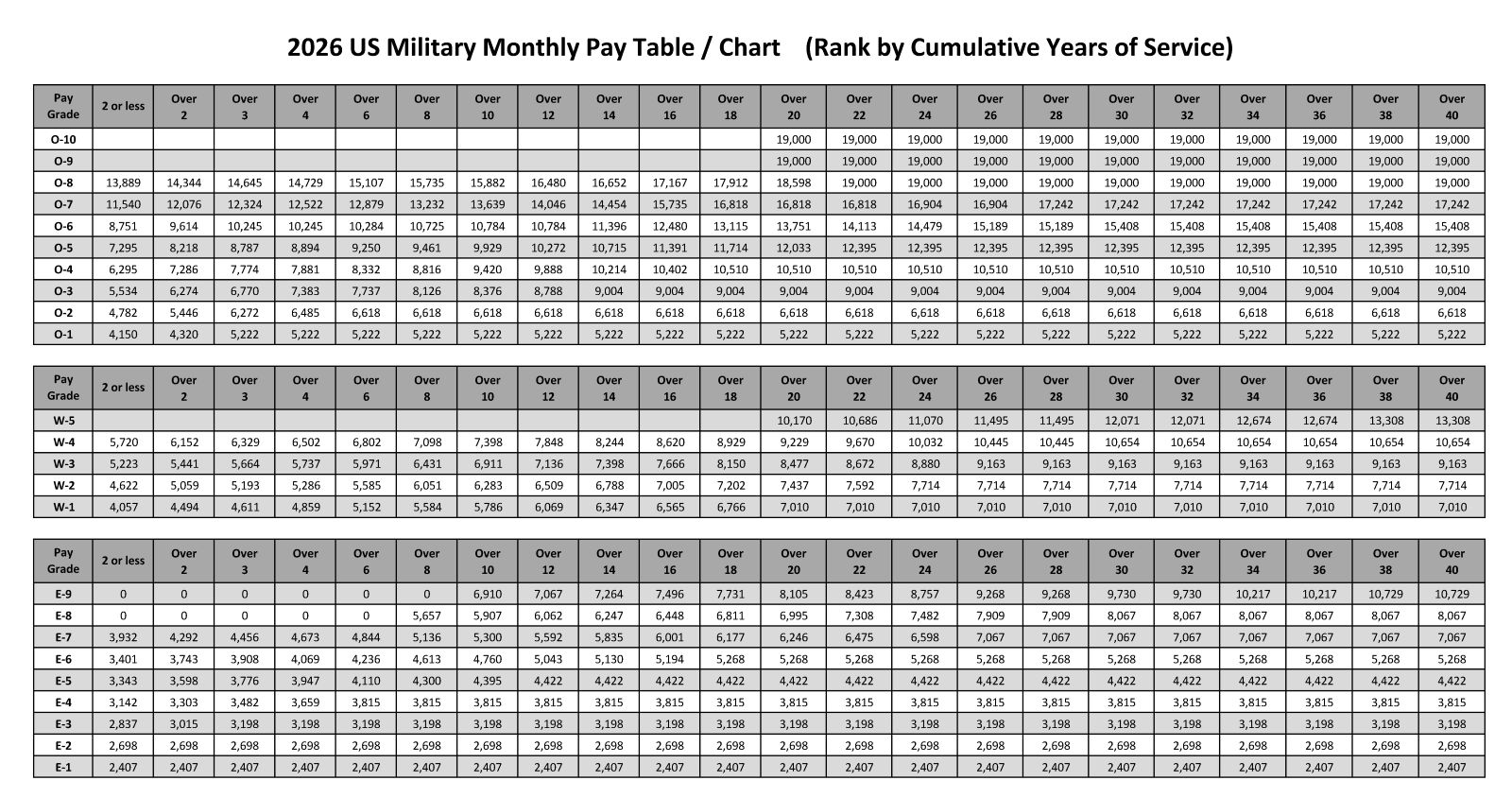
Download the Complete 2026 Military Pay Chart
All branches of the U.S. military use the same base pay tables for enlisted personnel.
2026 Military Pay Chart All Ranks (PDF)
2026 Military Pay Chart All Ranks (PNG)
Personal Perspective: Is Military Life Worth It?
Is a life in the military what you want? That is something you need to decide for yourself, because this is not just a spreadsheet question. It is a life question.
I loved my service in the Army and the Special Forces. I spent much of my career working in Latin America fighting the war on drugs, and I served three combat tours in Afghanistan. When I look back, I can say I helped make the world a safer place. I took dangerous work seriously, and I am proud of my service.
But there were also real costs. There were extreme environments, difficult training, loss, sacrifice, and long stretches of discomfort that most civilians will never experience. I lived in some of the hottest places on earth. I lost friends. I slept under mosquito nets and operated in places where comfort was not part of the equation. Even so, it was worth it.
That is why I think people should compare military pay and civilian salary honestly. My pay was sometimes lower than what some civilian peers were making, and the lifestyle was often much harder. But the meaning, the mission, the skills, the brotherhood, and the long-term benefits made the experience absolutely worth it for me.
What Is Military Pay?
Military pay is the compensation system used to pay members of the U.S. Armed Forces based on rank and years of service. At the most basic level, it includes base pay, which is the standard monthly amount a service member receives according to official military pay tables. That base pay is publicly published and generally applies across the Army, Navy, Air Force, Marine Corps, Coast Guard, and Space Force.
But base pay is only the beginning. In real life, military compensation also includes tax-advantaged allowances and major non-cash benefits that can dramatically change the true value of service. These can include Basic Allowance for Housing, Basic Allowance for Subsistence, healthcare, tuition benefits, retirement eligibility, special pay, bonuses, and other forms of support depending on duty location, job, family status, and career field.
That is why people make a mistake when they say, “An E-5 only makes this much,” or “An O-3 only makes that much.” In many cases, they are quoting only base pay while ignoring some of the most valuable parts of the package. If you want an honest comparison, you have to look at total compensation, not just the number on the left side of the leave and earnings statement.
What Is Civilian Salary?
Civilian salary is usually the gross income a person earns from an employer before taxes and deductions. In the civilian world, this may be presented as an annual salary, an hourly wage, or a compensation package that includes a bonus, stock options, retirement matching, health insurance, or other benefits. Unlike military pay, however, civilian compensation varies widely depending on company, industry, geography, education, experience, and negotiation skill.
A civilian earning a strong salary may still have significant expenses that reduce take-home value. Health insurance premiums, deductibles, rent or mortgage, retirement contributions, commuting costs, and job insecurity can all weaken the apparent advantage of a higher headline salary. A person earning more than a service member on paper may still feel financially stretched after taxes and living costs are accounted for.
That does not mean civilian careers are worse. In many cases, they offer higher upside, more location freedom, more career flexibility, and more control over lifestyle. But if you want a fair comparison, you cannot just compare a military base-pay number to a civilian gross-salary number. You have to compare the actual economic reality of both.
Military Pay vs Civilian Salary: Side-by-Side Comparison
The table below helps explain the core differences between military and civilian compensation systems.
Category | Military | Civilian |
Base income | Fixed by rank and years of service | Varies by market, employer, and negotiation |
Housing | Often supported by tax-free BAH or government housing | Paid from after-tax income |
Food support | BAS or meal support in some settings | Paid from salary |
Healthcare | Usually low-cost or covered through military system | Often expensive and partially employee-funded |
Retirement | Pension eligibility and blended retirement system | Usually 401(k), pension less common |
Job security | Generally strong while serving honorably | Can vary widely |
Bonuses | Special duty, retention, incentive, and enlistment bonuses may apply | Performance bonuses may apply depending on employer |
Taxes | Some allowances are tax-free | Most compensation is taxable |
Training | Extensive paid training and career development | Varies widely by employer |
Purpose and service | Mission-driven and service-oriented | Depends on employer and role |
This is why military compensation can be deceptively strong. Even if the base pay line looks modest, the total value can become much more competitive once the full package is included. Civilian compensation can absolutely exceed military compensation in many sectors, especially in technology, finance, law, medicine, and entrepreneurship, but those roles often come with different risks, expenses, and pressures.
Real Military vs Civilian Compensation Examples
The examples below are not exact calculators, because housing allowances and local costs vary by duty station, family status, and industry. But they give a useful strategic picture.
Example 1: Junior Enlisted Member vs Entry-Level Civilian
A junior enlisted service member may not look highly paid at first glance. An E-3 or E-4 can have a base pay figure that appears lower than the salary of a civilian working in an entry-level professional job, warehouse role, sales role, or skilled trade position. That is where many comparisons stop, and that is why many comparisons are wrong.
The military member may also receive housing support, food support, heavily subsidized or covered healthcare, paid training, steady employment, and a clearer early-career structure than many civilians have. In addition, many young civilians earning a seemingly better salary are also paying full rent, transportation costs, health insurance costs, and sometimes student loans. The gap often narrows more than people expect.
This does not mean the military is always financially better for junior personnel. In some cases, especially in strong job markets, a civilian may come out ahead in pure short-term income and lifestyle flexibility. But the military often provides something many 18- to 24-year-olds desperately need: discipline, direction, structure, and skill development, plus a more stable launch point into adult life.
Example 2: Mid-Level Officer vs Mid-Level Civilian Professional
Now the comparison changes. A military officer in the O-3 range, especially with several years of service and a housing allowance, can have a compensation package that becomes highly competitive with mid-level civilian professionals. Once you factor in housing, healthcare, tax advantages, and retirement trajectory, the total value can compare favorably with many civilian jobs in management, consulting, operations, or technical roles.
At this stage, the military often offers a mix of leadership experience and financial support that is hard to replicate early in the civilian world. A captain or equivalent is not just collecting a paycheck. That officer is gaining responsibility, management experience, personnel leadership, operational planning experience, and institutional credibility. Those intangibles matter, and they often convert well later in life.
A civilian professional may still earn more in certain fields. But the civilian side is often paying more because it expects specialized credentials, longer workweeks, greater risk, or high-cost urban living. In many cases, the military member is more financially competitive than outsiders realize.
Example 3: Senior Enlisted, Warrant Officer, or Senior Officer vs Civilian Manager
As rank and years of service increase, military compensation becomes much stronger. Senior noncommissioned officers, warrant officers, and field grade officers can earn substantial base pay while also benefiting from allowances, medical coverage, retirement progress, and institutional stability. This is where people who underestimated military compensation often change their minds.
A senior civilian manager may still out-earn military members in high-paying sectors, especially in private industry. But the military member may be building toward a pension while also avoiding some of the volatility that comes with layoffs, performance swings, company restructures, and the need to self-fund many benefits. That long-term security has real value.
By this stage, the comparison becomes less about raw salary and more about total life architecture. One path may offer more upside. The other may offer more certainty, stronger long-term benefits, and a different kind of meaning. For many people, that certainty is worth a lot.
The Hidden Value of Military Benefits
This is where the article really matters, because this is the part most people fail to calculate.
Housing Allowance Can Change Everything
Basic Allowance for Housing is one of the most important pieces of military compensation. In many cases, BAH is tax-free and substantial enough to significantly raise effective take-home value. A civilian earning the same gross pay as a service member may have to spend a much larger portion of after-tax income on rent or a mortgage.
Housing support is especially important in expensive areas. Even though BAH varies by duty station and status, the principle remains the same: housing support is not a minor detail. It is one of the biggest reasons military compensation should not be judged by base pay alone.
Healthcare Is a Massive Financial Advantage
Healthcare costs can crush civilian households. Monthly premiums, deductibles, co-pays, specialist bills, dental costs, and family coverage can consume a meaningful share of annual income. A civilian with a “higher” salary may not feel richer once these costs are deducted.
Military healthcare is one of the most underappreciated parts of compensation. Even when it is not literally free in every situation, it is usually dramatically more affordable than what many civilians pay. For families especially, this can be a major quality-of-life and financial advantage.
Retirement Still Matters
Many younger workers do not think seriously about retirement, but retirement benefits are one of the clearest long-term strengths of military service. A person who stays long enough to qualify for retirement can secure a stream of income that is increasingly rare in the civilian world. Even under the blended retirement system, the structure and discipline of the military path can help people build long-term financial security earlier than many civilians do.
Civilian workers may have excellent retirement outcomes too, especially if they earn strong salaries, invest wisely, and receive generous matching contributions. But many do not. The military system gives structure to a process that many civilians postpone or mishandle for years.
Education Benefits Create Second-Order Value
The GI Bill and related education benefits have enormous value. They can pay for college, graduate education, certifications, and transition opportunities that reshape a person’s entire future earning potential. The education value of military service is not just a perk. It is a force multiplier for long-term mobility.
A civilian may pay heavily for education upfront and then hope the investment pays off. A service member may earn educational benefits through service and use them later with less debt and more discipline. That matters financially and strategically.
The VA Loan Is Not a Minor Benefit
The VA home loan benefit is one of the strongest wealth-building tools available to many veterans. The ability to buy a home with favorable terms and without some of the barriers faced by civilians can create real financial momentum over time. It is not guaranteed wealth, but it can absolutely improve a veteran’s long-term position.
When people compare military and civilian pay while ignoring the VA loan, they are ignoring one of the most practical long-term benefits attached to service.
Pros and Cons of Military Pay
Advantages of Military Compensation
Military compensation offers predictability. You know how promotion and time in service affect your pay, and you know the system is built around standardized progression rather than pure negotiation. For many people, that structure reduces uncertainty and gives them a clearer planning horizon.
Military compensation also includes major support systems that civilians often have to build on their own. Housing assistance, healthcare, retirement structure, paid leave, educational opportunities, and training all combine to create a more complete package than outsiders often recognize. This is especially helpful for younger people who want a stable foundation.
Finally, military service offers benefits that are not just financial. Leadership development, mission, camaraderie, and a sense of service to something larger than yourself are real forms of value. They may not show up in a salary chart, but they matter deeply in life.
Disadvantages of Military Compensation
Military life is hard. That is not a slogan. It is reality. The schedule, the deployments, the training, the danger, the bureaucracy, the separations from family, the physical wear and tear, and the geographic limitations all impose serious costs that should not be minimized.
Early-career military pay can also feel modest, especially when compared to civilians who seem to have more freedom and fewer restrictions. Some service members may feel underpaid relative to the demands placed on them, and in some cases that feeling is understandable. Hardship and sacrifice are real, and compensation does not erase them.
There is also less flexibility in how you live your life. In the civilian world, a person may change jobs, cities, industries, or schedules more easily. In the military, your path is shaped by service obligations, operational needs, and institutional demands. That has opportunity costs.
Is Military Service Financially Worth It in 2026?
For some people, yes. For others, no. The better question is not whether military pay is universally better than civilian salary. The better question is whether the military path aligns with your goals, values, risk tolerance, family situation, and long-term plans.
For a young person who needs discipline, direction, income, training, and a stable foundation, the military can be a powerful launch platform. Even if the pay does not look spectacular on day one, the total package may be stronger than it appears, and the long-term development can be priceless.
For a highly specialized civilian with a marketable degree, strong network, and access to a high-paying field, the civilian path may be financially superior. That is especially true in careers where compensation scales rapidly and where the person values location freedom, entrepreneurship, or autonomy over structure.
But financial worth is not the same as life worth. The military offers a form of meaning that many civilian careers do not. That does not make it right for everyone, but it does mean the decision should be made with maturity and honesty.
The Strategic Reality Most People Miss
The most common mistake in this discussion is comparing military base pay to civilian gross salary. That is an incomplete comparison and often a misleading one. It ignores tax-free allowances, healthcare, retirement structure, education benefits, and the cost civilians absorb out of pocket.
The smarter comparison is this: total military compensation versus civilian after-tax salary minus housing, healthcare, and related expenses. Once you do that, the picture becomes much more balanced. In some cases, the military still loses financially. In other cases, it becomes surprisingly competitive. In still other cases, especially over time, it can become a very strong long-term deal.
The second mistake people make is pretending the decision is only about money. It is not. This is also about what kind of life you want, how much hardship you are willing to endure, what kind of mission you want to serve, and what tradeoffs you are willing to make in exchange for purpose, discipline, and long-term support.
Frequently Asked Questions
Is military pay better than civilian salary in 2026?
Military pay can be better than civilian salary in some situations, but not in every case. The answer depends heavily on rank, years of service, family status, duty station, and what civilian job you are comparing it to. A young civilian in a strong private-sector role may earn more in the short term, while a military member may receive stronger benefits and long-term security.
The biggest mistake is comparing military base pay alone to civilian gross pay. Once you include housing support, healthcare, retirement structure, tax advantages, and education benefits, military compensation often becomes much more competitive than people expect. The right answer is usually more nuanced than a simple yes or no.
What is the military equivalent of a $100,000 civilian salary?
There is no perfect one-to-one military equivalent, because military compensation is structured differently and includes benefits civilians often pay for separately. In many cases, an officer or senior enlisted member with housing allowance and benefits may have a total compensation package that feels closer to a six-figure civilian package than the base pay number alone would suggest.
The best way to think about this is in terms of after-tax lifestyle rather than headline income. A civilian making $100,000 may still pay heavily for rent, healthcare, retirement savings, and commuting, while a service member with a lower base salary may have major expenses reduced or partially covered. That is why the comparison needs context.
Do military members get paid more once benefits are included?
In many cases, yes, the total value of military compensation rises dramatically once benefits are included. Base pay is only one part of the picture, and for a fair comparison you need to add housing support, healthcare, tax advantages, retirement value, paid leave, and educational benefits. These can substantially increase the true economic value of service.
That does not mean every service member out-earns every civilian counterpart. It means that military compensation is often underestimated because outsiders do not calculate the package honestly. Looking only at the paycheck misses much of the real value.
How much is military pay after taxes compared to civilian income?
Military pay can be more tax-efficient than civilian salary because some military allowances, such as housing and subsistence allowances, are not taxed the same way regular salary is. This can make the service member’s effective take-home position stronger than a simple gross-income comparison would suggest. The details vary by situation, but the tax advantage is real and should not be ignored.
By contrast, most civilian salary is fully taxable and often accompanied by substantial deductions for healthcare and retirement contributions. That means a civilian with a higher nominal salary may not always enjoy a proportionally higher standard of living after taxes and expenses are considered.
Is BAH taxable?
Basic Allowance for Housing is generally not taxed as ordinary income, which is one of the reasons it is such an important part of military compensation. That tax treatment can significantly improve the practical value of military pay, especially in areas with high housing costs. It helps close the gap between military and civilian compensation more than many people realize.
For a civilian, housing is usually paid from after-tax income. That difference matters. When you compare a service member receiving tax-advantaged housing support to a civilian paying rent or a mortgage from a normal paycheck, the military side often looks stronger than the base-pay chart alone suggests.
Do military members make more than civilians over time?
Some do, and some do not. The military can become more competitive over time because promotions, years of service, allowances, retirement progress, and education benefits accumulate in ways many people do not fully appreciate. A person who stays in long enough to develop into a senior enlisted leader, warrant officer, or field grade officer may build a very strong long-term compensation profile.
On the civilian side, some industries offer higher upside and faster income growth, especially for highly skilled professionals or entrepreneurs. But those careers can also involve more volatility, self-funded benefits, layoffs, and weaker long-term guarantees. Over time, the military path often proves stronger in stability, structure, and retirement security.
What civilian jobs pay about the same as military officers?
That depends on the officer rank and the field being compared. A junior or mid-career officer may line up roughly with civilian professionals in management, operations, project leadership, engineering, logistics, consulting, or government roles. But the comparison is never perfect because military officers are paid under a structured system that includes benefits civilians often have to purchase separately.
The better way to compare is by responsibility and total package, not just by job title. Officers often manage people, resources, planning, operations, and risk at a relatively young age, which gives them a level of leadership experience that can exceed what many civilian peers have at the same age. That added responsibility should be part of the comparison.
Is joining the military financially worth it?
For many people, yes, it can be. The military can provide stable income, valuable training, healthcare, housing support, educational benefits, and a path to retirement that many civilian careers do not offer. For someone who wants structure and purpose, it can be financially worthwhile and personally transformative.
But it is not easy money. The hardships are real, and the sacrifices are substantial. Anyone considering military service should weigh the benefits honestly against the demands of the lifestyle rather than treating it as just another job.
What is total military compensation?
Total military compensation includes more than base pay. It can include housing allowance, food allowance, healthcare, retirement contributions, tax advantages, special pay, bonuses, leave, and education benefits. In practical terms, it represents the full economic value of military service rather than just the monthly paycheck.
This distinction matters because many public conversations about military pay are incomplete. If you want to compare the military to civilian employment fairly, total compensation is the number that matters most.
Do military retirees make more than civilians?
Many military retirees are in a strong long-term position because they may receive pension income and then begin a second civilian career. That combination can create a level of income stability and flexibility that many civilians do not enjoy. A retiree who also uses veterans benefits wisely may build a powerful financial base.
Of course, not every retiree becomes wealthy, and retirement quality depends on health, planning, transition success, and post-service employment. But the possibility of earning retirement income while starting a second chapter is one of the most compelling long-term financial advantages of a full military career.
Final Thoughts
Military pay is real, but military life is also real. The numbers matter, but so do the hardships, the purpose, the mission, the sacrifice, and the identity that come with service. If you compare military compensation to civilian salary honestly, the military is often more competitive than people think, especially when total compensation is calculated properly.
Still, this decision should never be reduced to money alone. You are not just choosing between two pay systems. You are choosing between two different lives.
For me, the military path was worth it. It was harder than the civilian alternative in many ways, and in some moments far harder than most people will ever know. But I am proud of what I did, proud of the people I served with, and proud that I can look back and say I contributed to something that mattered.
About the Author
Christopher Littlestone is a retired U.S. Army Special Forces Lieutenant Colonel, Airborne Ranger, and Combat Diver. He served in leadership roles across the special operations community, including as a Task Force Executive Officer working with multiple Air Force Special Operations teams, and he deployed to Afghanistan while also operating extensively in Latin America.
He holds a Master of Public Administration from Harvard University and a Doctorate in Business Administration focused on cybersecurity and privacy. Through both his military career and his educational work, Dr. Littlestone has spent decades mentoring service members and future leaders across the armed forces.
Next Steps
If you are considering a career in the military or special operations community, we have several resources to help you achieve your goal.
- Train Up – Arrive Prepared for Military or Special Operations Training
- Special Operations Mindset – Develop a Champion’s Mindset
- Fitness Programs – Get into Amazing Shape
- Military Leadership Course – Become the Leader Everyone Loves
- Military Planning Course – Plan Like Your Life Depends on It
Life is a Special Operation. Are you ready for it?

Training Preparation
Arrive Prepared for Military & Special Operations Training

Special Operations Mindset
Become the Hero in the Story of Your Life

Fitness
View our Training Plans

Elite Performance
Win - Lead - Succeed