OODA Loop: The Military Decision-Making Tool for Fast, Clear Action
In the military, plans rarely survive first contact with reality. Information is incomplete. Time is limited. Conditions change. People get tired. Leaders still have to make decisions.
Let’s look at a tool that the military and members of the Special Operations community use to make quick decisions in a rapidly changing environment. It is called the OODA Loop.
The OODA loop is a decision-making model developed by U.S. Air Force Colonel John Boyd. OODA stands for Observe, Orient, Decide, and Act. The model helps people make faster, clearer decisions in uncertain, competitive, or rapidly changing situations.
Let’s discuss what it is, how to use it, and then I’ll give you a military example of using the OODA loop while rescuing a downed pilot, and we’ll finish off with a business example.
Executive Summary
In this article, we break down the OODA loop, the Observe, Orient, Decide, Act decision-making model developed by Colonel John Boyd. You’ll learn why Orient is the hardest and most important step, see a real Special Operations rescue and a business decision walked through the full loop, get a free worksheet to run your own decisions through the model, and see how OODA compares to other planning tools like MDMP and Commander’s Intent.
Key Takeaways
- OODA stands for Observe, Orient, Decide, and Act, a decision-making cycle developed by Colonel John Boyd.
- Whoever can move through this cycle faster than their opponent gains a real advantage.
- Orient is the hardest and most important step. If your orientation is wrong, every decision after it gets worse.
- The OODA loop applies far beyond the military, including business, law enforcement, and cybersecurity.
- The OODA loop is not the most sophisticated decision-making method, but it’s one of the fastest.
- Some situations call for deliberate planning tools like MDMP instead of a fast OODA cycle.
- A decision without action is just an idea, and action without feedback wastes the next loop.
Watch the Video Version
Watch the full video here:
Table of Contents
- What Is the OODA Loop?
- What Does OODA Stand For?
- Who Created the OODA Loop?
- Why the OODA Loop Works
- The Real Secret: Why Orient Is the Hardest Step
- OODA Loop Diagram
- OODA Loop in Action: Rescuing a Downed Pilot
- OODA Loop in Business: Smith’s Coffee
- OODA Loop in Law Enforcement
- OODA Loop in Cybersecurity and AI
- Common OODA Loop Mistakes
- OODA Loop vs. MDMP, Commander’s Intent, and PDCA
- Free OODA Loop Worksheet
- Frequently Asked Questions
- About the Author
- Final Thoughts and Key Takeaways
What Is the OODA Loop?
OODA loop is an acronym that stands for Observe, Orient, Decide, and Act. It is a decision-making process and a concept developed by military strategist and United States Air Force Colonel John Boyd.
According to Boyd, decision-making occurs in a looping, recurring cycle of observe, orient, decide, act. The OODA loop is designed to be a continuous, iterative process for making quick decisions in complex and rapidly changing situations.
The OODA loop is not only applied in military contexts. It has also been adapted for fields including business, law enforcement, cybersecurity, and competitive sports.
What Does OODA Stand For?
| Letter | Meaning | Question It Answers |
|---|---|---|
| O | Observe | What is happening? |
| O | Orient | What does it mean? |
| D | Decide | What will I do? |
| A | Act | What happens when I execute? |
Here’s a brief overview of each phase:
Observe means collecting information about the situation, environment, opportunities, and potential threats.
Orient means analyzing and interpreting the information collected during the observation phase. This step involves assessing the current situation, understanding the context, and considering your own position and capabilities in relation to the environment and the people or forces working against you.
Decide means, based on the observation and orientation, making a decision about the course of action or your plan. This step involves choosing the best response or strategy to address the challenges or opportunities identified in the previous phases.
Act simply means implementing the decision by taking concrete action. This step involves executing the chosen course of action rapidly and decisively. The actions taken in this phase may further influence the environment, leading to a new cycle of observation, orientation, decision, and action.
Who Created the OODA Loop?
The OODA loop was developed by John Boyd, a United States Air Force Colonel, fighter pilot, and military strategist. Boyd studied air-to-air combat and concluded that winning wasn’t just about better aircraft or better weapons. It was about who could move through the decision cycle faster.
Boyd’s insight was that decision-making occurs in a looping, recurring cycle, and the side that can complete that cycle faster and more accurately gains a decisive advantage.
Why the OODA Loop Works
An individual or an organization that can observe and react to unfolding events more rapidly than their opponent can will get inside their opponent’s decision cycle and gain the advantage.
OODA works because it helps people update their understanding faster than the situation changes. It’s not really about rushing. It’s about seeing clearly, understanding quickly, deciding wisely, acting decisively, and learning faster than the situation around you is changing.
The Real Secret: Why Orient Is the Hardest Step
Most people treat all four steps of the OODA loop equally. They shouldn’t. Orient is the hardest part of the model, and it’s where the real skill lives. If your orientation is wrong, every decision after that gets worse.
Orientation isn’t just “look at the facts.” It’s shaped by a lot of factors happening at once, and this is really where situational awareness lives:
| Orientation Factor | What It Means |
|---|---|
| Mission | What are we trying to accomplish? |
| Experience | What have I seen before? |
| Training | What have I prepared to do? |
| Values | What matters most? |
| Bias | What might I be assuming incorrectly? |
| Culture | How does my background shape what I see? |
| Time | How fast must I decide? |
| Risk | What happens if I am wrong? |
| Enemy or Obstacle | What is working against me? |
Two people can observe the exact same facts and orient completely differently based on their experience, training, and bias. That’s why Orient, not Observe, is where most decisions actually go wrong.
OODA Loop Diagram

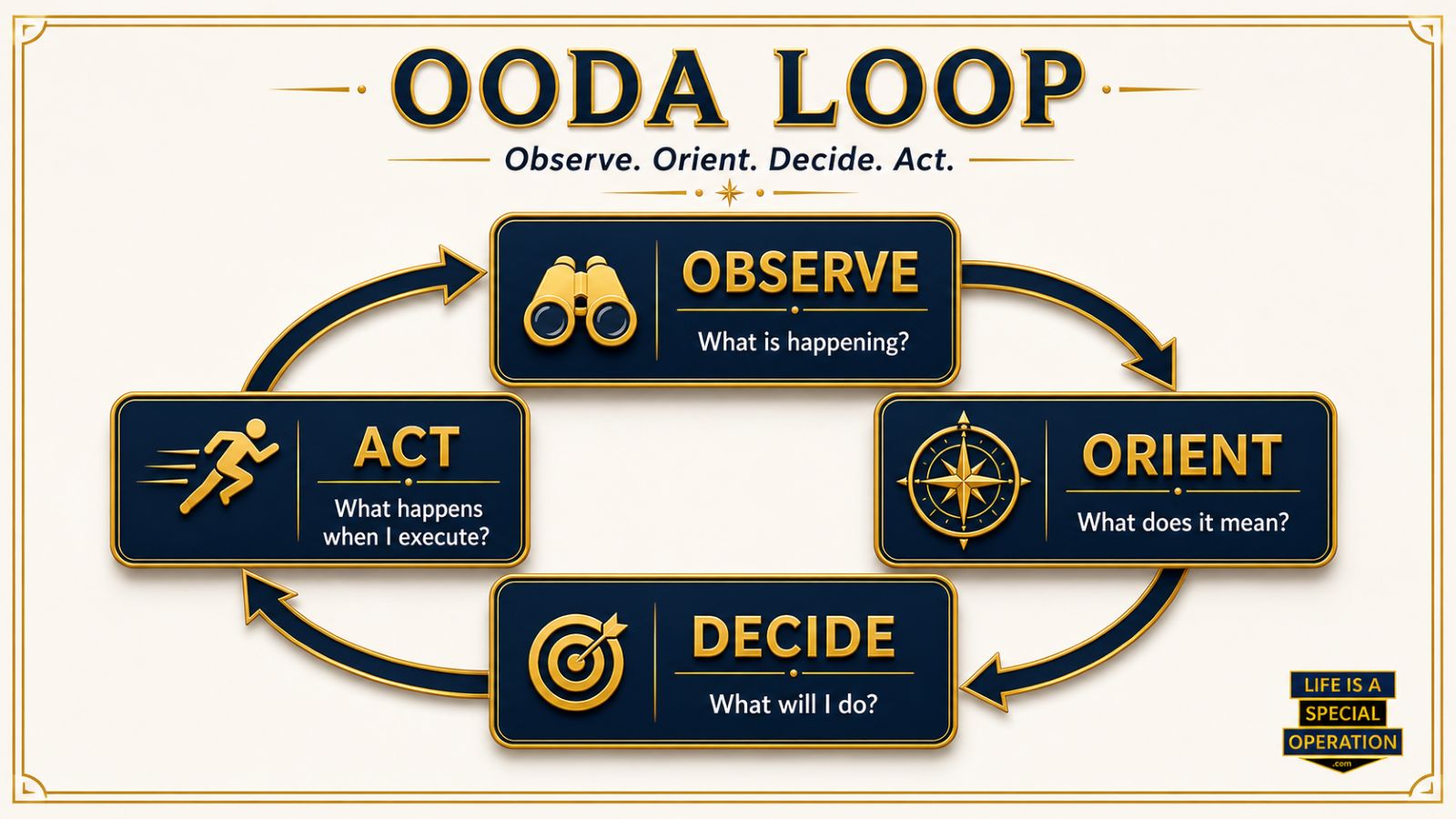
Notice that the loop doesn’t stop at Act. Action changes the environment, which means you immediately have new information to observe. That’s what makes it a loop instead of a checklist.
OODA Loop in Action: Rescuing a Downed Pilot
In the high-stakes scenario of a downed pilot behind enemy lines, Air Force Pararescuemen used the OODA loop to make a crucial decision at the landing site of a fighter pilot who broke his tib/fib while ejecting.
Observe: Observing the injured pilot’s condition, the encroaching darkness, and the proximity of the enemy, the team quickly assessed the risks and challenges.
Orient: Orienting themselves to the thick, mountainous terrain, they analyzed available options and recognized the urgency of avoiding enemy detection.
Decide: The team decided that because the enemy was so close, it would be too dangerous to call for a helicopter with a jungle penetrator and winch to pull the pilot up to safety. They decided to evade the enemy overnight and quietly move to their alternate extraction point.
Act: They stabilized the pilot’s broken leg and moved out quickly and quietly to the alternate extraction point.
Loop: As they moved, the team leader constantly updated their decision-making process. They adjusted their plan based on real-time intel, which ensured a covert movement and set the stage for a successful extraction the next morning.
OODA Loop in Business: Smith’s Coffee
Smith’s Coffee, a small business passionate about quality, implemented the OODA loop for making a strategic decision.
Observe: Observing market trends, they noticed a rising demand for organic coffee blends.
Orient: Orienting themselves to this shift, they analyzed suppliers, production costs, and potential profit margins.
Decide: They decided to introduce an organic line.
Act: They swiftly executed the plan by ordering organic coffee beans and updating their marketing materials.
Loop: Constantly repeating this decision-making process, they assessed customer feedback and adjusted their coffee blends accordingly. This adaptive OODA loop approach allowed Smith’s Coffee to stay agile in a dynamic market and deliver products aligned with evolving consumer preferences.
OODA Loop in Law Enforcement
Law enforcement officers face rapidly evolving situations where perception and split-second judgment matter. The OODA loop shows up here less as a tactical checklist and more as a way of thinking about perception and communication under pressure.
An officer has to observe body language, tone, and environment, orient based on training and experience, decide on the appropriate response, from de-escalation to a different action entirely, and then act while continuing to reassess as the situation develops. Departments that train officers to move through this cycle deliberately tend to make clearer, more defensible decisions under pressure.
OODA Loop in Cybersecurity and AI
Cybersecurity teams use OODA-style thinking because threats change quickly. The organization has to observe unusual activity, orient around risk, decide how to respond, act, and then update its defenses based on what it learned.
In the age of AI, the OODA loop matters even more. AI can help observe and analyze information faster than any human team, but human leaders still need to orient, decide, and remain accountable for the outcome. Speed without human judgment in the Orient and Decide steps is how organizations make fast, confident, and wrong decisions.
Common OODA Loop Mistakes
1. Thinking OODA is only about speed. Fast wrong decisions are still wrong.
2. Skipping orientation. People see the facts but misunderstand what they mean.
3. Waiting for perfect information. The OODA loop is built for uncertainty, not certainty.
4. Deciding but not acting. A decision without action is just an idea.
5. Acting but not learning. Action creates feedback, and feedback starts the next loop.
6. Ignoring the mission. Speed without purpose creates chaos.
7. Using OODA when deliberate planning is required. Some problems call for a more structured tool like MDMP, formal risk management, legal review, or medical judgment instead of a fast loop.
OODA Loop vs. MDMP, Commander’s Intent, and PDCA
The OODA loop isn’t the only decision-making tool worth knowing. Here’s how it compares to a few others we’ve covered.
OODA Loop vs. MDMP
| OODA Loop | MDMP |
|---|---|
| Fast and flexible | Detailed and structured |
| Good for uncertainty | Good for deliberate planning |
| Useful for individuals and small teams | Useful for staffs and formal organizations |
We cover MDMP and how it uses the 1/3-2/3 rule to manage planning time in more detail in that hyperlinked article.
OODA Loop vs. Commander’s Intent
| OODA Loop | Commander’s Intent |
|---|---|
| Helps you decide and act | Explains the purpose behind the action |
| Useful when the situation changes | Keeps people aligned when the plan changes |
| Answers “What now?” | Answers “Why does this matter?” |
OODA Loop vs. PDCA
| OODA Loop | PDCA |
|---|---|
| Best for uncertainty and competition | Best for process improvement |
| Faster and more adaptive | More structured and controlled |
| Useful in a crisis | Useful in stable systems |
Free OODA Loop Worksheet
Free OODA Loop Decision-Making Worksheet
Download the free worksheet and run your own decision through Observe, Orient, Decide, and Act the next time you need to think clearly under pressure.
Frequently Asked Questions
What is the OODA loop?
The OODA loop is a decision-making model developed by U.S. Air Force Colonel John Boyd. OODA stands for Observe, Orient, Decide, and Act, and the model helps people make faster, clearer decisions in uncertain or rapidly changing situations.
What does OODA stand for?
OODA stands for Observe, Orient, Decide, and Act, the four steps of the decision-making cycle.
Who created the OODA loop?
The OODA loop was created by John Boyd, a United States Air Force Colonel, fighter pilot, and military strategist.
What is the OODA loop used for?
The OODA loop is used to make fast, clear decisions in uncertain or rapidly changing situations. It’s used in the military, business, law enforcement, cybersecurity, and competitive sports.
What is an example of the OODA loop?
One example is a Special Operations rescue team observing a downed pilot’s condition, orienting to the terrain and enemy proximity, deciding to evade rather than call for immediate extraction, and acting by moving the pilot to an alternate extraction point.
What is the OODA loop in the military?
In the military, the OODA loop is used to make rapid tactical decisions under pressure, especially in situations where the enemy or environment is changing faster than a formal planning process could keep up with.
What is the OODA loop in business?
In business, the OODA loop helps companies observe market changes, orient around costs and opportunity, decide on a strategy, and act quickly, then use customer feedback to adjust in the next loop.
Why is Orient the most important part of the OODA loop?
Orient is where you interpret what you’ve observed based on your mission, experience, training, values, bias, and the situation’s time pressure and risk. If your orientation is wrong, every decision that follows gets worse, even if your observations were accurate.
How is the OODA loop used in law enforcement?
In law enforcement, the OODA loop supports fast perception and judgment under pressure, helping officers observe behavior and environment, orient based on training, decide on the appropriate response, and act while continuing to reassess.
How is the OODA loop used in cybersecurity?
In cybersecurity, teams use OODA-style thinking to observe unusual activity, orient around the level of risk, decide how to respond, act to contain the threat, and update their defenses based on what they learned.
What is the difference between the OODA loop and MDMP?
The OODA loop is fast and flexible, designed for uncertainty and individual or small-team decisions. MDMP is a detailed, structured planning process designed for staffs and formal organizations that have more time to plan deliberately.
About the Author
Christopher Littlestone is the founder of Life is a Special Operation and Special Operations University. He is a retired U.S. Army Special Forces Lieutenant Colonel, Airborne Ranger, and Combat Diver who relied on fast, clear decision-making tools like the OODA loop throughout his military career.
His YouTube channel has grown to nearly 380,000 subscribers, and he has personally trained thousands of students through Special Operations University, maintaining a 4.9-star rating on Trustpilot along the way.
Christopher draws on decades of operational decision-making experience, from Special Forces missions to military planning processes, to help civilians, business leaders, and aspiring military personnel think clearly and act decisively under pressure.
Final Thoughts and Key Takeaways
The flexibility and adaptability of the OODA loop make it a valuable concept for navigating dynamic and unpredictable situations. It emphasizes the importance of agility, quick decision-making, and continuous reassessment.
The OODA loop isn’t the most sophisticated method of making a decision. But if you are short on time and need a quick framework to help you make a decision, then maybe you should observe, orient, decide, and act.
If you would like to go deeper into decision-making, planning, and leadership, I encourage you to explore the resources available to you at Special Operations University:
- Military Planning Course – Plan Like Your Life Depends on It
- Military Leadership Course – Become the Leader Everyone Respects
- Special Operations Mindset – Develop a Champion’s Mindset
Life is a Special Operation. Are you ready for it?

Training Preparation
Arrive Prepared for Military & Special Operations Training

Special Operations Mindset
Become the Hero in the Story of Your Life

Fitness
View our Training Plans

Elite Performance
Win - Lead - Succeed