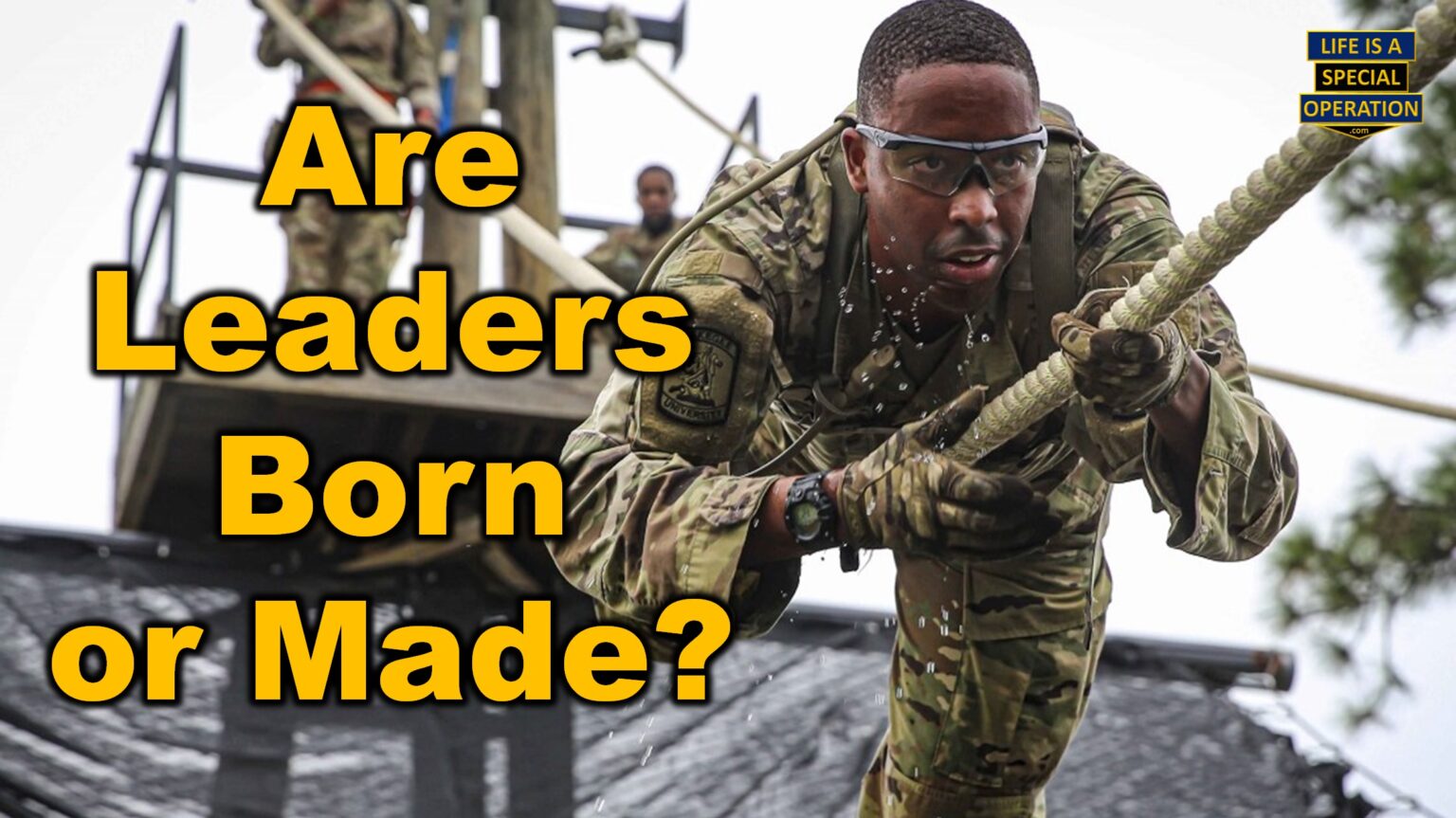
Are Leaders Born or Developed?
Are leaders born or developed? Are some people predisposed to be natural born leaders, or can anyone train and develop their leadership skills?
During my military and Special Forces career, I have had the honor of working with some of the best leaders in the world and attending some of the hardest leadership schools out there. And I have come to believe that leaders aren’t born. They are made.
Yes, some leaders have more aptitude than others, and some work harder to self-develop than others. But leadership competencies and abilities are trained, honed, and developed in the same manner in which any other skill is refined.
Executive Summary
In this article, we break down whether leaders are born or developed by comparing leadership to learning a language. You’ll learn the basics every leader must master first, the advanced instruments of leadership that build true expertise, the core principles of military leadership, how these lessons translate into leadership training for managers, and why leadership training and development is an ongoing process rather than a one-time event.
Key Takeaways
- Leaders aren’t born. They are made, through training, effort, and repetition.
- Some people have more natural aptitude for leadership, just like some people pick up certain languages faster than others.
- Every leader must first master the basics before moving on to advanced skills.
- The follower basics can be remembered using the acronym BASICS: Be on time, Actually there, Serve, In the right uniform, Competent, Security is rule #1.
- A leader must add planning, communication, being a good follower, reliability, setting the example, and hard work on top of the follower basics.
- True leadership expertise comes from integrating advanced skills like building systems, building rapport, anticipating risk, delegating, mentoring, and holding people accountable.
- Leadership skills, like language skills, get rusty without daily maintenance and use.
- Core military leadership principles, like knowing your people and setting the example, apply just as well outside the military.
- The same basics-to-expertise progression that builds military leaders also works for managers and business leaders.
- Great leaders are built through use, hard work, diligent study, application, practice, and rehearsal.
- Leadership training and development is an ongoing habit, not a one-time course or seminar.
Watch the Video Version
Watch the full video here:
Table of Contents
Learning the Basics
Learning the basics of leadership is like learning the basics of a second or third language.
The basics for some languages are easy. This is French and Spanish, where you can read and make sentences in your first days.
I submit that an extrovert, or someone with inherent confidence and aptitude, can quickly learn the basics of leadership just as a dedicated student can quickly learn the basics of French or Spanish.
But for other languages, like Chinese or Arabic, the basics are hard to acquire, taking months to learn how to read and make simple sentences. This is the introvert or insecure person who learns the basics of leadership slowly.
But once the basics are learned, and this is true for an easy language or a hard language, these basics must be mastered, which will establish a strong foundation.
Master the Basics
When learning a language, the basics include reading, pronunciation, sentence structure, and conjugation.
For a follower, I’ve already made a video about the basics, which stands for BASICS:
- B: Be on time
- A: Actually there
- S: Serve
- I: In the right uniform
- C: Competent (skills and knowledge)
- S: Security is rule #1
But for a leader, we need to add in a few more basics to the list, like the ability to:
- Plan
- Effectively communicate
- Be a good follower
- Be reliable
- Set the example
- Work hard
Expertise
Now that the basics are mastered, a language student must focus on fluency. And this requires mastering and integrating advanced skills like grammar, complicated sentence structures, professional vocabulary, and accents.
For the leader, this is integrating and orchestrating the other instruments available to you into an effective symphony of success. These instruments of leadership include:
- Building systems
- Building rapport
- The ability to anticipate and mitigate security issues and risks
- Delegating
- Mentoring
- Holding people accountable
Military Leadership Principles
Over my career, I attended some of the toughest leadership schools in the military, and every one of them came back to the same core principles of military leadership. These aren’t abstract theories. They are principles that get tested under real pressure, where the cost of poor leadership is measured in more than a missed deadline.
The principles that showed up again and again were things like know yourself and seek self-improvement, be technically and tactically proficient, seek responsibility and take responsibility for your actions, make sound and timely decisions, set the example, know your people and look out for their welfare, keep your people informed, develop a sense of responsibility in your subordinates, ensure the task is understood, supervised, and accomplished, and train your people as a team.
None of these principles are unique to the military. A business leader, a coach, or a parent can apply every one of them. What makes military leadership training different is the environment. You don’t get a second chance to learn these lessons in a live operation, so the military drills these principles into you until they become instinct rather than theory.
That is really the heart of military leadership skills. It is not about rank or title. It is about becoming the kind of person others can depend on when the basics you learned earlier in this article, and the expertise you build on top of them, actually get tested.
Leadership Training for Managers
You don’t need a uniform to apply any of this. Everything I’ve described so far, learning the basics, mastering the basics, and developing expertise, is exactly what a good leadership training programme in business looks like as well.
If you manage a team, the follower basics still apply to you. You still need to be on time, actually present, of service to the people you lead, competent in your role, and serious about protecting your team and your organization. Those basics don’t disappear once you get promoted. If anything, people watch a manager’s basics more closely than anyone else’s.
From there, the leadership basics I listed, planning, communication, being a good follower to those above you, reliability, setting the example, and hard work, translate directly into any manager and leadership training program, whether it’s run internally or through an outside leadership training course.
And once the basics are mastered, the same instruments of leadership apply in business: building systems your team can rely on, building rapport with the people you manage, anticipating and mitigating risk before it becomes a crisis, delegating instead of doing everything yourself, mentoring the people below you, and holding your team accountable to a standard.
Good leadership training for managers isn’t about a personality type or a title on an org chart. It’s about deliberately practicing the same basics-to-expertise progression that applies to leaders in any environment, military or civilian.
Maintenance Training
If you use any skill every once in a while, you will likely not be good at it. But if you practice and use that skill every day, it will eventually become second nature. And this is the importance of maintenance training.
A linguist will forget some of his language skills and get rusty. In order to build and maintain fluency, a linguist must read, write, listen, and speak their language every day. They must maintain their abilities.
Similarly, a leader must use and maintain their leadership skills to keep them sharp and effective.
So if you are wondering whether great leaders are born or developed, the answer is simple: they are developed. Through use and abuse. Hard work. Diligent study. And application. Practice. Rehearsing. And re-rehearsing the elite performance and leadership skills of their trade.
What leadership skills do you think are the most important for a leader to develop? Let me know in the comments below.
Leadership Training and Development
Everything covered in this article, learning the basics, mastering the basics, building expertise, and maintaining your skills, is really a single, ongoing process. That process has a name: leadership training and development.
The mistake a lot of people make is treating leadership development as a one-time event. They attend a single leadership training course, a weekend seminar, or a leadership training conference, check the box, and assume they’re finished. That’s not how it works, and it’s not how any other skill works either.
Real leadership training and development is continuous. It looks like reading books on leadership. It looks like seeking out mentors who are further along than you. It looks like asking for honest feedback and actually acting on it. It looks like deliberately putting yourself in situations that stretch your planning, communication, and decision-making skills, rather than waiting for those situations to find you.
In the military, we never considered leadership development finished. Every school, every deployment, every after-action review was another rep in a lifelong development process. The same should be true for you, whether you’re leading a Special Forces team, a small business, or a family.
If you are serious about your own leadership training and development, don’t look for a single course that will finish the job. Build a habit of ongoing growth instead. That habit, more than any single class, is what separates leaders who plateau from leaders who keep getting better.
Frequently Asked Questions
Are leaders born or made?
Leaders are made, not born. While some people have more natural aptitude for leadership, leadership competencies and abilities are trained, honed, and developed in the same manner as any other skill.
What does the BASICS acronym stand for?
BASICS stands for the fundamentals every follower must master: Be on time, Actually there, Serve, In the right uniform, Competent, and Security is rule #1.
What additional skills does a leader need beyond the follower basics?
Beyond the follower basics, a leader must also develop the ability to plan, effectively communicate, be a good follower, be reliable, set the example, and work hard.
Why is learning leadership compared to learning a language?
Like language learning, leadership has a basics stage, an expertise stage, and a maintenance stage. Some people pick up the basics quickly, like learning French or Spanish, while others take longer, like learning Chinese or Arabic. Either way, the basics must be mastered before moving on to advanced skills.
What are the advanced “instruments of leadership”?
At the expertise level, a leader must integrate advanced skills such as building systems, building rapport, anticipating and mitigating risk, delegating, mentoring, and holding people accountable.
What is maintenance training for leaders?
Maintenance training is the daily use and practice of leadership skills so they stay sharp. Just like a linguist gets rusty without daily practice, a leader’s skills fade without regular use.
Can an introverted person become a great leader?
Yes. An introverted or less confident person may learn the basics of leadership more slowly, similar to learning a harder language like Chinese or Arabic, but with consistent effort they can master the basics and build real expertise over time.
How long does it take to become a great leader?
There is no fixed timeline. Leadership develops through use, hard work, diligent study, application, practice, and repeated rehearsal of leadership skills over time.
What are the core principles of military leadership?
Core principles of military leadership include knowing yourself and seeking self-improvement, being technically and tactically proficient, seeking and taking responsibility, making sound and timely decisions, setting the example, knowing your people and looking out for their welfare, and training your people as a team.
Do civilian managers need leadership training too, or is this only for the military?
Civilian managers need the same basics-to-expertise leadership training as military leaders. The follower basics, leadership basics, and instruments of leadership described in this article apply directly to any manager and leadership training program in a business setting.
Is leadership training and development a one-time event?
No. Leadership training and development is an ongoing process, not a single course or seminar. It requires continuous reading, mentorship, honest feedback, and deliberate practice throughout a leader’s career.
About the Author
Christopher Littlestone is the founder of Life is a Special Operation and Special Operations University. He is a retired U.S. Army Special Forces Lieutenant Colonel, Airborne Ranger, and Combat Diver who spent his career working alongside and developing some of the best leaders in the world.
His YouTube channel has grown to nearly 380,000 subscribers, and he has personally trained thousands of students through Special Operations University, maintaining a 4.9-star rating on Trustpilot along the way.
Christopher draws on decades of operational leadership experience, from Special Forces selection to some of the toughest leadership schools in the military, to help civilians, business leaders, and aspiring military personnel build the leadership skills required to succeed in life.
Final Thoughts and Key Takeaways
Leaders aren’t born. They are made.
Like learning a language, leadership starts with the basics, grows into expertise, and requires ongoing maintenance to stay sharp. Whether you’re a natural extrovert or a quieter introvert, the path is the same: learn the basics, master them, build expertise, and keep training.
If you would like to go deeper into leadership, planning, and mindset, I encourage you to explore the resources available to you at Special Operations University:
- Military Leadership Course – Become the Leader Everyone Respects
- Special Operations Mindset – Develop a Champion’s Mindset
- Military Planning Course – Plan Like Your Life Depends on It
Life is a Special Operation. Are you ready for it?
The 4 Pillars of
"Life is a Special Operation"
What's Your Mission?

Training Preparation
Arrive Prepared for Military & Special Operations Training

Special Operations Mindset
Become the Hero in the Story of Your Life

Fitness
View our Training Plans

Elite Performance
Win - Lead - Succeed