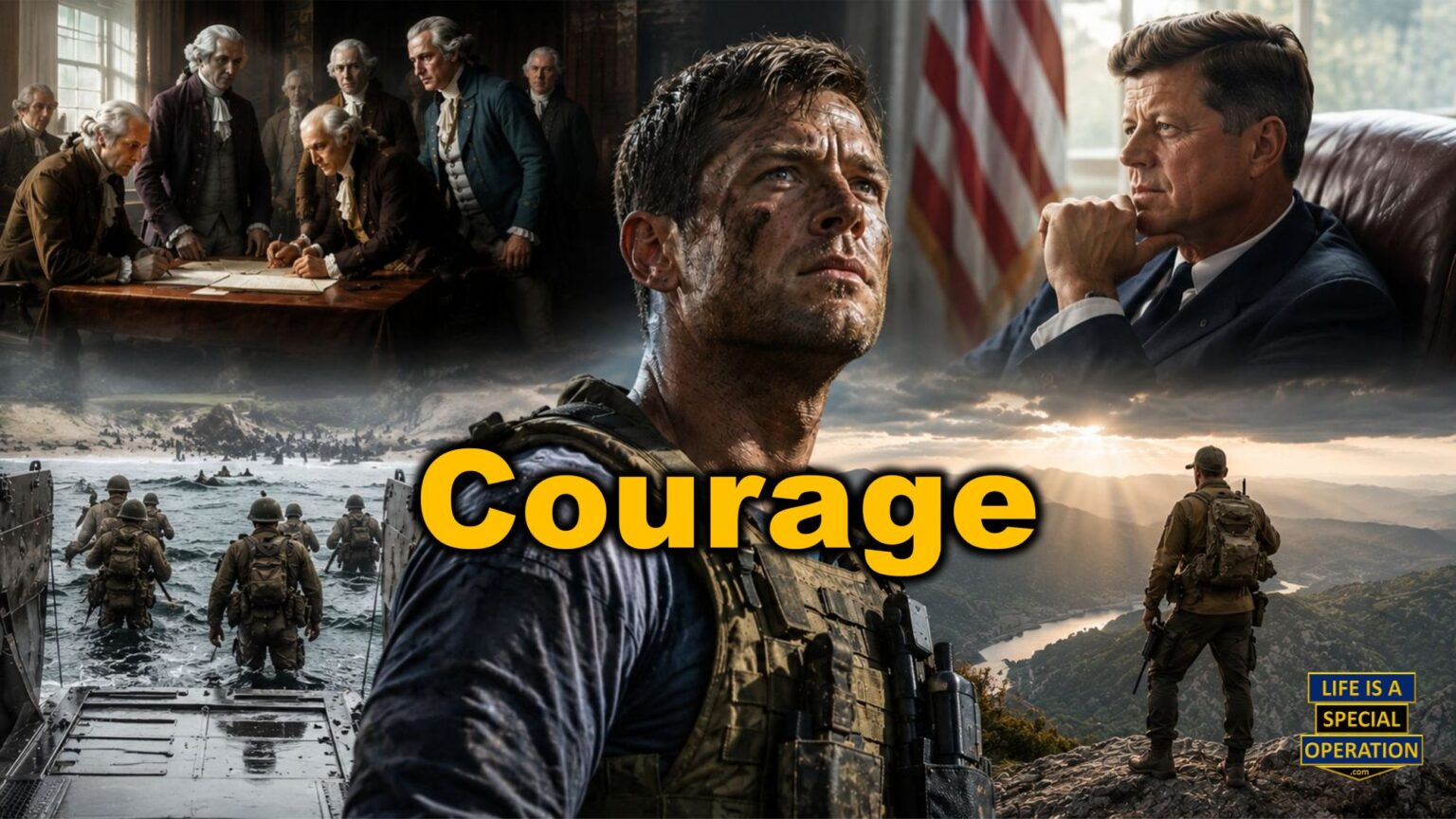
Courage: Special Forces (Green Beret) Discusses the Importance of Courage
What Is Courage?
Most people misunderstand courage. They think courage means not being afraid. That’s not true.
The Founding Fathers were afraid. The soldiers on Omaha Beach were afraid. Special Operations soldiers are afraid. Single mothers are afraid. Business owners are afraid. Students are afraid. Parents are afraid.
Courage is not the absence of fear. Courage is doing the right thing despite fear. It is action despite uncertainty. It is moving forward when every instinct tells you to stay where you are.
Greetings Team, this is Christopher Littlestone of Life is a Special Operation and SpecialOperationsUniversity.com. In this article, we’re going to discuss courage. We’re going to look at courage through four different lenses: the Founding Fathers, the heroes of D-Day, President JFK, a friend, and then we’re going to discuss how courage applies to your life.
Executive Summary
In this article, we explore what courage really means by looking at it through four lenses: the Founding Fathers, the heroes of D-Day, President Kennedy’s Profiles in Courage, and a fellow Green Beret’s quiet act of valor. You’ll learn the different forms of courage, why moral courage is often harder than physical courage, and how to start building more courage into your own daily life, one decision at a time.
Key Takeaways
- Courage is not the absence of fear. It is action despite fear.
- There are several forms of courage: physical, moral, leadership, emotional, and everyday courage.
- The Founding Fathers showed moral courage by risking their lives, fortunes, and families for liberty.
- The soldiers of D-Day showed physical courage by advancing into machine gun fire with no guarantee of survival.
- JFK’s Profiles in Courage taught that moral courage, standing alone for what is right, is often harder than battlefield heroics.
- Truly courageous people rarely talk about their own courage. They focus on the mission, not the recognition.
- Everyday courage, shown by parents, students, and entrepreneurs, is just as real as courage on the battlefield.
- Courage can be developed like fitness or leadership, through small, difficult choices practiced daily.
Watch the Video Version
Watch the full video here:
Table of Contents
What Courage Really Means
I like to say that courage is the willingness to do what is right, necessary, or honorable despite fear, uncertainty, discomfort, danger, or personal cost.
There are many forms of courage:
- Physical courage faces danger.
- Moral courage faces opposition.
- Leadership courage faces uncertainty.
- Emotional courage faces vulnerability.
- Everyday courage faces life’s challenges one step at a time.
Let’s look at some examples, starting with the Founding Fathers.
The Founding Fathers
When fifty-six men signed the Declaration of Independence, they weren’t signing a petition. They were committing treason against the most powerful empire on earth. If they failed, they could lose their property, their freedom, and even their lives. Yet they signed anyway.
Why? Because they believed some things were worth risking everything for: freedom, liberty, and self-government. They had moral courage. Not physical courage. And sometimes moral courage is even harder.
They knew there would be sacrifices. Several lost homes, fortunes, businesses, and family members during the war. Many spent years in constant danger and uncertainty. Others saw their property destroyed or looted. Yet they signed anyway because they believed liberty was worth the risk.
Imagine if they hadn’t. America as we know it might never have existed. Their courage changed the course of history.
D-Day
I’ve been scared before. I’ve jumped out of airplanes. I’ve been to war. I’ve sat in aircraft wondering what would happen next. I’ve felt uncertainty. I’ve felt fear.
But it is hard to fathom what it must have felt like when the ramp dropped on those landing craft. Cold water. Machine gun fire. Open sand. Chaos. Death. And then the cliffs. Imagine looking up at those cliffs and knowing you had to climb them.
That is courage.
JFK and Profiles in Courage
When I was in high school, I read a book by President John F. Kennedy called Profiles in Courage. I assumed it would mostly be a book about battlefield heroics, war stories, and physical courage. After all, Kennedy himself had served in World War II as the commander of PT-109, surviving after his patrol boat was cut in half by a Japanese destroyer. Years later, while recovering from major back surgery and dealing with significant health challenges, he used that period of recovery to work on the book.
What surprised me was that the book was not primarily about physical courage at all. Instead, it focused on moral courage, political courage, and the difficult decisions leaders must make when doing the right thing is unpopular. It explored elected officials who risked their careers, reputations, and political futures because they believed principle mattered more than popularity.
As a young man, I found that incredibly insightful. The book helped me understand that courage is not always charging a machine gun nest or storming a beach. Sometimes courage is standing alone, telling the truth, accepting criticism, and doing what you believe is right despite enormous pressure.
I highly recommend the book.
A Modern-Day Warrior
There were only two other men from my university class who went on to become Green Berets. One of them was Michael. I’ve known him for more than thirty years. We went through many of the same experiences as young officers, and over the years our paths crossed several times, including deployments to Afghanistan as both captains and later as majors.
I remember linking up with Michael in Afghanistan shortly after he had been involved in a major firefight while accompanying a partner nation force on a mission. When I saw him, he didn’t talk about the battle. He didn’t talk about himself. He didn’t talk about heroics. He was simply happy to see an old friend.
A few minutes later, however, I ran into his Team Sergeant. He pulled me aside and said, “That was intense. I can’t believe we fought through that ambush. It was like Mogadishu. Michael was a true hero.”
Years later, I learned that Michael was awarded a Bronze Star with Valor for his actions that day, but he never told me about it. Not once.
He was courageous, and that’s what courageous people do. They don’t focus on the recognition. They focus on the mission. They fight through fear because they believe in something larger than themselves. In this case, it was helping build a more secure Afghanistan. In other cases it is building a stronger state, directing the United Nations, and making the world a better place.
The truly courageous are often the least interested in talking about their courage. They simply do what needs to be done and move forward.
The Courage We See Every Day
But here’s the most important point. Most of us will never storm a beach. Most of us will never jump from an airplane into combat. Most of us will never sign a Declaration of Independence. Yet courage is still required. Every single day.
The single mother working two jobs. The father carrying burdens nobody sees. The student studying late at night. The entrepreneur trying again after another setback. The young man refusing to compromise his integrity.
Different battlefields. Same courage.
How to Develop Courage
The good news is that courage can be developed. Just like fitness. Just like leadership. Just like mental toughness.
You build courage by doing difficult things. You tell the truth when it would be easier to lie. You have the hard conversation. You take responsibility. You do what you know is right.
One decision at a time. One day at a time. One challenge at a time. And eventually courage becomes part of who you are.
As we wrap up this section, I want to leave you with three questions:
- What beachhead are you avoiding?
- What cliff are you afraid to climb?
- And what would happen if you took one step forward today?
Because courage is not the absence of fear. It is moving forward despite it.
Sign the document. Get off the landing craft. Scale the cliff. Fight through the ambush. Move forward. And become the hero in the story of your life.
Frequently Asked Questions
What is courage?
Courage is the willingness to do what is right, necessary, or honorable despite fear, uncertainty, discomfort, danger, or personal cost.
Is courage the same as not being afraid?
No. Courage is not the absence of fear. It is taking action despite fear. Even the Founding Fathers, D-Day soldiers, and Special Operations troops feel fear. Courage is moving forward anyway.
What are the different types of courage?
There are several forms of courage, including physical courage, which faces danger, moral courage, which faces opposition, leadership courage, which faces uncertainty, emotional courage, which faces vulnerability, and everyday courage, which faces life’s challenges one step at a time.
Why is moral courage often harder than physical courage?
Moral courage often means standing alone, telling the truth, and accepting criticism when it would be easier to stay silent. Unlike physical danger, which passes, the social and personal cost of moral courage can last much longer.
Can courage be developed, or are some people just born courageous?
Courage can be developed just like fitness or leadership. It is built by doing difficult things consistently, telling the truth, taking responsibility, and making the right decision one day at a time.
What is an example of everyday courage?
Everyday courage looks like a single mother working two jobs, a father carrying burdens nobody sees, a student studying late at night, or an entrepreneur trying again after a setback. It doesn’t require a battlefield to be real.
Why did truly courageous people, like Michael in this article, avoid talking about their own heroism?
Truly courageous people tend to focus on the mission rather than the recognition. They don’t need to broadcast their courage because their motivation comes from something bigger than themselves.
How do I start building more courage in my own life?
Start with small, honest decisions. Tell the truth when it would be easier to lie. Have the hard conversation. Take responsibility instead of making excuses. Courage becomes part of who you are through repetition.
About the Author
Christopher Littlestone is the founder of Life is a Special Operation and Special Operations University. He is a retired U.S. Army Special Forces Lieutenant Colonel, Airborne Ranger, and Combat Diver who spent his career leading soldiers through some of the most demanding environments in the world.
His YouTube channel has grown to nearly 380,000 subscribers, and he has personally trained thousands of students through Special Operations University, maintaining a 4.9-star rating on Trustpilot along the way.
Christopher draws on decades of operational experience, from Special Forces selection to deployments overseas, to help civilians, business leaders, and aspiring military personnel build the mindset, leadership, and resilience required to succeed in life.
Final Thoughts and Key Takeaways
Courage is not the absence of fear. It is moving forward despite it.
The Founding Fathers, the soldiers of D-Day, JFK’s profiles in political courage, and quiet warriors like Michael all show us the same truth: courage is not about being fearless. It is about doing what is right, necessary, or honorable anyway.
And you don’t need a battlefield to practice it. You need one decision, made today, despite the fear.
If you enjoyed this discussion and would like to learn more about courage, it is one of the key mindsets I discuss in my Special Operations Mindset book and course. It is available as an eBook, paperback, audiobook, and a 5-hour online course through Special Operations University.
If you are interested in preparing for military service or special operations training, or simply want to build more courage and mental toughness into your own life, we have several resources that will help you achieve your goal:
- Train Up – Arrive Prepared for Military or Special Operations Training
- Special Operations Mindset – Develop a Champion’s Mindset
- Fitness Programs – Get into Amazing Shape
- Military Leadership Course – Become the Leader Everyone Respects
- Military Planning Course – Plan Like Your Life Depends on It
Life is a Special Operation. Are you ready for it?
The 4 Pillars of
"Life is a Special Operation"
What's Your Mission?

Training Preparation
Arrive Prepared for Military & Special Operations Training
Special Operations Mindset
Become the Hero in the Story of Your Life

Fitness
View our Training Plans

Elite Performance
Win - Lead - Succeed