
The War Department Is Back: What the Secretary of War, Pete Hegseth, Just Told America
I didn’t plan to write this today—but Secretary of War Pete Hegseth’s September 30, 2025, speech to America’s senior military admirals and generals lit a fuse. If you care about readiness, standards, and winning wars, this address was a line-in-the-sand moment. Buckle up.
Executive Summary – (Too Long; Didn’t Read)
On September 30, 2025, Secretary of War Pete Hegseth delivered a fiery address to America’s senior military leaders announcing the return of the War Department—a symbolic break from decades of bureaucratic “defense” thinking. His speech called for a culture of readiness, accountability, and victory, not compliance or politics. Speaking directly to generals and admirals, Hegseth warned that America’s armed forces must re-embrace warrior ethos, raise physical and moral standards, and rebuild combat credibility. He declared that the United States will prepare for war to preserve peace, rejecting the era of social experiments and emphasizing mission, discipline, and decisive leadership across every branch of service.
Why I Transcribed the Speech (and Where to Read It)
I wanted to read the speech rather than watch it on YouTube—and I couldn’t find a transcript. So I took the liberty of spending a couple of hours to build one for you. It’s at the very bottom of this post so anyone can read the speech in full. I’d call it a 99% solution: there may be minor punctuation glitches, but it’s solid and faithful to the delivery.
Feel free to share this page or hyperlink this page … rather than cutting and copying the transcript I made.
Who I Am and Why This Matters
I’m Christopher Littlestone, a retired U.S. Army Special Forces (Green Beret) Lieutenant Colonel, Airborne Ranger, and Combat Diver. These days I teach the tools and strategies of the Special Operations community to civilians, business leaders, and the next generation of leaders. My mission is simple: transfer elite mindset, planning, leadership, and security skills so you can perform under pressure and win.
Another interesting aspect of my background is that I earned my Master in Public Administration from Harvard University, where my national security policy professor was Dr. Ashton Carter, who later became the U.S. Secretary of Defense. Watching how Dr. Carter approached leadership and policy — first in the classroom and later from the Pentagon — gave me a rare perspective on how defense strategy is taught versus how it’s actually executed. Hearing Secretary Hegseth’s address, I couldn’t help but compare their styles and priorities. The contrast between Carter’s academic precision and Hegseth’s warfighting pragmatism immediately caught my attention.
How This Article Is Organized
- Main Points from the Secretary’s speech (with key quotes).
- My professional assessment from a Special Operations perspective.
- DIME recap and why the Secretary wants the military to focus on the “M.”
- FAQs (8–10 practical questions I anticipate you’ll ask).
- Full Transcript of the speech (you can paste it below this section).
- Conclusion with how to learn more.
Main Takeaways You Should Not Miss
Peace Through Strength—Not Slogans
Key quotes:
- “Peace through strength.”
- “That’s why pacifism is so naive and dangerous.”
My take: Deterrence is cheaper than war and only works when your adversary believes you’ll dominate if they cross the line. The Secretary’s theme is unapologetically deterrence-first.
Standards, Lethality, and Culture
Key quotes:
- “Personnel is policy.”
- “We’re ending the war on warriors.”
- “Standards must be uniform, gender-neutral, and high. If not, they’re not standards—they’re just suggestions.”
My take: Culture eats strategy for breakfast. You can buy ships, jets, and drones, but lethality is a people problem first. The Secretary is re-centering on fitness, weapons proficiency, leader accountability, and ruthless clarity about combat standards.
Pro-Women, Anti–Double Standard
Key quotes:
- “This is not about preventing women from serving. We very much value the impact of female troops. Our female officers and NCOs are the absolute best in the world.”
My take: He’s explicitly pro-women and anti-double standard. That’s how elite teams work: one high bar, no carve-outs. In Special Operations, trust is built on knowing the person next to you can carry you—or you can carry them—under fire.
End the “Eggshells” Command Climate
Key quotes:
- “No more walking on eggshells.”
- “Of course, being a racist has been illegal in our formations since 1948… The same goes for sexual harassment… Those kinds of infractions will be ruthlessly enforced.”
- “We are drastically reducing the ridiculous amount of mandatory training that individuals and units must execute.”
My take: Good commanders need freedom to command. Enforce real laws and real standards. Cut the noise. Get back to train, maintain, and fight.
Win Wars—Don’t Just Defend
Key quotes:
- “We are training warriors, not defenders. We fight to win wars, not to defend.”
My take (and I’ve said this in countless videos): America wins battles and too often loses wars—not because of our troops, but because of strategy and policy. The Secretary’s insistence on war-winning end states and mission discipline is essential.
Clear End States, No Mission Creep
My take: Our own doctrine demands clear, achievable end states and an exit. You work yourself out of a job. We had that in the Gulf War; we’ve struggled since. That’s a failure shared by senior civilian and military leaders. The course correction is overdue.
Allies Must Carry Real Weight
Key quote:
- “The Free World requires allies with real hard power, real military leadership, and real military capabilities.”
My take: Allies are priceless—but only when they’re capable. Shared values are not a substitute for shared capacity.
What’s next for the U.S. Military?
Fitness, Weapons, and Field Standards Tighten
Expect higher, gender-neutral standards, mandatory regular PT, and service-specific combat tests executed in kit. If you lead troops, you’ll be expected to model the standard.
Commanders Get Their Authority Back
IG/EO/MEO process reforms aim to deter frivolous complaints and re-empower NCOs and commanders to enforce standards without fear of bureaucratic ambush—while still hammering actual illegal behavior.
Promotions on Merit
The tone suggests faster advancement for high performers, quicker off-ramps for low performers, and evaluations that actually evaluate.
Less Mandatory Click-Through Training, More Reps and Sets
More time in the motor pool, on the range, in the field. Less slide-deck theater.
Instruments of National Power (DIME) — And Where the Secretary Stands
- Diplomatic, Informational, Military, Economic.
- His message to generals and admirals: focus on the “M.” Other departments lead “D,” “I,” and “E.” The War Department’s job is to build, lead, and employ combat-credible forces that deter and, if necessary, win.
Key Quotes to Highlight (For Skimmers)
- “Peace through strength.”
- “That’s why pacifism is so naive and dangerous.”
- “The Free World requires allies with real hard power, real military leadership, and real military capabilities.”
- “Personnel is policy.”
- “We’re ending the war on warriors.”
- “Standards must be uniform, gender-neutral, and high. If not, they’re not standards. They’re just suggestions.”
- “This is not about preventing women from serving… our female officers and NCOs are the absolute best in the world.”
- “No more walking on eggshells.”
- “Being a racist… and sexual harassment… are illegal and will be ruthlessly enforced.”
- “We are drastically reducing the ridiculous amount of mandatory training that individuals and units must execute.”
- “We are training warriors, not defenders. We fight to win wars, not to defend.”
FAQs
What does “personnel is policy” mean in practice?
It means culture and outcomes are driven by who you promote, who you empower, and who you remove. Get the right leaders and the right standards, and readiness follows.
Is this anti-woman?
No. It’s anti-double standard. Women who meet the one high bar are welcomed and valued; women (and men) who don’t, won’t serve in certain roles. That’s how combat credibility works.
Will there really be less mandatory training?
That’s the intent. Expect reductions in non-mission-essential training to free time for PT, ranges, maintenance, and field problems.
What happens to grooming policies?
Expect stricter enforcement: no beards (with narrow exceptions), professional appearance, and command emphasis on the “small things” that reinforce discipline.
How do IG/EO/MEO reforms affect me?
Legitimate illegal behavior (racism, harassment) remains zero-tolerance. Frivolous, anonymous, or malicious complaints should be curtailed, restoring command authority while protecting lawful rights.
Why emphasize the “M” in DIME?
Because role clarity drives effectiveness. The War Department’s lane is military power—deterrence and, if needed, decisive combat. That demands focus.
Does this mean more money for munitions and platforms?
The speech calls for more munitions, drones, air defense, submarines, and B-21s, plus cyber/space and industrial base reforms. The thrust is capacity + speed.
Are promotions really going to speed up for high performers?
That’s the signal. Expect merit-based acceleration for top performers and faster separation for chronic under-performance.
Is this a shift from “defense” to “war-winning”?
Yes, conceptually. The focus is winning wars with clear end states, not perpetual “defense” that invites mission creep.
How does this connect to America “winning battles but losing wars”?
I’ve said it for years: tactical excellence without strategic clarity leads to Pyrrhic outcomes. The remedy is clear political aims, defined end states, and disciplined exits.
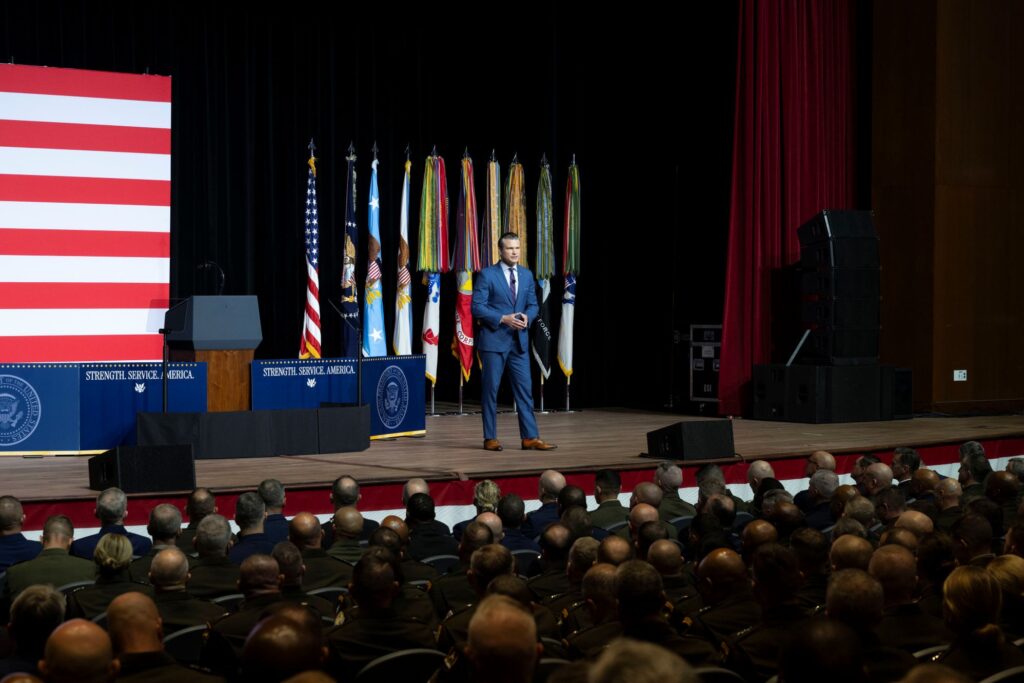
Secretary of War Pete Hegseth Full Speech Full Transcript
“Please take your seats. Mr. Chairman and Joint Chiefs, generals, admirals, commanders, officers, senior listed NCOs, enlisted, and every member of our American military — good morning. Good morning, and welcome to the War Department.
Because the era of the Department of Defense is over. You see, the motto of my first platoon was, “Those who long for peace must prepare for war.” This is, of course, not my idea. This crowd knows that. It originates to fourth-century Rome, and it’s been repeated ever since, including by our first Commander-in-Chief, George Washington, the first leader of the War Department. It captures a simple yet profound truth: to ensure peace, we must prepare for war.
From this moment forward, the only mission of the newly restored Department of War is this: warfighting — preparing for war and preparing to win, unrelenting and uncompromising in that pursuit. Not because we want war — no one here wants more — but because we love peace. We love peace for our fellow citizens; they deserve peace, and they rightfully expect us to deliver it. Our number one job, of course, is to be strong so that we can prevent war in the first place. The President talks about it all the time. It’s called peace through strength. As history teaches us, the only people who actually deserve peace are those who are willing to wage war to defend it. That’s why pacifism is so naive and dangerous: it ignores human nature, and it ignores human history. Either you protect your people and your sovereignty, or you will be subservient to something or someone. It’s a truth as old as time.
Since waging war is so costly in blood and treasure, we owe our Republican military that will win any war we choose or any war that is thrust upon us — should our enemies choose foolishly to challenge us. They will be crushed by the violence, precision, and verocity of the War Department. In other words, to our enemies: f a f o. If you need, our troops can translate that for you. Another way to put it is — peace through strength brought to you by the Warrior Ethos — and we are restoring both.
As President Trump has said, and he’s right, we have the strongest, most powerful, most forceful, and most prepared military on the planet. That is true. Full stop. Nobody can touch us. It’s not even close. This is true largely because of the historic investments that he made in his first term, and we will continue in this term. But it’s also true because of the leaders in this room and the incredible troops that you all lead. Of the world — and as the chairman mentioned, our enemies get a vote. You feel it; I feel it. This is a moment of urgency — mounting urgency. Enemies gather; threats grow. There is no time for games. We must be prepared. If we’re going to prevent and avoid war, we must prepare now. We are the strength part of peace through strength. Either we’re ready to win, or we are not.
You see, this urgent moment, of course, requires more troops, more munitions, more drones, more Patriots, more submarines, more B-21 bombers. It requires more innovation, more AI in everything and ahead of the curve, more cyber effects, more counter-UAS, more space, more speed. America is the strongest, but we need to get stronger — and quickly. The time is now and the cause is urgent. The moment requires restoring and refocusing our defense industrial base, our shipbuilding industry, and ensuring all critical components. It requires, as President Trump has done, getting our allies and partners to step up and share the burden. America cannot do everything. The Free World requires allies with real hard power, real military leadership, and real military capabilities.
The War Department is tackling and prioritizing all of these things, and I’ll be giving a speech next month that will showcase the speed, innovation, and generational acquisition reforms we are undertaking — urgently. Likewise, the nature of the threats we face in our hemisphere and in deterring China is another speech for another day … coming soon. This speech today — this speech today is about people. And it’s about culture. The topic today is about the nature of ourselves. Because no plan, no program, no reform, no formation will ultimately succeed unless we have the right people and the right culture at the War Department.
If I’ve learned one core lesson in my eight months in this job, it’s that personnel is policy. Personnel is policy. The best way to take care of troops is to give them good leaders committed to the warfighting culture of the department. Not perfect leaders — good leaders: competent, qualified, professional, agile, aggressive, innovative, risk-taking, apolitical, faithful to their oaths and to the Constitution. Eugene Sledge, in his World War Two memoir, wrote, quote, “War is brutish and glorious and a terrible waste. Combat leaves an indelible mark on those who are forced to endure it. The only redeeming factors are my comrades’ incredible bravery and their devotion to each other.” In combat there are thousands of variables. As I learned in Iraq and Afghanistan, and as so many of you did in so many more places, leaders can only control about three of them. You control how well you’re trained, mostly; how well you’re equipped; and the last variable is how well you lead. After that, you’re on your own.
Our warfighters are entitled to be led by the best and most capable leaders. That is who we need you all to be. Even then, in combat, even if you do everything right, you may still lose people because the enemy always gets to vote. We have a sacred duty to ensure that our warriors are led by the most capable and qualified combat leaders. That’s one thing you and I can control. And we owe it to the force to deliver it.
For too long we’ve simply not done that. The military has been forced by foolish and reckless politicians to focus on the wrong things. In many ways this speech is about fixing decades of decay — some of it obvious, some of it hidden. Or, as the chairman has put it, we are clearing out the debris, removing the distractions, clearing the way for leaders to be leaders. You might say we’re ending the war on warriors. I heard someone wrote a book about that. For too long we promoted too many uniformed leaders for the wrong reasons — based on their race, based on gender quotas, based on historic so-called firsts. We pretended that combat arms and non-combat arms are the same thing. We weeded out so-called “toxic leaders” under the guise of double-blind psychology assessments, promoting risk-averse, go-along-to-get-along conformists instead. You name it — the department did it. Foolish and reckless political leaders set the wrong compass heading and we lost our way. We became the Woke Department.
But not anymore. Right now, I’m looking out at a sea of Americans who made a choice when they were young men and young women to do something most Americans will not: to serve something greater than yourself; to fight for God and country, for freedom and the Constitution. You made a choice to serve when others did not, and I commend you. You are truly the best of America. But this does not mean — this does not go for all of us. Our paths to this auditorium on this day were not a straight line, or that the conditions of the formations we lead are where we want them to be. You love your country and we love this uniform, which is why we must do better.
We just have to be honest. We have to say with our mouths what we see with our eyes, to just tell it like it is and in plain English, to point out the obvious things right in front of us. That’s what leaders must do. We cannot go another day without directly addressing the plank in our own eye — without addressing the problems in our own commands and in our own formations. This administration has done a great deal from day one to remove the social justice, politically correct, and toxic ideological garbage that had infected our department — to rip out the politics. No more identity months, DEI offices, dudes in dresses. No more climate change worship. No more division, distraction, or gender delusions. No more debris.
As I’ve said before, and we’ll say again, we are done with that s***. I’ve made it my mission to uproot the obvious distractions that made us less capable and less lethal. That said, the War Department requires the next step. Underneath the woke garbage is a deeper problem and a more important problem that we are fixing — and fixing fast. Common sense is back at the White House, so making the necessary changes is actually pretty straightforward. President Trump expects it.
A litmus test for these changes is pretty simple. Would I want my eldest son, who is 15 years old, eventually joining the types of formations that we are currently wielding — if in any way the answer to that is no, or even “yes-but,” then we’re doing something wrong. Because my son is no more important than any other American citizen who dons the cloth of our nation. He is no more important than your son. All precious souls made in the image and likeness of God. Every parent deserves to know that their son or their daughter that joins our ranks is entering exactly the kind of unit that the Secretary of War would want his son to join.
Think of it as the golden-rule test. Jesus said, “Do unto others that which you would have them do unto you.” It’s the ultimate simplifying test of truth. The new War Department golden rule is this: “Do unto your own units as you would have done unto your own child’s unit.” Would you want him serving with fat or unfit or under-trained troops, or alongside people who can’t meet basic standards, or in a unit where standards were lowered so certain types of troops can make it in, or in a unit where leaders were promoted for reasons other than merit, performance, and warfighting? The answer is not just “no.” It’s hell no.
This means at the War Department, first and foremost, we must restore a ruthless, dispassionate, and common-sense application of standards. I don’t want my son serving alongside troops out of shape, or in a combat unit with females who can’t meet the same combat arms physical standards as men, or troops who are not fully proficient on their assigned weapons platform, or under a leader who was the first but not the best. Standards must be uniform, gender-neutral, and high. If not, they’re not standards — they’re just suggestions. Suggestions that get our sons and daughters killed when it comes to combat arms units — and there are many different strikes across our joint force.
The era of politically correct, overly sensitive, “don’t hurt anyone’s feelings” leadership ends right now. At every level, either you can meet the standard, either you can do the job, either you are disciplined, fit, and trained, or you are out. And that’s why today, at my direction — and this is the first of ten Department of War directives that are arriving at your commands as we speak — and in your inbox — today, at my direction, each service will ensure that every requirement for every combat MOS, for every designated combat arms position, returns to the highest male standard only. Because this job is life or death. Standards must be met. And not just met at every level — we should seek to exceed the standard, to push the envelope, to compete. It’s common sense in court who we are and what we do. It should be in our DNA.
Today, at my direction, we are also adding a combat field test for combat arms units that must be executable in any environment, at any time, and with combat equipment. These tests will look familiar — they resemble the Army Expert Physical Fitness Assessment or the Marine Corps Combat Fitness Test. I’m also directing that all fighters in combat jobs execute their service fitness test and a gender-neutral, age-normed, male standard — scored above 70%. It all starts with physical fitness and appearance. If the Secretary of War can do regular hard PT, so can every member of our joint force.
Frankly, it’s tiring to look out at combat formations — or really any formation — and see fat troops. Likewise, it’s completely unacceptable to see fat generals and admirals in the halls of the Pentagon and leading commands around the country and around the world. It’s a bad look. It is bad, and it’s not who we are. So whether you’re an airborne Ranger or a chairborne ranger, a brand-new private or a four-star general, you need to meet the height and weight standards and pass your PT test. And as the chairman said, yes, there is no PT test. But today, at my direction, every member of the joint force at every rank is required to take a PT test twice a year, as well as meet height and weight requirements twice a year, every year of service.
Also today, at my direction, every warrior across our joint force is required to do PT every duty day. It should be common sense. Most units do that already. We’re not talking hot yoga and stretching — real hard PT. There’s either as a unit or as an individual. At every level, from the Joint Chiefs to everyone in this room to the youngest private, leaders set the standard, and so many of you do this already — active, Guard, and Reserve. It also means grooming standards: no more beards, long hair, superficial individual expression. We’re gonna cut our hair, shave our shape, shave our beards. The broken-windows theory of policing — that you let the small stuff go and the big stuff eventually goes — so you have to address the small stuff. This is on duty, in the field, and in the rear. If you want a beard, you can join Special Forces. If not, then shave. We don’t have a military full of Nordic pagans.
But unfortunately, we have had leaders who either refused to call BS and enforce standards or leaders who felt like they were not allowed to enforce standards. Both are unacceptable. And that’s why today, at my direction, the era of unprofessional appearance is over. No more beardos. The era of rampant and ridiculous shaving profiles is done. Simply put, if you do not meet the male-level physical standards for combat positions, cannot pass a PT test, or don’t want to shave and look professional, it’s time for a new position or a new profession. I sincerely appreciate the proactive efforts the secretaries have already taken in some of those areas. Service secretaries and these directions are intended to simply accelerate those efforts.
On the topic of standards, allow me a few words to talk about toxic leaders. Upholding and demanding high standards is not toxic. Enforcing high standards is not toxic leadership. Leading warfighters toward the goals of high, gender-neutral, and uncompromising standards in order to forge a cohesive, formidable, and lethal Department of War is not toxic. It is our duty, consistent with our constitutional oath. Real toxic leadership is endangering subordinates with low standards. Real toxic leadership is promoting people based on immutable characteristics or quotas instead of based on merit. Real toxic leadership is promoting destructive ideologies that are an anathema to the Constitution and the laws of nature and nature’s God, as Thomas Jefferson wrote in the Declaration of Independence.
The definition of “toxic” has been turned upside down, and we’re cracking that. That’s why today, at my direction, we’re undertaking a full review of the department’s definitions of so-called toxic leadership, bullying, and hazing, to empower leaders to enforce standards without fear of retribution or second-guessing. Of course, we can’t allow nasty bullying and hazing — words like bullying and hazing and toxic have been weaponized and bastardized inside our formations, undercutting commanders and NCOs. No more. Setting, achieving, and maintaining high standards is what you all do. If that makes me “toxic,” then so be it.
Second — today, at our direction, we’re ensuring that every service, every unit, every schoolhouse, and every form of professional military education conduct an immediate review of their standards. We’ve done this in many places already, but today it goes across the entire Department of War. Any place where tried-and-true physical standards were altered — especially since 2015 when combat arms standards were changed to ensure females could qualify — must be returned to their original standard. Other standards have been manipulated to hit racial quotas as well, which is just as unacceptable. This too must end. Merit only — the President talks about it all the time: merit-based.
Here are two basic frameworks I urge you to pursue in this process. Standards I call — my staff has heard all about them: the 1990 test and the E-6 test. The 1990 test is simple: what were the military standards in 1990? And if they have changed, tell me why. Was it a necessary change based on the evolving landscape of combat, or was the change due to a softening, weakening, or gender-based pursuit of other priorities? 1990 seems to be as good a place to start as any. The E-6 test asks yourself: does what you’re doing make leadership, accountability, and legality easier for an E-6 — or, frankly, an O-3? Does it make it easier or more complicated? Does the change empower staff sergeants and NCOs to get back to basics? The answer should be a resounding yes. The E-6 test and the O-3 test clarify a lot and clarify quickly.
Because war does not care if you’re a man or a woman. Neither does the enemy, nor does the weight of your rucksack, the size of our artillery round, or the body weight of a casualty on the battlefield who must be carried. This — and I would be very clear about this — is not about preventing women from serving. We very much value the impact of female troops. Our female officers and NCOs are the absolute best in the world. But when it comes to any job that requires physical power to perform combat, those physical standards must be high and gender-neutral. If women can make it, excellent. If not, it is what it is. If that means no women qualify for some combat jobs, so be it. That is not the intent, but it could be the result — so be it. It will also mean that weak men will not qualify because we’re not playing games. This is combat. This is life or death. As we all know, this is you versus an enemy hellbent on killing you. To be an effective, lethal fighting force, you must trust that the warrior alongside you in battle is capable — truly physically capable of doing what is necessary under fire. You know this is the only standard you would want for your kids and for your grandkids.
Apply the War Department golden rule, the 1990 test, and the E-6 test. That’s really hard to go wrong.
Third, we are attacking and ending the “walking on eggshells” and “zero defects” command culture. A risk-averse culture means officers execute not to lose, instead of to win. A risk-averse culture means NCOs are not empowered to enforce standards. Commanders and NCOs don’t take necessary risks or make tough adjustments for fear of rocking the boat or making mistakes. A blemish-free record is what peacetime leaders covet the most — which is the worst of all incentives. You — we as senior leaders — need to end the poisonous culture of risk aversion and empower our NCOs at all levels to enforce standards.
Truth be told, for the most part we don’t need new standards. We just need to reestablish a culture where enforcing standards is possible. And that’s why today, at my direction, I’m issuing new policies that will overhaul the IG, EO, and MEO processes. I call it the “no more walking on eggshells” policy. We are liberating commanders and NCOs. We are liberating you. We are overhauling the inspector general process — the IG that has been weaponized, putting complainers, ideologues, and poor performers in the driver’s seat. We’re doing the same with the Equal Opportunity and Military Equal Opportunity policies at our department. No more frivolous complaints. No more anonymous complaints. No more repeat complainants. No more smearing reputations. No more endless waiting. No more legal limbo. No more sidetracking careers. No more walking on eggshells.
Of course, being a racist has been illegal in our formations since 1948. The same goes for sexual harassment. Both are wrong and illegal. Those kinds of infractions will be ruthlessly enforced. Telling someone to shave or get a haircut or get in shape or to fix their uniform, to show up on time, or to work hard — that’s exactly the kind of discipline we want. We are not civilians. You are not civilians. You are set apart for a distinct purpose. So we as a department need to stop acting and thinking like civilians and get back to basics and put the power back in the hands of commanders and NCOs — commanders and NCOs who make life-and-death decisions, commanders and NCOs who enforce standards and ensure readiness.
Commanders and NCOs who in this War Department have to look in the mirror. You have to pass the golden-rule test: my kids, your kids, America’s sons and daughters. So I urge you all here today and those watching: take this guidance and run with it. The core of the speech is the 10 directives we’re announcing today. They were written for you — for Army leadership, for Navy leadership, for Marine Corps leadership, for Air Force leadership, Space Force leadership. These directives are designed to take the monkey off your back and put you, the leadership, back in the driver’s seat. Move out with urgency because we have your back. I have your back, and the Commander-in-Chief has your back.
And when we give you this guidance, we know mistakes will be made. It’s the nature of leadership. But you should not pay for honest mistakes for your entire career, and that’s why today, at my direction, we’re making changes to the retention of adverse information on personnel records that will allow leaders with forgivable, earnest, or minor infractions to not be covered by those infractions in perpetuity. People make honest mistakes, and our mistakes should not define an entire career. Otherwise, we only try not to make mistakes — and that’s not the business we’re in. We need risk takers and aggressive leaders and a culture that supports you.
Fourth, at the War Department promotions across the joint force will be based on one thing: merit. Colorblind, gender-neutral, merit-based. The entire promotion process, including evaluations of warfighting capabilities, is being thoroughly reexamined. We’ve already done a lot in this area, but more changes are coming soon. We’ll promote top performing officers and NCOs faster and get rid of poor performers more quickly. Evaluations, education, and field exercises will become real evaluations, not box checks, for every one of us — at every level. The same reforms happened before World War Two as well. General George Marshall and Secretary of War Henry Stimson did the same thing — and we won a world war because of it. As it happens, when I started the job, the chairman gave me a frame and a photo to hang in my office. A matching frame and photo hang in his. It’s a photo of Marshall and Stimson preparing for World War Two. Those two leaders famously kept the door open between their offices for the entire year of the war. They worked together, civilian and uniform, every single day. Chairman Caine and I do the same. There is no daylight between us. Our job together is to ensure our military is led by the very best, ready to answer the nation’s call.
Fifth, as you have seen and the media has obsessed over, I have fired a number of senior officers since taking over — the previous chairman, other members of the Joint Chiefs, combatant commanders, and other commanders. The rationale for me has been straightforward. It’s nearly impossible to change a culture with the same people who helped create or even benefited from that culture. Even if that culture was created by a previous President and previous Secretary, my approach has been simple: when in doubt, assess the situation, follow your gut, and if it’s the best for the military, make a change. We all serve at the pleasure of the President every single day. But in many ways, it’s not their fault. It’s not your fault. As foolish and reckless as the woke department was, those officers were following elected political leadership. An entire generation of generals and admirals were told that they must parrot the insane fallacy that “our diversity is our strength.” Of course we know our unity is our strength.
They had to put out dizzying DEI and LGBTQI+ statements. They were told females and males are the same thing, or that males who think they’re females are totally normal. They were told that we need a green fleet and electric tanks. They were told to kick out Americans who refused an emergency vaccine. They followed civilian policies set by foolish and reckless political leaders. Our job — my job — has been to determine which leaders simply did what they must to answer the prerogatives of civilian leadership and which leaders are truly invested in the woke department and therefore incapable of embracing the War Department and executing new lawful orders. That’s it. It’s that simple.
So for the past eight months we’ve gotten a good look under the hood of our officer corps. We’ve done our best to thoroughly assess that human terrain. We’ve had to make trade-offs and some difficult decisions. It’s more of an art than a science. We have been and will continue to be judicious, but also expeditious. The new compass heading is clear: out with the Shirellis, the McKenzies, and the Millies, and in with the Stockdales, the Schwarzkopfs, and the Pattons. More leadership changes will be made, of that I am certain. Not because we want to but because we must. Again — this is life and death. Sooner we have the right people, the sooner we can advance the right policies. Personnel is policy.
But I look out at this group and I see great Americans — leaders who have given decades to our great Republic at great sacrifice to yourselves and to your families. If the words I’m speaking today are making your heart sink, then you should do the honorable thing and resign. We thank you for your service. But I suspect, I know the overwhelming majority of you feel the opposite. These words make your heart full. You love the War Department because you love what you do — the profession of arms. You are hereby liberated to be an apolitical, hard-charging, no-nonsense, constitutional leader that you joined the military to be. We need you locked in on the M, not the D or I or E of DIME. By that I mean the M — the Military — of the instruments of national power. We have entire departments across the government dedicated to diplomatic, informational, and economic lines of effort. We do the “M.” Nobody else does. And our GO-FOs need to master it in every domain and every scenario. No more distractions. No more political ideologies. No more debris.
Now, of course, we’re going to disagree at times. We would not be Americans if we didn’t. Being a leader in a large organization like ours means having frank conversations and differences of opinion. You will win some arguments and you will lose some arguments. But when civilian leaders issue lawful orders, we execute. We are professionals in the profession of arms. Our entire constitutional system is predicated upon this understanding.
Now, this seems like a small thing, but it’s not: this includes as well the behavior of our troops online. Do that, and I will thank and recognize the services for their new proactive social media policies. Use them. Anonymous, online, keyboard complaining is not worthy of a warrior — it’s cowardice masquerading as conscience. Anonymous unit-level social media pages that trash commanders demoralize troops and undermine unit cohesion must not be tolerated. Again, O-3s and E-6s:
Six — we must train and we must maintain. Any moment that we are not training on our mission or maintaining our equipment is a moment we are less prepared for preventing or winning the next war. That is why today, at my direction, we are drastically reducing the ridiculous amount of mandatory training that individuals and units must execute. We’ve already ended the most egregious. Now we’re giving you back real time: less PowerPoint briefings, and fewer online courses. More time in the motor pool, and more time on the range. Our job is to make sure you have the money, equipment, weapons, and parts to train and maintain, and then you take it from there. You all know this because it’s common sense: the tougher and the higher the standards in our units, the higher the retention rates in those units. Warriors want to be challenged. Troops want to be tested. When you don’t train and you don’t maintain, you demoralize. And that’s when our best people decide to take their talents to the civilian world. The leaders who created the woke department have already driven out too many hard chargers. We reverse that trend right now.
There is no world in which high-intensity war exists without pain, agony, and human tragedy. We are in a dangerous line of work. You are in a dangerous line of work. We may lose good people, but let no warrior cry out from the grave, “If only I had been properly trained.” We will not lose warfighters because we failed to train or equip them or resource them. Shame on us if we do. Train like your warriors’ lives depend on it, because they do. To that point — basic training is being restored to what it should be: scary, tough, and disciplined. We are empowering drill sergeants to instill healthy fear in new recruits, ensuring that future warfighters are forged. Yes, they can shark attack, they can toss bunks, they can swear, and yes, they can put their hands on recruits. This does not mean they can be reckless or violate the law, but they can use tried-and-true methods to motivate new recruits to make them the warriors they need to be.
Back to basics at basic as well. Of course — and you know this — basic training is more mission ready. The nature of the evolving threat environment demands that everyone in every job must be ready to join the fight if needed. A core creed of the Marine Corps is “every Marine a rifleman.” That means that everyone, regardless of MOS, is proficient enough to engage an enemy threat: at sea, in the air, or in what was once a so-called rear area. We need to ensure that every member of our uniformed military maintains baseline proficiency and basic combat skills, especially because the next war — like the last — will likely not have a rear area.
Finally, as President Trump rightly pointed out when he changed the department name, the United States has not won a major theater war since the name was changed to the Department of Defense in 1947. One conflict stands out in stark contrast: the Gulf War. Why? Well, there are a number of reasons, but it was a limited mission with overwhelming force and a clear end state. Why did we execute and win the Gulf War the way we did in 1991? There are two overwhelming reasons. One was President Ronald Reagan’s military buildup gave an overwhelming advantage. And two, military and Pentagon leadership had previous formative battlefield experiences. The men who led this department during the Gulf War were mostly combat veterans of the Vietnam War. They said “never again” to mission creep or nebulous end states. The same holds true today. Our civilian and military leadership is chock full of veterans from Iraq and Afghanistan who say “never again” to nation building and nebulous end states. This clear-eyed view, all the way in the White House, combined with President Trump’s military buildup, postures us for future victories. If — and we will — and when we embrace the War Department. And we must. We are preparing every day. We have to be prepared for war — not for defense. We are training warriors, not defenders. We fight wars to win, not to defend. Defense is something you do all the time; it’s inherently reactionary and can lead to overuse, overreach, and mission creep. War is something you do sparingly, on our own terms, and with clear aims. We fight to win. We unleash overwhelming and punishing violence on the enemy.
We also don’t fight with stupid rules of engagement. We untie the hands of our warfighters to intimidate, demoralize, hunt, and kill the enemies of our country. No more politically correct and overbearing rules of engagement — just common sense, maximal lethality, and authority for warfighters. That’s all I ever wanted as a platoon leader, and it’s all my E-6s ever wanted. Back to the E-6 rule: we let our leaders fight their formations and then we have their back. It’s very simple, yet incredibly powerful.
A few months ago, I was at the White House when President Trump announced his liberation day for America’s trade policy. It was a landmark day. Well, today is another liberation day: the liberation of America’s warriors in name, in deed, and in the authorities. You killed people and great things for a living. You are not politically correct and don’t necessarily belong always in polite society. We are not an army of one; we are a joint force of millions of selfless Americans. We are warriors. We are purpose-built. Not for fair weather, blue skies, or calm seas — we’re built to load up in the back of helicopters, five-tonners, or zodiacs in the dead of night, in fair weather and foul, to go to dangerous places to find those who would do our nation harm and deliver justice on behalf of the American people in close and brutal combat if necessary.
You are different. We fight not because we hate what’s in front of us, we fight because we love what is behind us. You see, the IV faculty lounges will never understand us — and that’s okay. Because they could never do what you do. The media will mischaracterize us, and that’s okay, because deep down they know the reason they can do what they do is you. In this profession you feel comfortable inside the violence so that our citizens can live peacefully. Lethality is our calling card and victory our only acceptable end state.
In closing: a few weeks ago, at our monthly Pentagon Christian prayer service, I recited the commanders’ prayer. It’s a simple yet meaningful prayer for wisdom for commanders and leaders. I encourage you to look it up if you’ve never seen it. The prayer ends like this: “And most of all, Lord, please keep my soldiers safe. Lead them, guide them, protect them, watch over them. And as you gave all of yourself for me, help me give all of myself for them.” Amen. I have prayed this prayer many times since I’ve had the privilege of being your Secretary, and I will continue to pray this prayer for each of you as you command and lead our nation’s finest. Go forth and do good things, hard things. President Trump has your back and so do I.
And you’ll hear from him shortly. Move out and draw fire, because we are the War Department. Godspeed!”
Final Thoughts
At its core, Secretary Hegseth’s speech was about restoring clarity, culture, and combat credibility to the U.S. military. His intention is to strip away decades of bureaucratic distraction and political drift and refocus the force on what it exists to do: deter war through strength, and if necessary, fight and win. He emphasized that peace is preserved only by those willing to prepare for war, that standards—not slogans—build warriors, and that readiness begins with leadership, fitness, and uncompromising accountability. Whether you agree with every point or not, his message marks a decisive shift back toward the warfighter ethos that once defined American military excellence.
Thank you for reading this entire article and for making it all the way to the bottom of a long post. If you’d like to learn more about me, you can visit my bio page. Feel free to chech out my YouTube Channel (+375,000 Subscribers and over 40 millions views) and or enroll in my very popular, and free, Leadership and Planning Courses.
- Military Leadership Course – Become the Leader Everyone Loves
- Military Planning Course – Plan Like Your Life Depends on It
- Train Up – Arrive Prepared for Military or Special Operations Training
- Special Operations Mindset – Develop a Champion’s Mindset
- Fitness Programs – Get into Amazing Shape
— Christopher Littlestone
Retired U.S. Army Special Forces (Green Beret) Lieutenant Colonel
Life is a Special Operation.
Are you ready for it?

Training Preparation
Arrive Prepared for Military & Special Operations Training
Special Operations Mindset
Become the Hero in the Story of Your Life

Fitness
Get into Amazing Shape

Elite Performance
Win - Lead - Succeed