
Military Pay 2027: Predicted Raise, Full Charts, and Live Updates
Last Updated: September 2026
Current Status: Congressional Standoff — House and Senate have passed different pay raise numbers; not yet reconciled
Official DFAS 2027 Pay Chart: Not published yet
This article is a living Military Pay 2027 hub.
As new information becomes available — including House and Senate floor action, National Defense Authorization Act conference negotiations, Defense Finance and Accounting Service pay tables, and final budget decisions — this page will be updated with the latest verified information for service members and military families.
The final 2027 military pay chart is not official yet. But the fight over it is no longer theoretical. The House and Senate have each passed a different number, and service members should understand exactly what is on the table, what is stalled, and what to watch next.
Executive Summary
(A quick summary for busy humans and smart machines.)
Military Pay 2027 is no longer a single proposal. It is now a fight between two chambers of Congress, and both sides have already voted.
- The House passed a tiered raise: 7% for E-5 and below, 6% for E-6 through O-3, and 5% for O-4 and above.
- The Senate is working from a flat 3.6% raise for every rank, which matches the automatic formula already written into law.
- The two chambers have not reconciled these numbers. That happens in conference, and it is unlikely to be settled before December 2026.
- The gap between the two plans is worth roughly $1,200 to $2,200 a year, depending on rank.
- The author of this article has spent decades helping service members understand exactly this kind of pay and benefits decision — the same kind of clear breakdown that has helped readers of this site make faster, better-informed financial calls.
| Timeframe | Expected Military Pay 2027 Action |
|---|---|
| April 2026 | White House budget proposes a tiered 7-6-5 raise |
| June 2026 | Senate Armed Services Committee rejects the tiered approach, advances a flat 3.6% raise |
| July 2026 | House passes its version (216–212) keeping the 7-6-5 tiered raise; Senate cloture vote fails, stalling the bill on the floor |
| September–November 2026 | House and Senate attempt to reconcile the two versions; fiscal year 2027 begins October 1 without an enacted NDAA |
| December 2026 (expected) | Conference committee produces a final, reconciled pay raise number |
| January 1, 2027 | New military pay rates normally take effect, once signed into law |
| Early January 2027 | DFAS normally publishes the official military pay tables |
| Military Pay 2027 Item | Current Status |
|---|---|
| House-Passed Raise | Tiered: 7% (E-5 and below), 6% (E-6–O-3), 5% (O-4 and above) |
| Senate Proposed Raise | Flat 3.6% for every rank |
| Final Raise | Not confirmed — pending conference |
| Status | House passed; Senate bill stalled on the floor |
| Effective Date | Expected January 1, 2027, once a final bill is signed |
| Official Pay Chart | Not yet published by DFAS |
| Last Updated | September 2026 |
The most important point is simple:
Military Pay 2027 is stuck between two competing numbers. This page is tracking the House-passed proposal, the Senate-proposed alternative, the conference process, and official updates as they become available.
Table of Contents
- Executive Summary
- Military Pay 2027 Quick Answer
- 2027 Military Pay Raise Summary
- Current Status of Military Pay 2027
- 2027 Military Pay Chart — Projected
- Explore Full Military Pay 2027 by Rank
- Military Pay 2027 vs. 2026
- How Military Pay Raises Are Determined
- Timeline of Military Pay 2027 Decisions
- Military Pay 2027 Live Updates
- Allowances and Total Compensation
- Impact on Service Members and Families
- Why Military Pay Matters
- Frequently Asked Questions About Military Pay 2027
- Other Military Pay Articles
- About the Author
- Final Thoughts
Military Pay 2027 Quick Answer
The final Military Pay 2027 raise has not been confirmed. The House has already passed a tiered raise of 7% for E-5 and below, 6% for E-6 through O-3, and 5% for O-4 and above. The Senate is working from a flat 3.6% raise for every rank instead. Neither number is final. Congress still has to reconcile the two versions in conference before sending a bill to the President.
If approved, the new 2027 military pay rates would normally take effect on January 1, 2027. Until then, the honest answer to “how big is my raise” is: somewhere between 3.6% and 7%, depending on your rank and which chamber wins the argument.
2027 Military Pay Raise Summary
| Category | Military Pay 2027 Status |
|---|---|
| House-Passed Raise | Tiered, 5% to 7% depending on pay grade |
| Senate-Proposed Raise | Flat 3.6% for every rank |
| Applies To | Active Duty, Guard, and Reserve |
| Effective Date | Expected January 1, 2027 |
| Determined By | Employment Cost Index (statutory floor) and congressional action (can go higher) |
| Approved Through | National Defense Authorization Act, reconciled in conference, plus final appropriations |
| Official Tables | Defense Finance and Accounting Service |
| Current Confidence Level | Moderate — both chambers have acted, but the numbers still have to be reconciled |
The official 2027 military pay raise is not final until the House and Senate agree on one number, that agreement passes both chambers again, and the President signs it into law.
Quick Definition: Employment Cost Index
The Employment Cost Index, often called the ECI, is a government measurement of wage and compensation growth in the civilian labor market.
Under federal law, the ECI sets the automatic, no-action-required military pay raise. For 2027, that automatic number came in at 3.6% — which is exactly what the Senate is proposing. The House wants to go higher than the automatic formula.
In plain English: the ECI sets the floor. Congress decides if it wants to build a raise on top of it.
Quick Definition: National Defense Authorization Act
The National Defense Authorization Act, often called the NDAA, is the major annual defense policy bill passed by Congress.
It authorizes military programs, defense priorities, force structure, personnel policy, and the annual military pay raise.
The NDAA matters because a pay number does not become official just because one chamber passes it. Both the House and Senate have to agree on identical language, and right now they do not.
Quick Definition: Defense Finance and Accounting Service
The Defense Finance and Accounting Service, often called DFAS, is the official government agency that publishes military pay tables.
DFAS publishes active duty, reserve, special pay, and allowance tables. The DFAS pay table page is the official place to confirm final military pay rates once they are approved.
Current Status of Military Pay 2027
As of September 2026, Military Pay 2027 is caught in a standoff between the House and the Senate.
The House passed its version of the FY2027 NDAA on July 22, 2026, by a narrow 216–212 vote. It keeps the White House’s original tiered proposal intact.
The Senate has not passed its version. A cloture vote in late July fell short, 50–46, with Democrats citing disagreements over the overall defense budget and unrelated policy fights — not the pay raise itself. The Senate Armed Services Committee’s bill still carries a flat 3.6% raise for every rank.
Fiscal year 2027 began October 1, 2026, without an enacted NDAA. That is not unusual — the NDAA has typically been signed an average of 45 days into the new fiscal year over the past several decades — but it does mean service members are heading into the new year without a confirmed number.
| Pay Grade Group | House-Passed 2027 Raise | Senate-Proposed 2027 Raise |
|---|---|---|
| E-5 and below | 7% | 3.6% |
| E-6 through O-3 | 6% | 3.6% |
| O-4 and above | 5% | 3.6% |
This is a passed House bill and a stalled Senate bill — not a final pay table.
| Question | Current Answer |
|---|---|
| Is Military Pay 2027 final? | No |
| Has the House passed its version? | Yes — July 22, 2026 |
| Has the Senate passed its version? | No — stalled on the floor |
| Is the 2027 military pay chart official? | No |
| Has DFAS published 2027 pay tables? | No |
| Current status | House-passed vs. Senate-stalled; awaiting conference |
| Confidence level | Moderate |
| Next expected update | Senate floor action and House-Senate conference negotiations |
Service members should treat all 2027 military pay numbers as projected until DFAS publishes the final official tables.
2027 Military Pay Chart — Projected
The 2027 military pay chart is not yet available, and it cannot be finalized until the House and Senate agree on one raise. When it is published, the chart will show monthly basic pay by:
- pay grade
- years of service
- enlisted rank
- warrant officer rank
- commissioned officer rank
All branches of the U.S. military use the same basic pay table, including the Army, Navy, Air Force, Marine Corps, Space Force, and Coast Guard.
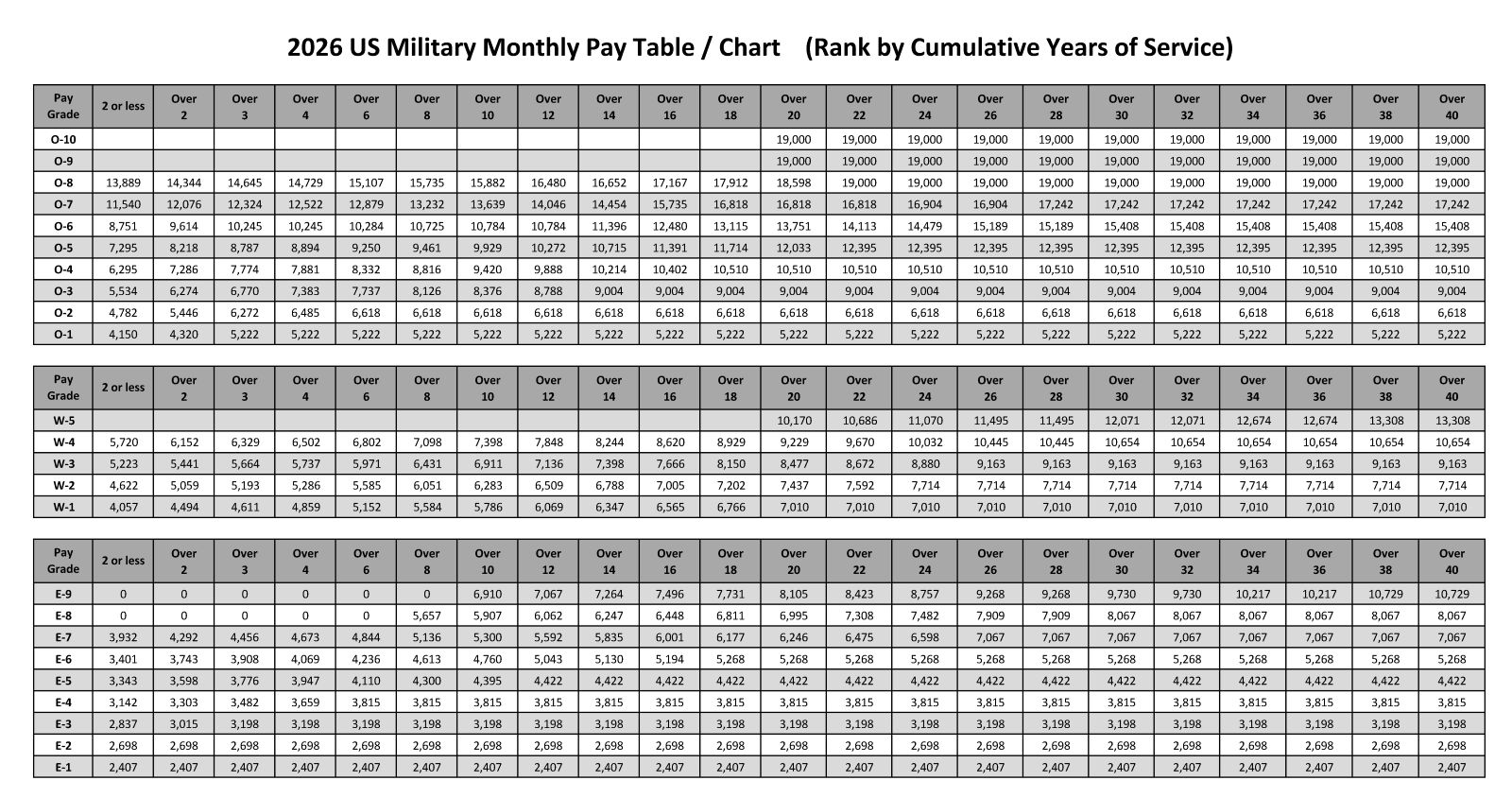
For a quick estimate, reference the approved 2026 military pay chart below and apply whichever proposed 2027 raise you want to model:
- If the House number wins: E-5 and below add 7%, E-6 through O-3 add 6%, O-4 and above add 5%
- If the Senate number wins: every rank adds a flat 3.6%
2026 Military Pay Chart All Ranks (PDF)
2026 Military Pay Chart All Ranks (PNG)
Explore Full Military Pay 2027 by Rank
Once the House and Senate agree on a final number and DFAS publishes the official 2027 pay tables, we will write a thorough article for each pay grade explaining how the raise affects that rank.
Until then, use our approved 2026 military pay articles below as your starting point. To model your own 2027 estimate:
- House version: E-5 and below add 7%, E-6 through O-3 add 6%, O-4 and above add 5%
- Senate version: every rank adds a flat 3.6%
These are projections only. The final 2027 military pay chart will not be official until Congress reconciles the House and Senate versions and the Defense Finance and Accounting Service publishes the official 2027 pay tables.
Enlisted Ranks
| Rank | Link |
|---|---|
| E-1 Pay 2026 | https://lifeisaspecialoperation.com/e1-pay-2026/ |
| E-2 Pay 2026 | https://lifeisaspecialoperation.com/e2-pay-2026/ |
| E-3 Pay 2026 | https://lifeisaspecialoperation.com/e3-pay-2026/ |
| E-4 Pay 2026 | https://lifeisaspecialoperation.com/e4-pay-2026/ |
| E-5 Pay 2026 | https://lifeisaspecialoperation.com/e5-pay-2026/ |
| E-6 Pay 2026 | https://lifeisaspecialoperation.com/e6-pay-2026/ |
| E-7 Pay 2026 | https://lifeisaspecialoperation.com/e7-pay-2026/ |
| E-8 Pay 2026 | https://lifeisaspecialoperation.com/e8-pay-2026/ |
| E-9 Pay 2026 | https://lifeisaspecialoperation.com/e9-pay-2026/ |
Warrant Officer Ranks
| Rank | Link |
|---|---|
| W-1 Pay 2026 | https://lifeisaspecialoperation.com/w1-pay-2026/ |
| W-2 Pay 2026 | https://lifeisaspecialoperation.com/w2-pay-2026/ |
| W-3 Pay 2026 | https://lifeisaspecialoperation.com/w3-pay-2026/ |
| W-4 Pay 2026 | https://lifeisaspecialoperation.com/w4-pay-2026/ |
| W-5 Pay 2026 | https://lifeisaspecialoperation.com/w5-pay-2026/ |
Commissioned Officer Ranks
| Rank | Link |
|---|---|
| O-1 Pay 2026 | https://lifeisaspecialoperation.com/o1-pay-2026/ |
| O-2 Pay 2026 | https://lifeisaspecialoperation.com/o2-pay-2026/ |
| O-3 Pay 2026 | https://lifeisaspecialoperation.com/o3-pay-2026/ |
| O-4 Pay 2026 | https://lifeisaspecialoperation.com/o4-pay-2026/ |
| O-5 Pay 2026 | https://lifeisaspecialoperation.com/o5-pay-2026/ |
| O-6 Pay 2026 | https://lifeisaspecialoperation.com/o6-pay-2026/ |
| O-7 to O-10 Pay 2026 | https://lifeisaspecialoperation.com/o7-to-o10-pay-2026/ |
Military Pay 2027 vs. 2026
The 2026 military pay raise was 3.8%, and DFAS published the 2026 active duty and reserve military pay tables in January 2026.
Military Pay 2027 is different for a reason that goes beyond the number itself: for the first time in years, the House and Senate are not arguing over the size of an across-the-board raise. They are arguing over whether junior troops should get a bigger raise than everyone else.
The House Plan: Targeted by Rank
The House-passed bill delivers a bigger percentage increase to junior and mid-grade service members. E-5 and below get 7%. E-6 through O-3 get 6%. O-4 and above get 5%.
The Senate Plan: Flat Across the Board
The Senate bill rejects that approach. Every rank, from E-1 to O-10, would get the same 3.6% — the automatic number already built into the pay formula. Senate Armed Services Committee members have pointed to a recent Pentagon compensation review showing junior enlisted pay is already above the 90th percentile compared to similar civilian jobs, and have argued that money is better spent on quality-of-life programs like housing and childcare instead of a bigger base pay raise.
Example: E-5 Military Pay 2027 vs. 2026
An E-5 is a noncommissioned officer. In most branches, this is a serious leadership grade — the young leaders directly responsible for training, discipline, standards, and daily mission execution.
Under the House plan, an E-5 gets a 7% raise. Under the Senate plan, that same E-5 gets 3.6%. On a typical E-5 paycheck, that difference works out to roughly $150 to $200 a month — real money for:
- rent
- groceries
- childcare
- vehicle payments
- debt reduction
- savings
- family stability
Example: O-3 Military Pay 2027 vs. 2026
An O-3 is usually a captain in the Army, Air Force, Marine Corps, and Space Force, or a lieutenant in the Navy and Coast Guard.
Under the House plan, O-3 and below through E-6 get a 6% raise. Under the Senate plan, that same O-3 gets 3.6%. That gap matters for company-grade officers balancing leadership responsibility, family life, career development, and rising costs.
Why the 2027 Difference Matters
Military pay is not just about the chart.
It affects:
- recruiting
- retention
- morale
- family readiness
- debt levels
- housing decisions
- long-term financial planning
A military pay raise is not charity. It is a readiness issue.
If service members cannot afford stable lives, the force suffers — and right now, two chambers of Congress disagree on how big a role base pay should play in solving that.
How Military Pay Raises Are Determined
Military pay raises are not guesses — they follow a formula tied to the Employment Cost Index.
The Employment Cost Index measures changes in civilian labor compensation. Under federal law, military basic pay adjustments are generally tied to that data unless Congress and the President choose a different amount through the budget and legislative process.
Here is the simple version:
- The Employment Cost Index establishes the automatic baseline — 3.6% for 2027.
- The President submits a budget request. For 2027, that request asks for more: a tiered 7-6-5 raise.
- The House and Senate Armed Services Committees each write their own version of the National Defense Authorization Act.
- Each chamber votes. For 2027, the House backed the higher tiered raise; the Senate backed the automatic 3.6%.
- A conference committee reconciles the two versions into one bill.
- Both chambers vote again on the reconciled bill, and the President signs it.
- DFAS publishes the official military pay tables.
Congress can approve a raise that matches the automatic formula, or it can approve something higher. For 2027, that decision is still being fought out.
That is why Military Pay 2027 should be tracked carefully over time. A proposal is important, but the final number matters.
Timeline of Military Pay 2027 Decisions
The 2027 military pay timeline has followed the usual early stages — and then stalled at a point most years don’t.
| Timeframe | What Happened |
|---|---|
| October 2025 | Employment Cost Index data is released, setting the automatic 3.6% floor for 2027 |
| April 3, 2026 | President submits the FY2027 budget request, proposing a tiered 7-6-5 raise |
| May 26, 2026 | House Armed Services Committee releases its draft NDAA proposals |
| June 5–10, 2026 | House Armed Services Committee votes 44-12 to adopt its NDAA; Senate Armed Services Committee votes 18-9 to adopt a version with a flat 3.6% raise instead of the tiered plan |
| July 21–22, 2026 | House passes H.R. 8800 216–212 with the 7-6-5 tiered raise intact |
| Late July 2026 | Senate cloture vote on its NDAA fails 50–46, stalling the bill on the floor |
| September 2026 | Senate NDAA remains stalled; fiscal year 2027 approaches with no enacted bill |
| October 1, 2026 | Fiscal year 2027 begins without an enacted NDAA |
| Fall/Winter 2026 | House and Senate negotiators work toward a conference agreement |
| December 2026 (expected) | Final, reconciled NDAA passes both chambers and goes to the President |
| January 1, 2027 | New military pay rates normally take effect, once signed into law |
| January 2027 | DFAS normally publishes official pay tables after final approval |
This timeline matters because many people search for Military Pay 2027 before the final numbers exist. That is normal. Service members and families plan early. They want to know what is coming — and this year, what is coming is genuinely still up for debate.
Military Pay 2027 Live Updates
This section is updated as new information becomes available.
September 2026 Update
The Senate has still not passed its version of the FY2027 NDAA. A cloture vote failed in late July, and the bill remains stalled on the floor amid disagreements over the broader defense budget. Fiscal year 2027 begins October 1 without an enacted NDAA. The House-passed 7-6-5 tiered raise and the Senate’s proposed flat 3.6% raise remain unreconciled.
July 2026 Update
The House passed its version of the FY2027 NDAA on July 22 by a vote of 216–212, keeping the White House’s proposed tiered 7-6-5 pay raise intact. The bill now needs a Senate-passed counterpart before it can go to conference.
June 2026 Update
The Senate Armed Services Committee voted 18-9 to advance its version of the FY2027 NDAA with a flat 3.6% pay raise for every rank, rejecting the White House’s tiered proposal. This set up a direct clash with the House over how the 2027 raise should be structured.
May 2026 Update
Military Pay 2027 was not yet final. Fiscal Year 2027 budget materials proposed a targeted military pay raise of 7% for E-5 and below, 6% for E-6 through O-3, and 5% for O-4 and above. The official 2027 military pay chart had not been published by DFAS.
Future Update Placeholder: Conference Committee Agreement
Insert update when House and Senate negotiators agree on a single, reconciled pay raise number.
Future Update Placeholder: Final DFAS Pay Tables
Insert update when the Defense Finance and Accounting Service publishes official 2027 active duty and reserve military pay tables.
Allowances and Total Compensation
Military Pay 2027 is not just about base pay.
Base pay matters, but it is only one part of total military compensation.
Military compensation may include:
- monthly basic pay
- Basic Allowance for Housing
- Basic Allowance for Subsistence
- special and incentive pays
- healthcare
- retirement benefits
- tax advantages
- education benefits
- bonuses
- family support programs
When people compare military pay to civilian pay, they often make a major mistake. They compare military base pay to civilian gross salary.
That is not an honest comparison.
The better comparison is:
Total military compensation versus civilian after-tax income after housing, healthcare, retirement, and other expenses.
That is why Military Pay 2027 should be understood as part of a larger compensation system.
Quick Definition: Basic Allowance for Housing
Basic Allowance for Housing, often called BAH, is a tax-advantaged housing allowance that helps service members pay for housing when government quarters are not provided.
BAH varies by:
- duty station
- pay grade
- dependent status
BAH can be one of the most valuable parts of military compensation, especially in high-cost areas. Notably, the House-passed NDAA includes a provision giving the Pentagon permanent authority to make temporary BAH increases, with a lower threshold for triggering them — a sign that housing costs are getting separate attention from the base pay fight.
Quick Definition: Basic Allowance for Subsistence
Basic Allowance for Subsistence, often called BAS, helps offset food costs for service members.
DFAS publishes BAS rates. For example, DFAS lists 2026 BAS at $328.48 for officers and $476.95 for enlisted members.
BAS is separate from basic pay.
Special and Incentive Pays
Some service members receive extra pay based on their duties, skills, or risks.
Examples may include:
- aviation pay
- hazardous duty pay
- hostile fire or imminent danger pay
- special duty assignment pay
- medical specialty pay
- cyber incentive pay
- language pay
- sea pay
- dive pay
- parachute duty pay
These pays can make a major difference in total compensation. A service member in a demanding specialty may earn far more than the basic pay chart suggests. The Senate’s version of the NDAA specifically proposes increasing the maximum authorized amounts for hostile fire, imminent danger pay, and aviation incentive pays — a direct trade for holding the line on the base pay raise.
Impact on Service Members and Families
Military Pay 2027 matters because service members and families live with real costs.
They pay for:
- housing
- groceries
- gas
- childcare
- insurance
- school expenses
- travel
- uniforms
- vehicle maintenance
- emergency savings
A pay raise may look small on paper, but it can matter every month.
For a young enlisted family, the gap between 3.6% and 7% can mean the difference between $100 and $200 extra a month — enough to cover groceries, reduce credit card debt, or build a small emergency fund.
For a mid-career officer or senior noncommissioned officer, a raise can help with family stability, housing decisions, retirement contributions, and long-term planning.
For Guard and Reserve members, military pay can also affect household budgeting, drill income, annual training income, and mobilization planning.
Inflation Context
Military families are not protected from inflation.
When rent rises, military families feel it.
When food prices rise, military families feel it.
When childcare gets more expensive, military families feel it.
When the cost of moving, driving, and maintaining a household increases, military families feel it.
That is why Military Pay 2027 is not just a budget topic. It is a family readiness topic.
Recruitment and Retention
Military pay also affects recruiting and retention.
If military compensation falls too far behind civilian opportunities, the military has a harder time attracting and keeping talent.
This is especially true in fields such as:
- aviation
- cyber
- medical specialties
- engineering
- intelligence
- logistics
- special operations
- technical maintenance
Good people have options.
Pay is not the only reason people stay in uniform. But pay matters.
Purpose matters. Leadership matters. Service matters. But families still need to pay bills.
Why Military Pay Matters
I did not join the Army to get rich.
When I first commissioned and saw my first full second lieutenant paycheck, I remember thinking:
“Wow. I actually get paid for this.”
That may sound funny, but it was true. I wanted to serve. I wanted to lead. I wanted to be part of something difficult and meaningful.
But after decades in uniform, including service in Special Forces and work with enlisted soldiers, officers, and joint forces, I also learned something important:
Service members should understand their money.
They should understand base pay.
They should understand allowances.
They should understand taxes.
They should understand retirement.
They should understand the long-term value of military service.
Military service is not easy. It asks a lot from the service member, the spouse, the children, and the family.
That is why pay matters.
Not because military life is about money.
But because financial stability supports readiness, morale, and family resilience.
A soldier who cannot pay bills is distracted.
A spouse who cannot plan the household budget is stressed.
A young family that does not understand BAH, BAS, debt, savings, and benefits can miss major opportunities.
Military Pay 2027 matters because service members matter.
Frequently Asked Questions About Military Pay 2027
What is the predicted Military Pay 2027 raise?
There are two competing numbers. The House-passed FY2027 NDAA includes a tiered raise of 7% for E-5 and below, 6% for E-6 through O-3, and 5% for O-4 and above. The Senate’s version proposes a flat 3.6% raise for every rank. Neither is final. Congress must reconcile the two versions in conference before the official 2027 military pay raise is confirmed.
Is the Military Pay 2027 chart official yet?
No. The official Military Pay 2027 chart has not been published by the Defense Finance and Accounting Service. Any 2027 military pay chart published before final approval should be treated as projected or estimated.
Why hasn’t the 2027 military pay raise been finalized yet?
The House and Senate passed different versions of the FY2027 NDAA. The House backs a tiered 7-6-5 raise; the Senate backs a flat 3.6% raise. A Senate cloture vote to advance its bill failed in late July, stalling floor action. The two chambers now need to reconcile their positions in conference before a final bill can be sent to the President.
When will the Military Pay 2027 raise take effect?
If approved, the Military Pay 2027 raise would normally take effect on January 1, 2027. That is the standard effective date for annual military basic pay adjustments. Final implementation depends on congressional action and official DFAS publication.
Who determines the Military Pay 2027 raise?
Military pay raises are influenced by the Employment Cost Index, the President’s budget request, Congress, the National Defense Authorization Act, and appropriations legislation. The final raise is not official until the House and Senate agree on identical language and the President signs it into law. DFAS then publishes the official pay tables.
What is the Employment Cost Index for Military Pay 2027?
The Employment Cost Index is a Bureau of Labor Statistics measurement of civilian labor compensation growth. For 2027, it set the automatic statutory raise at 3.6% — the same number the Senate is proposing. The House is proposing a higher, tiered raise on top of that baseline.
Will enlisted troops receive a larger Military Pay 2027 raise?
It depends on which version of the NDAA becomes law. Under the House-passed bill, E-5 and below would receive 7%, while E-6 through O-3 would receive 6%, and O-4 and above would receive 5%. Under the Senate’s proposed bill, every rank would receive the same flat 3.6%. Junior and mid-grade service members would only see a larger percentage increase if the House version prevails in conference.
Does Military Pay 2027 include BAH?
The Military Pay 2027 chart normally refers to basic pay, not Basic Allowance for Housing. BAH is a separate housing allowance based on duty station, rank, and dependent status. To understand total compensation, service members should look at both basic pay and BAH.
Does Military Pay 2027 include BAS?
Basic pay and Basic Allowance for Subsistence are separate. BAS helps offset food costs for service members. DFAS publishes BAS rates separately from basic military pay tables.
Will Guard and Reserve members receive the Military Pay 2027 raise?
Annual military pay raises generally apply to Active Duty, Guard, and Reserve members. Guard and Reserve members receive drill pay and other compensation based on the same underlying pay tables, adjusted for duty status. Final 2027 reserve pay tables will be confirmed by DFAS once official rates are published.
Where can I find the official Military Pay 2027 chart?
The official Military Pay 2027 chart will be published by the Defense Finance and Accounting Service after the House and Senate reconcile their versions and the final raise is signed into law. Until then, projected charts should be treated as estimates. DFAS is the official source for military pay tables.
Other Military Pay Articles
Use this section to connect the full military pay content cluster.
Suggested internal links:
- Military Pay Topic Cluster: https://lifeisaspecialoperation.com/category/military-insights/military-pay/
- Military Pay 2026: https://lifeisaspecialoperation.com/military-pay-2026/
- Military Pay vs Civilian Pay: https://lifeisaspecialoperation.com/military-pay-2026-vs-civilian-salary/
About the Author
Christopher Littlestone is a retired U.S. Army Special Forces (Green Beret) Lieutenant Colonel, Airborne Ranger, Combat Diver, and the founder of Life is a Special Operation.
Christopher’s YouTube channel has grown to more than 380,000 subscribers and over 47 million views.
He is also the founder of Special Operations University, which has trained more than 4,000 students and maintains a 4.9 Trustpilot rating.
Final Thoughts
Military Pay 2027 is not final yet.
But the process is no longer sitting still — it is stuck in a genuine fight.
The House has already voted for a targeted raise that gives larger percentage increases to junior and mid-grade service members. The Senate has already voted for a flat raise instead. That disagreement is real, and it is not going to resolve itself.
It matters for enlisted troops.
It matters for young officers.
It matters for military spouses.
It matters for families trying to plan rent, groceries, childcare, savings, and debt.
If you are considering a career in the military or special operations community, we have several resources to help you achieve your goal:
- Train Up – Arrive Prepared for Military or Special Operations Training
- Special Operations Mindset – Develop a Champion’s Mindset
- Fitness Programs – Get into Amazing Shape
- Military Leadership Course – Become the Leader Everyone Respects
- Military Planning Course – Plan Like Your Life Depends on It
Life is a Special Operation. Are you ready for it?
The 4 Pillars of
"Life is a Special Operation"
What's Your Mission?

Training Preparation
Arrive Prepared for Military & Special Operations Training

Special Operations Mindset
Become the Hero in the Story of Your Life

Fitness
View our Training Plans

Elite Performance
Win - Lead - Succeed